Contemplating pbl vs. PBL

If you are a student, educator, parent, or other-labeled learner, then do you ever wonder about this acronym “PBL?” In my daily work, I hear people ask such questions as, “Does it stand for ‘project-based learning’ or ‘problem-based learning?'” I hear others respond, “I thought it stood for ‘place-based learning.'” Still others ask, “Is PBL the same thing as CBL (Challenge-Based Learning) or DBL (Design-Based Learning)?” And a host of others curiously wonders, “Isn’t PBL just inquiry-driven instruction?” I hear some 30-year veterans declare that they’ve been doing PBL forever, and I work with master educators of various career stages that puzzle and struggle with the complexities of PBL…wondering if they’ll ever be able to “do PBL.”

I may spend the better part of a full-life career in education contemplating and practicing PBL. Personally and professionally, I find PBL fascinating and a critical component to all this talk about 21st century teaching and learning, as well as to school transformation. For me, I can think of at least a few major waypoints on my path of better understanding the depth and breadth of PBL.

  • Becoming a middle-school principal and realizing that all of my real-world work, all day long, is project-based…and that I am supposed to prepare students for life in the “real world.”
  • Serving in a sabbatical that was largely geared to understand more of how the “real-world” works in projects.
  • Watching my two sons, currently ages 7 and 4, emerge in the world as master learners…simply because they are humans. Realizing in a “duh” moment, that has lasted for years, that their learning is primarily project-based…or passion-based…or problem-based…or place-based. And starting #FSBL (Father-Son Based Learning) as a Twitter hashtag to chronicle some of how my sons and I explore and discover in order to learn stuff that fascinates us!
  • Reading, studying, and immersing myself in the book The Falconer, by Grant Lichtman (who is now an invaluable colleague).
  • Participating in the TEDxAtlanta community and forging a relationship with Gever Tully, now of The Brightworks School.
  • Undertaking a multiyear project to operationalize my research in 21st century learning – and to enact a Falconer-type class – by creating and co-facilitating a course known as Synergy (community-issues problem solving, transdisciplinary, non-graded but heavily assessed).
  • Connecting with Jonathan Martin, currently at St. Gregory School – especially over a blog-based discussion about PBL (examples here and here).

And, in the last month, I may just have added another significant waypoint on my path to understand better the depth and breadth of PBL. In September 2010, I read an article in Educational Leadership, but I have only recently returned to the article to study it intensely – because my team of PLC (Professional Learning Community) facilitators is using the article to support the creation of a lesson study devoted to PBL.

7 Essentials for Project-Based Learning,” John Larmer and John R. Mergendoller, Educational Leadership, September 2010, Vol. 68 No. 1, http://www.ascd.org.

For over a year, I have been thinking about the spectrum which is PBL. For PBL is not a monolithic construct, nor a dichotomous light switch. PBL is a spectrum, and I think of the spectrum as ranging from lowercase “pbl” to uppercase “PBL.” Well, what in the world causes a learning experience to move along the spectrum from lowercase pbl to uppercase PBL? I think a number of factors contribute to this spectrum location and dynamic. Two such factors are: 1) degree of focus on a community issue, and 2) connection to an authentic audience. [In future blog posts, I may discuss a number of the other contributing factors.]

Students might replicate the kinds of tasks done by professionals—but even better, they might create real products that people outside school use. (from “7 Essentials for Project-Based Learning”)

And…

Schoolwork is more meaningful when it’s not done only for the teacher or the test. When students present their work to a real audience, they care more about its quality. (from “7 Essentials for Project-Based Learning”)
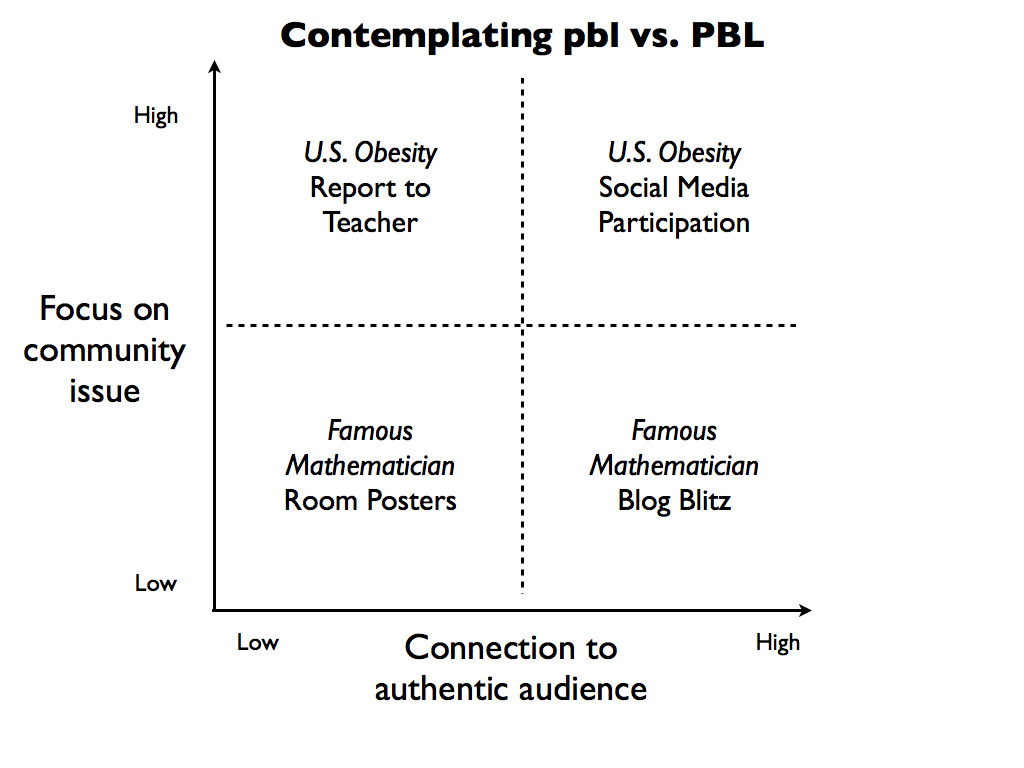
In my opinion, there are sound reasons why teachers and schools should pursue projects all along this spectrum. There are appropriate times for operating in the lower left quadrant, as well as appropriate times for operating in the upper right quadrant. But the more we work in the upper right quadrant, the more that we uppercase and capitalize the PBL. Ultimately, if education and learning are about making a positive difference in this world, then perhaps we are all striving to engage in more work at the upper right quadrant.

What do you think?

[That’s all the time I have to write this morning, and I want to publish this post 24 hours prior to our PLC-Facilitator meeting on Thursday morning, so, like most things, this is a work in progress!]

What’s Coming Up on It’s About Learning? How I use observation journaling to discover and ideate about possible PBL opportunities… Stay tuned!

“What year are you preparing your students for?” Heidi Hayes Jacobs #TEDxNYED

As usual, Heidi Hayes Jacobs makes some intriguing and thought-provoking points. Among them…

  • Are we educators studying television literacy and its effect on learning, especially given its force relative to print media? If not, why not?
  • Are we upgrading (making strategic replacements of outdated curriculum)?
  • Are we keeping “classroom curiosity” lists to archive the fascinating questions and researching of our learners? Or are we too busy “covering what has to be covered?”
  • “I can’t think of a better time to be a public learner…which is what you must be if you want to teach.”
  • Social production democratizes learning.

Take 17 minutes and explore theses and other provocations yourself. Or don’t.

[Note: In her talk, Heidi mentions “contagion” from a video that kicked off TEDxNYED. I bet that is Kiran Bir Sethi’s TED talk. If you have not seen it, and if you are interested in PBL with a “capital P,” then watch it. Or don’t.]

Schools promote drivers ed – learning by driving with guidance. Schools should do same with social media.

When students reach a certain age and responsibility level, I believe that school should permit – promote even – the use of various social media tools. I think we should “Be safe and teach them to drive.” If we truly  are preparing students to lead and serve in a changing world, then we should teach students to utilize respectfully and responsibly the methods and processes that can be used in an engaged and purposeful citizenry. Literacy in today’s terms essentially demands that schools take an active role in educating our learners about how to connect with others from whom we can learn and with whom we can contribute to causes of import and worth.

I regularly think and engage with others about the reasons why students should or should not be allowed to use social media as part of school. These sessions, of course, include the opportunities, as well as the potential consequences. Perhaps soon, I will try to write a post that summarizes more of these ledger items, arranged as assets and liabilities. For now, though, I am focusing on two aspects of social media that I crave for my students: 1) encouragement and interaction from a wider, more authentic audience, and 2) opportunities to engage in civil discourse to develop one’s thinking and understanding.

1. Encouragement and Interaction from a Wider, More Authentic Audience

On Friday, December 23, 2011, I published a blog post entitled “Homework – Conforming to School Norms, Opps for Exploration, Unnecessary, Essential?” Moments after pressing the publish button, the following response came via Twitter (see image).

I know @occam98 personally; we work together at the same school. As a colleague and as an educator, I admire and respect @occam98, and I value his feedback and encouragement. To my knowledge, though, I have never met @bauerphysics. Because @occam98 tweeted about my blog, I now have encouragement and support from another educational thinker and teacher. Such feedback is wonderful. And, thanks to these two immediate responses, I may garner more comments on the actual blog post that will help me further to develop my thinking and understanding about homework as a school practice.

What if my exploration about the practice of homework were more confined, as if I could only talk to my immediate classmates and my teacher about my developing thinking and research about homework? I would have fewer potential network nodes on which to connect my thinking and learning. For students, I wish that they could engage in such connected communication through appropriate use of social media in schools. Some schools permit such use. Some schools promote it. Other schools forbid such use. Yet many students use social media independent of school. Duh! I prefer that students have the opportunity to benefit from the co-pilots, navigators, and coaches who are their school teachers (in addition to their parents). With such over-the-shoulder Yoda-dom for the emerging Luke Skywalkers, I believe students can safely interact and receive encouragement from the “teachers” whom they’ve never met in person…without turning to the Dark Side.

2. Opportunities to engage in civil discourse to develop one’s thinking and understanding

On the same day that Twitter brought the responses detailed above, I also engaged in another Twitter discussion with an acquaintance and a never-before-met-face-to-face person. If I am remembering correctly, I believe I met @SarahebKaiser at a Solution Tree event. But I have never met @Paul_Mugan. As in the above example, Sarah tweeted a blog post that I had written (“Pracademics”). I deeply appreciated the tweet and the encouragement, like I appreciated the support from @occam98 and @bauerphysics. In this second example, though, my learning advanced as a result of a different kind of online interaction than I had had in the first case. During this second case, I enjoyed participating in a fairly vigorous civil discourse, from which I grew immensely.

@Paul_Mugan, a follower of @SarahebKaiser, disagreed with an idea that Sarah tweeted – an idea specifically drawn from my “Pracademics” blog post. What then transpired was a fabulous learning opportunity for me…with a “stranger.” In the Scribd document below, I provide a taste of the dialogue and discussion. I did not capture the entire conversation on Scribd, but one could find the full exchange on Twitter. In total, I think over 30 exchanges occurred. We discussed and debated the nature of learning – acquiring versus applying knowledge. My views and opinions on the topic were both reinforced and altered. I grew tremendously in my understanding of learning – a topic that I think about quite actively. And thanks to an acquaintance and a “stranger,” I was able to think even more actively through the course of a civil disagreement and interchange. The back-and-forth provided a great opportunity for me to develop even more perspective consciousness about the complex domain of learning.

I would love for students to experience more opportunities for such civil discourse. Potential debates and discussions and teachers and learning opportunities are everywhere. With open minds and open media, we can immerse ourselves in invaluable conversations.

Also, as students engage in more project-based learning, I believe that their school activities increasingly  will tend to address various issues that confront our communities. Through such connected-communication tools as WordPress and Twitter, our students could write about their growing understanding of the issues (like our Writing Workshop: Environmental Studies eighth graders do on WordPress). Blog posts could be tweeted and readers from around the globe could engage in great discussion and civil discourse about the issues. With coaching from trusted teachers, our students could both solidify and expand their understanding. Students could connect with other thinkers and advocates on such issues as obesity, the importance of sleep, computer-assisted language translation, mass-scale window gardening, and developing better prosthetic limbs for amputees (all topics that have recently benefited from open-source problem solving). I would love for more students to contribute to such problem finding and problem solving.

#itsaboutlearning

Because of the connected learning in which I am involved, I believe my knowledge and understanding has accelerated exponentially in the last two years – yesterday alone provided a hyper-speed movement of my thinking on homework and learning. “School” is anytime and anywhere for me now. What’s more, on a sociological level, I tend to believe that people are good and want to help – I experience such examples from “strangers” on a daily basis now. And as a teacher, I want these lessons and perspectives for my students, too.

Knowing versus doing. Knowledge versus wisdom.

It is no longer enough to know. Learning is about so much more than radio-receiver information gathering. Education must help us learn what we can (and should) do with our growing knowledge. I believe such is called wisdom.

One of the most important things we can do is teach our students how to use social media wisely, and how social media can be used for social good.

– Shelly Wright

Life in an Inquiry Driven, Technology Embedded, Connected Classroom: English

When learning is open and connected…thanks Homaro Cantu

I imagine I am a middle schooler – maybe around age 13. I just watched a TED talk because my teacher has guided me to an interest in the plethora of “teachers” on TED. I write a blog post on the TED talk because I write for an authentic audience now, not only for my teacher’s eyes. My blog posts automatically tweet. The author of the TED talk sees the tweet and responds. He sends me this link in his @reply:

http://whatsnext.blogs.cnn.com/2011/11/29/chefs-miracle-berries-turn-sour-foods-sweet/

I become more interested in molecular gastronomy because my learning has been open and connected. I become more interested in sustainability because of my online teacher’s example of edible menus. I learn to help feed the world with an increased interest in health and an added flair for design. I am forging myself into a pattern of lifelong learning. I am thankful my school allows such open and connected learning. It seems scary to do this without such guidance and leadership…my parents don’t really understand this way of learning.

[Many thanks to Homaro Cantu for replying to this 41-year-old, lifelong learner’s pre-post thinking and automatically tweeted blog post on Dec. 16! What a thrill and path of learning! May I help make it so for others.]