Unknown's avatar

About boadams1

Learner. Husband. Dad. Mountaineer. Head of School at Mackintosh Academy - Boulder, in Boulder, Colorado. Have worked in transformation design, educational innovation, and school leadership for 30+ years.

How are pedagogies acting like species in the school ecosystem? #PedagogicalMasterPlanning

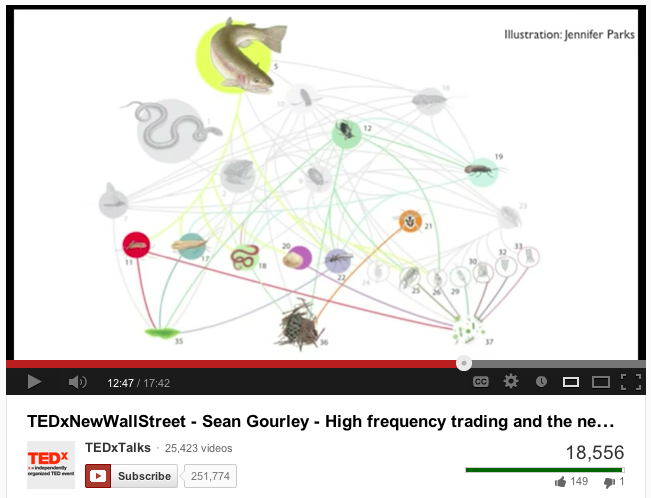
by Jennifer Parks as seen in Sean Gourley's talk: http://www.youtube.com/watch?v=V43a-KxLFcg

by Jennifer Parks as seen in Sean Gourley’s talk: http://www.youtube.com/watch?v=V43a-KxLFcg

Do you ever wonder about the various ways that schools are working to transform their teaching and learning practices? I wonder about this all the time. In fact, thinking about school transformation and working for school transformation define my educational career, especially the past decade and current next chapter of my career.

I’m convinced that schools are complex ecosystems. Within those ecosystems, in efforts to enhance education and forward schools, I wonder how our developing practices are acting like competing species in a natural ecosystem’s food or energy web.

In the screen grab above, we can see a diagram of an ecosystem energy web. I’ve seen this image used in a number of presentations and talks. The colored species are thriving and dominating, and the grayed species are declining and disappearing from the ecosystem.

I wonder how project-based learning, design thinking, inquiry-based instruction, formative assessment, standards-based grading, performance-based assessment, e-portfolios, etc. are interacting in transforming schools. I wonder how these Dewey-progressive and 21st-century-skills approaches are behaving like reinforcing and competing “species” in the school ecosystem. I wonder how they are interacting with more traditional practices and methodologies, and I wonder how they are interacting with each other. The interactions with each other really fascinate me.

For those who know me or read this blog, you understand that I am a strong believer in PBL (project-based learning, problem-based learning, passion-based learning, etc.). Yet, I often worry when I imagine a middle school student taking six or seven departmentalized courses, and her teachers somewhat or entirely adopting PBL… as independent practitioners. Even thinking about half of them adopting PBL as independent practitioners can cause me some concern.

I start to imagine that seventh grader trying to manage four large-scale projects that are not coordinated or integrated across the departmentalized subjects. I start to wonder if the PBL will be the “dominant species” in the ecosystem, or if the departmentalized subject species will devour and crowd out the PBL species. Will the 55-minute time slot for class be the predator or the prey? Or could they become symbiotic species, if the other system characteristics were thoughtfully re-examined and redesigned? How might “flipping the classroom” become a symbiotic or predatory species? (If folks aren’t careful, can you imagine those poor parents at home managing four independent projects with their over-stretched children? Yikes!)

I wonder how the teachers’ assessment practices (species) will complement or compete with the PBL species. I wonder about design thinking being integrated into a course whose teacher is moving intentionally toward PBL. Then, I start to wonder how the traditional content grading will fit with a species that depends on iterative prototyping and rapid failing to conceptualize enhancement and reach eventual success. I wonder about the report card or progress report species trying to capture the elements of this system – elements that are better understood disaggregated rather than smashed into a single number.

I wonder about students designing for perceived problems and struggling to interact with “real” community members because of the online policy species that was introduced to the school ecosystem. I wonder about the level of access of the students and teachers to the surrounding community, and then I think back to those departmentalized subjects and students trying to manage four sets of discovery-and-interview phases in their silo-ed project work.

Which species will prove dominant in the ecosystems of our schools? Are we thoughtfully designing these ecosystems with collaborative and integrated thinking, so that the parts of the system harmonize with instead of cannibalize each other?

Are we designing and nurturing and sustaining the ecosystem from a learner UX point of view? (“UX” is short for user experience.)

#PedagogicalMasterPlanning

—

Thanks to @MarkCHale, head of Greensboro Day School, for putting me onto “Recombinant Education: Regenerating the Learning Ecosystem,” which is KnowledgeWorks’ Forecast 3.0 and the work of Andrea Saveri. Exploring this resource led me to “TEDxNewWallStreet – Sean Gourley – High frequency trading and the new algorithmic ecosystem,” all of which significantly helped me think more deeply about the interplay of the current and coming changes in schooling and education.

#MustRead Shares (weekly)

  • tags: change #MustRead

  • Great resource from Business Innovation Factory —
    “BMGF contracted the Business Innovation Factory (BIF) to better understand the feedback that teachers receive, in what ways that feedback is shared, and under what conditions the feedback impacts teacher performance (both negatively and positively).”

    tags: feedback teachers professional learning teacher_effectiveness #MustRead

  • What if school were not modeled on an industrial paradigm – seemingly composed of various parts that make a whole? Perhaps instruction, curriculum, assessment, etc. are not parts but more accurately a system of one “material.” Using such natural paradigm for the design of schools could result in a more organic and human way of learning. 

    I enjoyed discovering Neri Oxman’s work via Business Innovation Factory. There is much here to translate to school transformation and redesign.

    tags: innovation #MustRead

  • “The central strategy for Bennington turned out to be disarmingly simple and straightforward: to turn the world’s most pressing problems themselves into major definers and organizers of the curriculum. They would be accorded the same authority to generate and organize curriculum now held exclusively by the traditional disciplines in the arts and sciences.”

    tags: #MustRead PBL real-life Challenge_Based_Learning Bennington problem_based_learning

  • “In recent years interest has grown in ‘pedagogy’ within English-language discussions of education. The impetus has come from different directions. There have been those like Paulo Freire seeking a ‘pedagogy of the oppressed’ or ‘critical pedagogy’; practitioners wanting to rework the boundaries of care and education via the idea of social pedagogy; and, perhaps most significantly, governments wanting to constraint the activities of teachers by requiring adherence to preferred ‘pedagogies’.

    “A common way of approaching pedagogy is as the art and science (and maybe even craft) of teaching. As we will see, viewing pedagogy in this way both fails to honour the historical experience, and fails to connect crucial areas of theory and practice.”

    tags: pedagogy #MustRead

  • “The school’s mission statement spells out the core ingredients such a re-imagining will require: “cultivating creative, joyful and compassionate inquirers who use courageous and innovative thinking to build a harmonious and sustainable world.” “

    tags: transformation #MustRead

Posted from Diigo. The rest of my favorite links are here.

School in the Cloud – Sugata Mitra’s TED Prize

We’re born learners…

Onstage at TED2013, Sugata Mitra makes his bold TED Prize wish: Help me design the School in the Cloud, a learning lab in India, where children can explore and learn from each other — using resources and mentoring from the cloud. Hear his inspiring vision for Self Organized Learning Environments (SOLE), and learn more at tedprize.org.

PROCESS POST: How are schools planning and designing their pedagogical renovations?

Will we achieve meaningful school reform with independent efforts that are not designed as interdependent wholes?

Not long ago, I received an email from a group that I highly respect and admire. In the email, they advertised a number of courses for educators, such as:

  • Web 2.0 Tools
  • Common Core
  • Project Based Learning
  • iPads and Apps
  • Gaming
  • Teaching Online
  • Blended Learning
  • Flipped Classrooms
  • STEM, STEAM, and STREAM
  • (and some others)

To be clear, I am a “fan” of many, if not all, of these practices, standards, and approaches. And I am certainly not criticizing the educators who enroll in these courses to enhance their practices and work with student learners. I’m all for adult learning and improved instruction.

But where is the school-level approach to enhancement and improvement in these reform practices? Are schools architecting and blueprinting the systemic transformation of which these practices are parts of a whole? How will the “renovations” named above fit into a master plan that harmonizes the curriculum, instruction, assessment, and learning environments that function together as the ecosystem of a school’s teaching and learning core? Is it enough to have “independent contractors” at various schools enrolling in such courses and enhancing their individual practices? Would schools renovate their physical campuses in the same manner in which they are remodeling their pedagogical constructions?

What about the user experience of the student learners who are enrolled in the schools for which these adult learners work? What’s it like for them to live in their school houses when the rooms and the sub-systems of the home don’t seem to be undergoing remodeling that is planned, coordinated, and orchestrated as a connected whole – from a common set of well-crafted designs?

#PedagogicalMasterPlanning

#MustRead Shares (weekly)

Posted from Diigo. The rest of my favorite links are here.