In the old paradigm of writing and publishing, a writer essentially worked to have all of his or her ideas formed and packaged before publishing. Such was required – all of the thinking on paper had to be relatively complete before it went to press, experienced the magic of publication, and landed on a shelf.
With blogging, as well as with other social media, the power of the printing press has been democratized to the masses. For some, that is frightening. I often hear choruses of “Anybody can get something on the Internet now. Used to be only experts could express their ideas onpaper. Now any yokel can press publish.”
For me, getting to think out loud is exciting and empowering. Sure, sometimes thinking out loud means that a blog post possesses that feeling of “unfinished-ness.” However, it is this unfinished-ness that excites me. By thinking out loud, I can amplify my current thinking and incorporate others’ thinking – if they will just take the risk to think out loud, too, and share. WE are smarter than me. Steve Johnson’s “coffee house” has a better chance of materializing if we are congregating and sharing our thinking. With a growth mindset, I worry not about what people will think of my unfinished, unrefined, unpolished post. I want to grow. Growing requires sticking your neck out. It’s not about looking silly. It’s about learning.
Of course, I am not telling you readers anything you don’t already know. Rather, I am simply finishing a preface to what I really want to write about this morning – but, gloriously, my thinking is not finished on this next topic. By sharing some initial thoughts, those thoughts stand the chance of being read and amplified by a Jonathan Martin, a Lyn Hilt, a Bill Ferriter, a John Burk, a Jill Gough, an Anna Moore, or a colleague that I have yet to meet – either in reality or in virtual space. I can leverage my PLN if I will just risk letting them in to my thinking.
So…

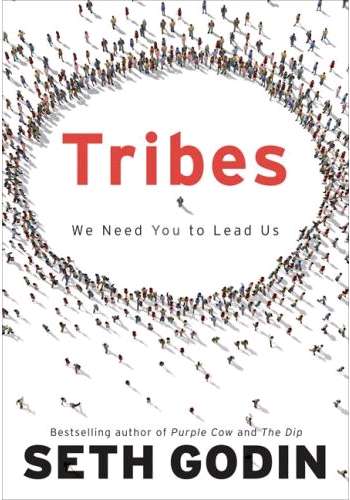
This morning I am re-reading Seth Godin’s Tribe. Many of you may know that I am a stack reader – I will digress if I explain that strategy of my reading. I could just highlight some passages and take some notes, but then those highlights and notes would only benefit me. Additionally, those highlights and notes could not be amplified by others whose thinking could magnify my own. So…I am recording some ideas here – unfinished, unpolished ideas. Here’s to the potential of amplification. If nothing happens to these ideas, I am no worse off. However, if even one reader chooses to comment, question, argue, or postulate, then my thinking can be improved.
- On page 83 of the hard-copy of Tribes, Godin writes, “When you fall in love with the system, you lose the ability to grow.” Many people probably think that I love PLCs. They would be wrong. I love learning. I think schools and education should be ALL about learning. Over the last century or two, I worry a bit that schools may have fallen in love with the system of efficient operations and teaching. I have faith in people as learners, but I do believe that learning is a social activity. If teachers do not have time together – job-embedded time, not just their own time – then it is too easy to get in a repititious rut of teaching the same things, the same ways. To explore, experiment, wrestle with ideas…we need fellowship, time to think out loud, a tribe with whom to work. I am not in love with the system of PLCs. I am in love with learning. Show me a system that promotes learning better, and I will follow.
- Folks who are not really studying PLCs seem to fall into the trap that PLCs ARE the meetings, the structures, the frameworks. PLCs are about the principles of learning. Call them whatever you want, structure them however you want…as long as the focus is on deep, mearningful learning. In our PLCs at Westminster (at least most of the current, formalized PLCs), we put things through four filters: 1) what should be learned?, 2) how will we know if learning is happening?, 3) what will we do if learning is not happening?, 4) what will we do if the learner already knows this? These questions guide all learning – student, adult, teacher, admin. ALL LEARNERS.
- Godin uses pp. 79-85 to explore an extended metaphor comparing and contrasting faith and religion. Godin remarks, “Faith is critical to all innovation. WIthout faith, it’s suicidal to be a leader, to act like a heretic.” We MUST believe in the work and the change we are bringing about. Preserving the pre-existing structures, the worked-in-the-past frameworks, is not leadership. It’s management. Leadership revolves around learning. Learning is, by definition, about change. Leading and learning cannot love the status quo – to do so would admit that we have achieved all that we can achieve. We are as good as we can get.
More later. My thoughts are unfinished…
Godin, Seth. Tribes. New York: Penguin Group, 2008.
 it's about learning