A future of synergists and dot connectors…for enhanced customer experience

I am a synergist. I love to work at the intersection and collision of ideas, disciplines, and departments. Of course, like anything, I have to practice this skill, and I hope to continue progressing in the synergizing of things. As Carol Dweck has taught me to say, “I am not yet the synergist that I will be!” I believe Howard Gardner that one of the five minds of the future is the “synthesizing mind.” So, I practice synthesizing and synergizing.

How do I practice? I look for the connections between and among things. I purposefully look. I risk and experiment and take chances. Often, I fail. But I keep synergizing. I work to connect those parts that might result in a whole whose sum is greater than I originally imagined. Also, I get a lot of help from others. WE are smarter than ME when it comes to colliding and synergizing ideas.

This morning, I watched another synergist on TED. In just 4 short minutes, Nathalie Miebach demonstrated to me that mathematical data collection, weather science, 3D art, and music are marvelously integrated. What if school promoted and empowered this type of work…

Then, I remembered a blog post from Garr Reynolds in which he quotes Steve Jobs from a 1997 interview:

You’ve got to start with the customer experience and work backwards to the technology. You can’t start with the technology and try to figure out where you’re going to try and sell it…we have tried to come up with a strategy and vision for Apple, it started with “What incredible benefits can we give to the customer? Where can we take the customer?” Not starting with “Let’s sit down with the engineers and figure out what awesome technology we have and then how are we going to market that?” And I think that’s the right path to take.”

And, so, here is some of my synergy practice this morning: I see Miebach’s TED talk and Job’s quote as inextricably linked together. Schools are envisioning a transformation towards more integrated studies. Some schools are already doing so with great success. Researchers are studying such schools and writing about the Powerful Learning that is happening in such places. Among other shared traits, the schools that are transforming successfully are putting “customer experience” far ahead of “awesome technology.” The successful ones, it seems to me, are guiding students to discover the intersections – the synergies – among such things as mathematical data collection, weather science, 3D art, and music. Then, they are engaging various technologies as tools with which to explore and deepen understanding.

Yesterday, at our faculty meeting, we also took a step in synergy practice. For the second meeting in a row, we told “campfire stories” of some exciting “customer experiences” from our classes and courses. We identified some points on our faculty graph. Now, we have a greater potential to play that great game of motor skill – connect the dots. Wanna play?
Thinking like a child – it may be exactly what we adults need! #21C

So, I just watched a newly posted TED talk by Alison Gopnik: What do babies think?

Throughout the talk, I was fascinated by the experimentation that she implemented in order to test her hypotheses about baby cognition. Looking at the totality of her results, Gopnik posits that babies can decipher what others are thinking, that babies think more like a lantern than a spotlight, and that babies naturally experiment and hypothesize and prototype to test their understanding of the world.

Listening to Gopnik, I found connection with her talk and Tom Wujec’s Marshmallow Challenge – the key to building better things is experimenting, failing, and prototyping improvements. It turns out that kindergarteners are really quite good at this reiterative learning.

Additionally, I was reminded of Steven Johnson’s The Innovator’s Cookbook, in which he encourages us to “get a little lost” and “play each other’s instruments.” By placing ourselves in novel situations, we can deliberately disorient ourselves and return to our “baby brains.” When we are young, we are all artists, inventors, astronauts, and aliens! Unfortunately, too many of us unlearn these perceptions about ourselves.

We have a great many transitions and transformations to make in school and the ways in which school is structured. I believe our world demands us to re-imagine “school.” Just today, one of the student-learners in Synergy 8 posted this pondering on our group Posterous:

How much in school has changed since the 1800’s?

Posted by  josephka to Synergy-8-2011-12-S1
Even with computers and smart boards not much has changed since the 19th centruy, but why not? the world has changed so much. People don’t have tha same jobs that they would have had 200 years ago. Maybe the system should be changed.

Another Synergy 8 team member commented back:

sumterf just commented on the post “How much in school has changed since the 1800’s?” on Synergy-8-2011-12-S1

I think if someone came to the future from the 1800s, they would recognize that our science, math, english, and language classes are school, but they probably would not recognize Synergy class as school.

And even if you don’t believe that school could stand a makeover, then perhaps you could allow that school should at least be re-examined…re-explored. To stand still is to grow stagnant and to ignore current research and learning from emerging best practices. Let’s employ the scientific method to our own structure…let’s play with ideas and possibilities like a child plays and integrates imagination with future possibility for reality. Let’s tap the butterflys that are our children and learn to flutter from their capacities and potential for creation and reiterative examination of enhancing prototypes. Let’s DO DIFFERENT…to discover and improve our current attempts.

Here’s to playing, to thinking more like a lantern, to trying another’s instrument, to disorienting ourselves, to wanting to know what others might be thinking. Here’s to not yet knowing that math, science, English, and history will be taught separately and from the vantage point of a individual desk and chair.

It’s not about convenience nor convention. It’s about learning!

Geoff Mulgan: A short intro to the Studio School

In my regular and continuous search to locate schools that are implementing deep project-based learning, I came across this recently released TED talk by Geoff Mulgan. In just eight, short minutes, Mulgan demonstrates the set up and the success of the Studio School movement in England.

Couldn’t we establish such a studio school here – even as a school within a school? I can imagine an “innovation strategist” working within a school that is serious about transforming education. Such an innovation strategist could work with a cohort of teachers, a collection of willing parents, and an enthusiastic team of students to build such a studio school within one of our existing schools. Or such a studio school could hub together the spokes of a few willing institutions. Can you imagine all that we would learn…by doing?!

Geoff Mulgan and the Studio School are leading from the emerging future. This past week, I began my deep read of C. Otto Scharmer’s Theory U: Leading from the Future as it Emerges. I have read the book once through on a quick read. Now, I am meandering and studying the work. It is mesmerizing and compelling. Near the opening, Scharmer explains, “leaders cannot meet their existing challenges by operating only on the basis of past experience, for various reasons. Sometimes the experiences of the past aren’t very helpful in dealing with the current issues. Sometimes you work with teams in which the experiences of the past are actually the biggest problem with and obstacle to coming up with a creative response to the challenge at hand” (Kindle location 256 of 5811). Scharmer devises Theory U to address “the core question that underlies the book: What is required in order to learn and act from the future as it emerges?” (Kindle location 325 of 5811).

I believe Geoff Mulgan leads from the future as it emerged. He established Studio School as a doorway into the future. A few could argue that Studio School looks a lot like education of hundreds of years past. Few could argue that many, if any, formalized schools of the industrial age and information age have looked like Studio School. No, Geoff Mulgan is showing us the future and leading from the future. He is leading in such a way as to help the future emerge.

Geoff Mulgan is committed to “Do Different.” Bless him.

Chimamanda Adichie: The danger of a single story

Recently, the History Department at my school has circulated the TED talk from Chimamanda Adichie, The Danger of a Single Story.

The talk is a beautiful challenge for us all to remain diligent about learning the complexity of people – not to rely on the shallowness and incompleteness of a single story. In the talk, Adichie makes numerous statements of profound importance, full of thought-provoking resonance. I include two quotes below:

So that is how to create a single story. Show a people as one thing, as only one thing, over and over again, and that is what they become.

The single story creates stereotypes. And the problem with stereotypes is not that they are untrue but that they are incomplete. They make one story become the only story.

Now, Adichie’s message is richly and deeply human. And I mean not to cheapen the message by reflecting on just one of the applications that is presently poignant for me. However, I believe a number of schools are in danger of committing the “danger of a single story” as it relates to the way in which some view global connectedness for young learners. As I explained in my post, Be Safe and Teach Them to Drive, I believe adamantly in keeping children safe. Nevertheless, I also worry about the power of some single messages – some “single stories” – to demonize the effect of the online community on young learners. Certainly, there are dangers, but there are also amazing opportunities to connect with countless teachers and co-learners. We can make our decisions as schools from a perspective overly dominated by fear, or we can make our decisions as schools from a perspective more evenly dominated by positive possibility. Both demand that we protect children and keep them safe, but they are not at all alike in how the perspectives shape how we step and walk down the path – with anxiety-ridden trepidation or with confident thoughtfulness.

A tapestry of perspectives needs to be woven from a diversity of view points and multiple stories – stories rich in visual detail and purposeful imagery. Guiding our students to become global citizens who understand the danger of a single story demands that we do so.

Synergy 8 Beginnings – Day 1 and Day 2 Recap

As a student for many years, I can remember the general trend of the first day of classes. As a whole, most of my teachers distributed a handout with numerous rules and expectations. We were told what kind of notebook to carry, how to organize it, how much quizzes and tests counted in our averages, what not to do in class, etc.

As a counselor at Camp Sea Gull, we learned that first impressions are powerful. Captain Lloyd used to say that it takes only minutes to form a first impression but days and weeks to change or alter that first impression.

DAY 1

In Synergy, Jill Gough and I wanted to facilitate a careful and thoughtful first impression of what the course would be focused on. Our first class period is only 15 minutes long because of the orientation design of our first days of school. In that quarter hour, we hoped to inspire our 24 teammates – all 8th graders – to know that Synergy was about empowering us to be the change we wish to see in the world. So…we began with Kiran Bir Sethi’s 9 minute TED talk:

In the minutes that remained, we asked the student learners to reflect on why we would begin the course with such a video “act 1.” Several piped up and said, “Because we can do things to make a difference.” “This class is about applying our subjects to making a difference in the world.” “We are just kids, but we can act to change things that we see need changing.”

A successful beginning!

DAY 2

On day 2, we began with the Marshmallow Challenge (see Tom Wujec TED talk). Shortly after the class, we cut this 5 minute video:

The student learners wrote some responses in a mediated journal, and the focus centered on the importance of prototyping and engaging in an iterative process of trial, error, success, improvement, revision, retrial.

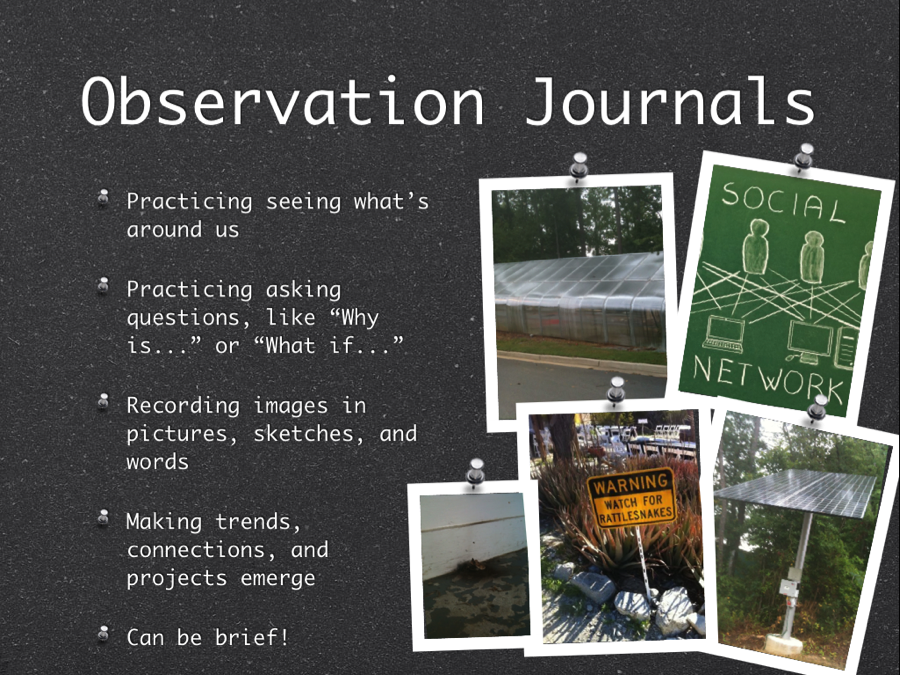
Next, we explained that our team would engage in a common practice and habit of observation journaling. To kick off this tool-explanation session, we employed Jonathan Klein’s TED talk:

Students briefly reacted to the power of visual imagery and using images (text, sketch, or picture images) to drum up awareness, reaction, and discussion. This was our jumping off point for beginning the powerful habit of recording our observations in a kind of regular diary about what we see and what causes us to question.

Jill and I then demonstrated a method that we both use to keep our observation journals – a great e-mail based blogging system called Posterous. Jill “postered” an observation journal of me postering” an observation journal: http://jplgough.posterous.com/observations-synergy

Finally, before we had to depart, we provided the students with the private access code to our class Schoology site – our primary means of digital communication and archiving for the Synergy community.

From my seat, it was a great beginning with a team of 26 people full of the “I Can” bug…ready to engage the iterative process of prototyping…so that we can take charge and use our images and voices to make a difference in this world. I still don’t know what kind of binder we should use, but that seems relatively insignificant. And we have weeks to overcome that first impression about notebooks and binders!