Thanks to Michaelangelo

Yesterday, when I got home, I asked my six-year-old about school. “What was your most fun thing today?” He answered that they had seen some slides of a guy who painted, sculpted, designed architecture, messed around in math, and read a lot of books. I asked if he remembered who the “guy” was. My son said, “No, but he painted some chapel ceiling.” I said, “Michaelangelo.” My son said, “Yeah, that’s the guy.”

I am not entirely sure why I love all of the categories (and more!) that my son listed, but I do. I hope someone, someday, will describe me as a Renaissance person. I hope my sons – both of them – seek to learn about the full range of things in the world. Specialization is overrated. I hope my sons find ways to stay integrated in their thinking. PJ found no disconnect that that “guy” did all those things. For now, I am thankful that my kindergartener had an interaction with a Renaissance person today…through his teacher. Thanks, Michaelangelo.

Riffing, Swirling, and Boarding

Had I taken my sabbatical more than four years ago, I believe that my time at Unboundary would have seemed like a journey to a foreign land. As it is now, Unboundary is very recognizable and familiar to me because of the work in which I have immersed myself regarding PLCs – professional learning communities.

In The Fifth Discipline, Peter Senge writes:

The tools and ideas presented in this book are for destroying the illusion that the world is created of separate, unrelated forces. When we give up this illusion – we can then build ‘learning organizations,’ organizations where people continually expand their capacity to create the results they truly desire, where new and expansive patterns of thinking are nurtured, where collective aspiration is set free, and where people are continually learning how to learn together.

During my first week as a sabbatical intern at Unboundary, I witnessed the power of three collaborative tools: riffing, swirling, and boarding.

  • Riffing is improvisational brainstorming. Often team members will declare that they are riffing. This seems to bring into play a set of unspoken, agreed-upon norms – these next ideas are for building more ideas, so don’t shoot them down and don’t add them to the more-concrete draft yet. Just hear me and think with me. Try to pick up a note that you can riff on, too.
  • Swirling is perspective and feedback seeking. It is asking for input and assessment. It provides evaluation from the standpoint of mixing things up so that new lenses can be applied to the thinking and creation.
  • Boarding is communal mind-mapping. Making boards literally means putting index cards up on a tack-board wall (often movable panels) in order to outline and storyboard an idea. By utilizing a board, big-picture visualization and idea connectivity is facilitated.

Watching an Unboundary team riff, swirl, and board is akin to watching a PLC. In a PLC, team members work through the four questions: 1) what should be learned, 2) how will we know if learning is happening, 3) what will we do if it has already been learned, and 4) what will we do if it is not being learned. In a PLC, this work is accomplished collaboratively through such practices as analyzing student work, establishing SMART goals and essential learnings, engaging in lesson study, and participating in instructional rounds. By working together and breaking out of the traditionally isolated way of working in schools, PLC members are able to riff, swirl, and board their ideas…all for the benefit of learning. WE are smarter than ME. Therefore, schools need to ensure time and space for teachers to work together as lead learners, rather than continuing on the path of the egg-crate culture typical of most schools.

In the 21st century, schools and other businesses – all learning organizations – must partner together to share productive and innovative techniques. We need to expand our capacities to create the results we truly desire, we need to nurture new and expansive patterns of thinking, we need to set free our collective aspirations, and we need to learn how to learn together. We need to riff, swirl, and board…together. We need to unboundary ourselves and strive for more significance…together. Imagine the thinking that school and business could do as a team. Imagine the thinkers we would facilitate in schools – thinkers who would grow into the business leaders of tomorrow. Imagine the learning that could happen!

– Senge, Peter. The Fifth Discipline: The Art and Practice of the Learning Organization. New York: Currency Doubleday. Accessed via e-copy on Amazon Kindle App for iPad.

Race to Nowhere – An Excellent Response

On February 28, Trinity School hosted an educators’ screening of the powerful and provocative film Race to Nowhere. I have struggled a bit to articulate my reactions and responses to the experience of viewing the movie. Fortunately, a colleague who is an invaluable member of my PLN (whom I will meet for the first time at the end of March) has posted a response that articulates extremely well my views from the screening. Thanks to Jonathan Martin for a strong and balanced response – located here.

Shouldn’t Practice Mimic the Game?

During my life, I have participated pretty heavily in sports. Play is fun and a great way to learn. I have dabbled in all kinds of sports. As I grew up, I played a lot of soccer. Not surprisingly, preparing to play soccer involved a great deal of playing the actual game. Sure, we drilled, but the drills were just micro-parts of the whole game. In late high school, I migrated to triathlon. While I certainly lifted weights and participated in stretching and plyometrics, most of my training involved actually doing long hours of swimming, biking, and running. Practicing was direct application and immersion in the sports. On “brick” days, I actually combined two, and sometimes all three, of the sub-sports with transitions so that practice immitated an actual triathlon. Practice was a virtual mimic of the game/event for which I was preparing. Is school, in its traditional format, a virtual mimic of the game/event for which we are preparing students?

My school’s mission states that we are preparing students for college and for life. I have a pretty good idea of what college is like. I have been to several as an undergrad, a post-grad, and a graduate student. My experiences at those colleges was fairly similar to my experiences as a student in K-12 school. The formats, structures, and cultures were similar. By “life” I think we mean “work” to a considerable degree. For many of one’s waking hours of life are spent working. During the past 20 years, I have spent my career working in schools, but I have never really worked in the “business” world. As an undergrad, I trained as an economist and as a marketing-management scientist. But that’s not the same as really living the business-world life that most of our students will enter after college. How do we know that we are preparing students for the “life” part of our mission? Are you reading as much as I am that business leaders indicate that students are not so well-prepared for the work-life realities? Could it be that the the practice is not a close enough mimic of the game? Is this why UVa Med School is striving to make practice more like the actual game?

In the past three days at Unboundary, I believe I have been given a rare gift as an educator. I have immersed myself in the “business world.” I will continue to do so for several weeks. While one, short sortee into the business world makes me no expert, I do have a new perspective than many career educators don’t really get to experience. I feel like I have been able to discern another data point on the life-education graph, and doing so allows me potentially to draw a line of better fit from school to college to life.

Moreover, in the past three days, I have seen in my mind’s eye the replaying of several influencial videos that I have written about and shared in previous blog posts. Sir Ken Robinson’s RSA video has come to mind countless times. The Buck Institute videos about project-based learning, and the ongoing conversation that Jonathan Martin and I are having, come to mind. Steve Johnson’s “Where Good Ideas Come From” – both the TED talk and the RSA video – come to mind. Kiran Bir Sethi’s Riverside School comes to mind. Edutopia’s videos on High Tech High and other immersive learning environments come to mind.

Maybe more than anything, I feel empowered to continue refining and revising the Synergy 8 course. For those who are new to this blog, Synergy 8 is a new course that Jill Gough and I co-facilitate for 8th graders at Westminster. This fall, Synergy 8 experienced it’s pilot semester. In short, the course is…

  • Based on The Falconer by Grant Lichtman
  • Non-departmentalized and integrated in nature (we combine content and skills from the various departmental domains)
  • Project-based and problem-based
  • Steeped in high-level communication and presentation
  • Focused on community issue identification and solution
  • Learner-centered

Watching a team of three Unboundary pros working on a pitch, presentation and workshop design has been like watching the game or event that we are preparing Synergy 8 students to play in our practice sessions. It has been like looking in a mirror to study our form and muscle memory. It has been like preparing for life. Not “like”…it has been preparing for life.


Thinking Out Loud: Tribes

In the old paradigm of writing and publishing, a writer essentially worked to have all of his or her ideas formed and packaged before publishing. Such was required – all of the thinking on paper had to be relatively complete before it went to press, experienced the magic of publication, and landed on a shelf.

With blogging, as well as with other social media, the power of the printing press has been democratized to the masses. For some, that is frightening. I often hear choruses of “Anybody can get something on the Internet now. Used to be only experts could express their ideas onpaper. Now any yokel can press publish.”

For me, getting to think out loud is exciting and empowering. Sure, sometimes thinking out loud means that a blog post possesses that feeling of “unfinished-ness.” However, it is this unfinished-ness that excites me. By thinking out loud, I can amplify my current thinking and incorporate others’ thinking – if they will just take the risk to think out loud, too, and share. WE are smarter than me. Steve Johnson’s “coffee house” has a better chance of materializing if we are congregating and sharing our thinking. With a growth mindset, I worry not about what people will think of my unfinished, unrefined, unpolished post. I want to grow. Growing requires sticking your neck out. It’s not about looking silly. It’s about learning.

Of course, I am not telling you readers anything you don’t already know. Rather, I am simply finishing a preface to what I really want to write about this morning – but, gloriously, my thinking is not finished on this next topic. By sharing some initial thoughts, those thoughts stand the chance of being read and amplified by a Jonathan Martin, a Lyn Hilt, a Bill Ferriter, a John Burk, a Jill Gough, an Anna Moore, or a colleague that I have yet to meet – either in reality or in virtual space. I can leverage my PLN if I will just risk letting them in to my thinking.

So…
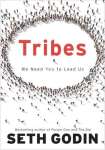
This morning I am re-reading Seth Godin’s Tribe. Many of you may know that I am a stack reader – I will digress if I explain that strategy of my reading. I could just highlight some passages and take some notes, but then those highlights and notes would only benefit me. Additionally, those highlights and notes could not be amplified by others whose thinking could magnify my own. So…I am recording some ideas here – unfinished, unpolished ideas. Here’s to the potential of amplification. If nothing happens to these ideas, I am no worse off. However, if even one reader chooses to comment, question, argue, or postulate, then my thinking can be improved.

  • On page 83 of the hard-copy of Tribes, Godin writes, “When you fall in love with the system, you lose the ability to grow.” Many people probably think that I love PLCs. They would be wrong. I love learning. I think schools and education should be ALL about learning. Over the last century or two, I worry a bit that schools may have fallen in love with the system of efficient operations and teaching. I have faith in people as learners, but I do believe that learning is a social activity. If teachers do not have time together – job-embedded time, not just their own time – then it is too easy to get in a repititious rut of teaching the same things, the same ways. To explore, experiment, wrestle with ideas…we need fellowship, time to think out loud, a tribe with whom to work. I am not in love with the system of PLCs. I am in love with learning. Show me a system that promotes learning better, and I will follow.
  • Folks who are not really studying PLCs seem to fall into the trap that PLCs ARE the meetings, the structures, the frameworks. PLCs are about the principles of learning. Call them whatever you want, structure them however you want…as long as the focus is on deep, mearningful learning. In our PLCs at Westminster (at least most of the current, formalized PLCs), we put things through four filters: 1) what should be learned?, 2) how will we know if learning is happening?, 3) what will we do if learning is not happening?, 4) what will we do if the learner already knows this? These questions guide all learning – student, adult, teacher, admin. ALL LEARNERS.
  • Godin uses pp. 79-85 to explore an extended metaphor comparing and contrasting faith and religion. Godin remarks, “Faith is critical to all innovation. WIthout faith, it’s suicidal to be a leader, to act like a heretic.” We MUST believe in the work and the change we are bringing about. Preserving the pre-existing structures, the worked-in-the-past frameworks, is not leadership. It’s management. Leadership revolves around learning. Learning is, by definition, about change. Leading and learning cannot love the status quo – to do so would admit that we have achieved all that we can achieve. We are as good as we can get.

More later. My thoughts are unfinished…

Godin, Seth. Tribes. New York: Penguin Group, 2008.