#Learnopolis and INMAX

Today, Westminster is hosting INMAX – a Benchmark Research membership group of large, independent schools in the U.S. The topic of focus is leadership and innovation, and the agenda appears quite intriguing as a whole.

At 11:30 a.m., Jill Gough (@jgough) and I (@boadams1) will be sharing a story about tearing down walls and connecting dots. We will be sharing the story of our school’s multi-year journey to become a PLC – a professional learning community. The official title of our session is “Learnopolis: Tearing Down Walls with PLC.” We plan to use the Twitter hashtag #learnopolis for tweeters, and a PDF of our slide deck is embedded below (the iMovie in slide #9 is inserted below, too, as a YouTube video).

In short, we are trying to communicate the following:

  • “School” hasn’t changed very much in the last century – maybe longer. [We need to adapt and evolve!]
  • Schools exist in a bit of an “egg-crate culture” (Kathy Boles), as we have generally organized with individual teachers and rows and columns of students. For the most part, teachers are relatively isolated as professionals.
  • In the 21st c., we can capitalize on the notion of social networks by rethinking and rebuilding the critical infrastructure of schools – the human infrastructure. [New basic building block should be learning teams.]
  • While we cannot rebuild the physical plant, we can rebuild the way we work within the physical plant. We can build a learnopolis!
  • By shifting our central paradigm from “teaching” to “learning,” and by providing regular, job-embedded, structured time for teachers to collaborate, we can build the schools that 21st c. learners desire and deserve.

We are looking forward to learning together with our colleague schools at INMAX today! And we are looking forward to building a learnopolis! After all…it’s about learning!
PBL: Let’s Build Something Together

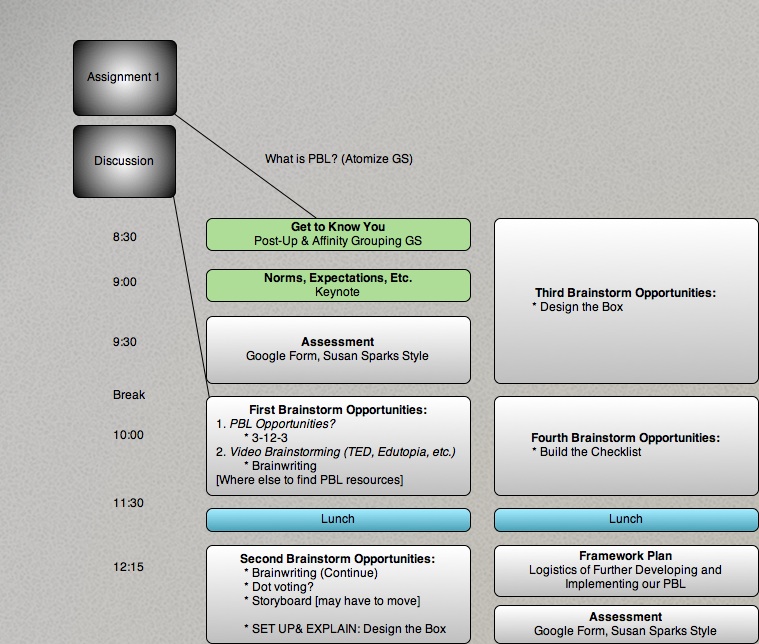
As I write this, it’s early Sunday morning. Tomorrow, on Monday, June 13, Jill Gough and I will begin Day 1 of co-facilitating “PBL: Let’s Build Something Together.” This course is a two-day (10 hour, 1PLU) summer institute through the Center for Teaching at the Westminster Schools. We have about 15 educators coming from 4-5 different Atlanta area schools. Primarily, our essential learnings – our fundamental desired outcomes – number “just” two objectives:

  1. I can brainstorm various possibilities for PBL (project-based learning).
  2. I can create framework plans for various PBL.
Here’s our Curio7 mindmap of how we are structuring the ten hours:
Whereas some people attend conferences, institutes, and workshops expecting a considerable amount of “sit-n-get” knowledge transfer, our participants will be sorely disappointed if they are wanting that typical educational conference experience. Jill and I know we will not “finish” what we are setting out to do. Monday and Tuesday will be mere beginnings.
.
You see…we really want to build something together. If we actually accomplish our essential learnings, these 15 Atlanta educators will leave committed to enacting and implementing a PBL-project in the first semester of 2011-12. We are going to learn PBL by doing PBL. Our project: build a multi-school PBL to try in the fall. So, potentially, we could have 4-5 schools putting a PBL idea into practice with students.
.
Imagine the possibilities there! We could continue to develop the project as a virtual lesson study. We could engage in instructional rounds and visit each other’s schools to observe how the project is implemented at each place.
.
Last week, at a learning opportunity at Trinity School, @gcouros challenged us all to think of ourselves as school people and lead learners. He asked us to think bigger than just our own individual classrooms. Shouldn’t we do the same for school vs schools?! Imagine what we can learn together.
.
I love being excited about something which is about to begin!

A Team of Learners Innovates Writing Workshop

On rare occasions, I sometimes think it would just be easier to go start another school instead of working on teams of educators trying to innovate curriculum and instruction that has a long history and tradition. However, each and every day (seriously) something or someone brings me back from that relatively irrational cliff face. One of the great hallmarks of my current school – my place of work for the past 16 years – is our regular practice and willingness to analyze and consider ourselves. And I don’t mean admiring ourselves, although all people and institutions can fall into that trap periodically. No, I mean “considering ourselves” in the sense of examining our practices and asking if we can do better for the learners in our care. No matter how frustrating some issues of static inertia or dynamic change may seem, I believe we are genuinely into continuous improvement.

A few weeks ago, the chair of the English department came to see me. He said he had been thinking about what PBL (project-based learning, problem-based learning, passion-based learning, etc.) would look like in a 21st century English classroom. Now this man is a great thinker, so when he said he had been “thinking about,” I knew he had put some serious time, research, reflection, and conversation into the effort. In short, his idea for 21st century PBL in English involves the complexities and integrated nature of publishing. An idea with genius and endless potential!

What to do with the idea? Well, we work in PLCs (professional learning communities) in the Junior High. While not everyone is formally involved – YET! – it is our developing way of working…our ethos of working and learning together. So…the idea was taken to the JH English PLC and, specifically, the Writing Workshop team. Several members of this team had been thinking about potential innovations to the Writing Workshop course and its intersection with Synergy and Economics, which are two more courses in a triad of classes for our eighth graders. Now a confluence of thinking and thinkers used Steven Johnson’s “coffee house” to swirl and rift on some possible manifestations of publishing in the Writing Workshop course. What a blessing that we have four hours a week built into our work days in order to collaborate in this way. May we never take for granted that we have a developing infrastructure to get us anywhere we want to go!

Largely because we could collaborate in PLC meetings, a proposal was quickly drafted and presented to a few administrators. Largely because we have a dynamic vision statement for our work as a school, a foundation existed that practically inspired this type of curricular and instructional innovation and improvement. This week, we were able to send a letter to parents of rising eighth graders explaining that Writing Workshop would be innovating for 2011-12 in order to utilize topical or thematic electives. Here is the letter that was sent:

Today, rising eight-grade students will hear about the innovations in group homeroom, and they will be able to respond to a survey which requests their desired topic of elective focus. Now, they have a choice much greater than that which existed before in this course. Now, they will be able to develop an authentic audience through publishing work. Oh the places we could go!

Possibilities and realities enacted through the passions and determinations of a team of educators. How fortunate I am to work with these teachers! How fortunate I am to work with these learners! How fortunate I am to learn with these learners! It’s about learning!

A note of celebration and a tapestry of bright spots

Don’t you love getting little notes – notes that thank you for something and name the specific thing for which you are being thanked? Makes me feel celebrated when I get one of those. I instantly hit “send to OneNote” and place in a “sunshine file” for a proverbial rainy day. As a principal, I have a lot of opportunity to celebrate folks. To be honest, I am not very good at public celebration, but I am working on it – celebrating publicly is a learning goal of mine. But I do try to send email notes (I write better in pixels than on paper) as often as I can.

Yesterday, though, my learning partner and co-facilitator of PLCs beat me to the notes. She wasted no time in celebrating the bright spots of our teams. Specific behaviors were named and resulting outcomes were celebrated. What inspiration that is to a receiver to keep doing those things and improve. Of course, the notes reveal the situations and moments and behaviors that were celebrated, and those notes collectively tell a story about some truly amazing work in our Junior High math-science PLC, which meets four days a week, for about an hour each day. Some days the entire community of JH math and science teachers is together, and some days we break into course teams or other teams.

Enough from me…GO READ ABOUT IT at Experiments in Learning by Doing.

Who can you send a note to today? What bright spot can you celebrate? Pick one and do it! It’s about learning.

Tearing Down Walls

We live in an increasingly connected world. Yet barriers to connection continue to operate in schools. Kathy Boles at Harvard has described school as the egg-crate culture. With some exceptions, teaching can be an isolated and isolating profession, unless teachers and administrators work to be connected to other learners. It is far too easy to go into one’s classroom and teach…relatively alone…siloed. Classes right next door to each other, much less across a building or campus, often have no idea what is going on outside the four walls in which they are contained. And departmentalization makes for an efficient way to deliver content in neat, organized packages, but departmentalization is not the best parrot of the real, inter-connected, messy-problem world.

What can we do to step closer to modeling and experiencing real, inter-connected problem-addressing?  How do we communicate with each other when we are assigned classrooms where we can be siloed?  What could greater connectivity look like for learners of all ages?

Recently, learning partners Jill Gough and Bo Adams submitted a roughly made prototype of a three-minute video to apply for a speakers spot at TEDxSFED. It’s about “Tearing Down Walls.” It’s about experiments in learning by doing. It’s about learning.