Goal Keepers, Part 2 of 3

In this three-part set of posts about goals, I explore the general concept of goal setting and action stepping, and I drill down more specifically into my school’s new vision statement, Learning for Life, as well as my own professional goals for the year, which are a part of my school’s Faculty Assessment and Annual Review (FAAR) Plan.

Recently, after completing our 2010 SACS-SAIS (Southern Association of Colleges and Schools – Southern Association of Independent Schools) self-study, and during engagement with our ongoing strategic planning as a school, a faculty-administration committee drafted our new vision statement, Learning for Life. In late Spring of 2011, the Westminster board, administration, and faculty overwhelmingly endorsed the new vision statement. A copy of the document can be accessed below via Scribd, and you can read a recent Westminster Magazine article about the vision here (see President’s Remarks on pages 2-3 and Cover Story on pages 6-11 of the pdf).

In a nutshell, I am thrilled about the Learning for Life vision statement! In 2011-12, I will be excited to pursue deeper understanding and implementation of such pedagogical practices as project-based learning and problem-based learning (PBL), integrated studies, and balanced assessment. I am charged up, full of creative tension, to explore schedules and spaces that promote deep learning; to work with my colleagues, students, and parents in learning teams; and to connect globally with the countless “teachers” who can help us achieve our vision.

On the ground, with sleeves rolled up, how are we going to achieve our vision, Learning for Life? Among a multitude of efforts aimed to make our vision our new current reality, I believe a community full of creative tension lies at the center. All of the people I work with want to do our best to enhance learning – what a great trait to possess at the outset and all along the way! To close the gap between our existing current reality and our new vision, we at Westminster have our developing Faculty Assessment and Annual Review (FAAR) Plan to help structure our paths, our undertakings, and our desire to improve and enhance learning. The plan has five, integrated and interwoven parts:

  • Goals and Self-Assessment
  • Peer Visits and Observations
  • Administrative Observations
  • Student Course Feedback
  • Feedback from Duties “Outside the Classroom”

During the development of our FAAR plan, a colleague and I made the following video to help explain the philosophical underpinnings of our professional learning framework.

In essence, our FAAR Plan encourages us, as faculty and administration – WE, not “us” and “them” – to set goals that are going to help us learn how to educate in increasingly enhanced ways while pursuing our collective vision as a school. The other four component pieces of the FAAR Plan are supposed to work as a system, in conjunction with our goals and self-assessment, to provide us with feedback (like that reflective mirror and our biological feedback systems mentioned in “Goal Keepers, Part 1 of 3”) which helps us see if our creative tension is steering us to reaching and achieving our goals and vision. From the feedback, if we realize our actions are not steering us closer to our vision, we can adjust course and re-direct our paths.

If you are a reader from Westminster’s faculty and administration, I hope you will carefully reflect during your self-assessment process and establish a primary goal which will motivate you, and all of us, to strive for and achieve the elements of our Learning for Life vision. What’s more, I hope you will utilize your feedback pieces as a whole system to collect and analyze the data which can come back to you from self and others in order to signal how “on target” our efforts and actions are to achieving our vision. Engaging with the FAAR Plan can be so much more than “jumping through bureaucratic hoops.” Engaging with the FAAR Plan can systematize and coordinate our individual efforts into collaborative actions that result in a realized vision – a vision for the best learning that we can provide for ourselves and our student learners.

What matters most is the mindset with which we take on this challenge! What is your mindset going to be? Will you employ a growth mindset? Will you engage with our professional learning plan in such ways that you are energized with creative tension? Will you collaborate with others so that we can work as a team to take on this exciting and invigorating journey as educators and as learners?

I hope you will! I hope you will help me stay focused as both a leader and as a participant team member. It’s about what’s best for our students! It’s about learning!
A 007 Principal’s Ride and Making Films

This week, my family and I saw Cars 2, the sequel to the fabulous, animated story of Lightening McQueen and his learnings of humility with his new-found family in Radiator Springs. In Cars 2, McQueen finds himself in a new racing and life-learning challenge, and Mater, his best friend the rusty, ol’ tow truck, finds himself a secret agent who doesn’t realize his own creative intelligence and unique sense of problem solving. During much of the film, Mater is paired with Finn McMissile, an Aston Martin who serves in Her Majesty’s Secret Service…like James Bond. In addition to just loving the story and the time with my family, the movie got me thinking on two tracks…

What Would My 007 Principal Ride Be Like?
As for me, I was raised on James Bond, 007. I loved (still love) the gadgets, especially the cool cars with the special-agent features. In Cars 2, like in the 007 series, Finn McMissile and Mater deploy their gadgetry to stop the bad guys, solve high-speed dilemmas, and save the day from the forces of evil. You know…stuff like smoke screens and oil slicks and machine guns in the fenders – all controlled from a panel in the car. Well, that got me thinking what “gadgets” my 007 Principal Ride might contain. (Note: I am NOT talking about being a “sneak” in school.) Perhaps my “smoke screen” would be a “truth telling cloud” that would promote some people telling me what they really think rather than what they think I might want to hear. Perhaps my “oil slick” would be a meeting-canceler so that I could spend more time in classrooms and other learning spaces with the students and teachers. Perhaps my “machine gun fenders” would be quick-fire assessment tools to help me and others see what is being learned and where we need to go next in instruction and project guidance.

What would be some gadgets on your 007 Principal Ride? Or 007 Teacher Ride? Or 007 Parent Ride? Or 007 Student Ride? I hope you’ll add some ideas in the comments.

Making Animated Films as Character-Ed, Integrated Studies, PBL
As a father of six-year-old and four-year-old sons, I see my fair share of animated films. Some, owned on DVD, we watch many times! I am amazed by the best films – they tell a great story that can be enjoyed by anyone ages 3 to 103, AND they provide great life insight and messages of deep character. They are creatively funny, humanely serious, and technologically and aesthetically artistic. A solid core of animated films are simply brilliant!

So why couldn’t our middle school students make such films? Wouldn’t the project-based learning required to do so provide deep lessons in cross-curricular, integrated studies? Wouldn’t the students – film makers – have to delve deeply into concepts we typically separate and classify into English, math, science, social studies, history, foreign language (think Toy Story 3!), visual arts, performance arts (think sound tracks, etc.) advisement, etc. Talk about transliteracy development…and FUN! I imagine embarking on such a complex endeavor would pose unforeseen problems to confront and solve. I imagine PIXAR Studios could tell some stories about authentic problem solving and collaborative creation.

As a culminating activity/assessment, we could have a series of film festivals for elementary schools, and even larger audiences. We could invite some PIXAR execs and film makers who use their craft to make a positive difference in this world. Other real-audience possibilities seem endless, as do the opportunities to do something meaningful with the final results and any resulting proceeds.

So why don’t we do such a thing? Maybe other schools do…but I don’t know of any. Maybe we should try it as an experiment and learn by doing. Anyone want to give it a try? The green flag is waving, as far as I can see. Perhaps it’s time for us to start our engines!

Readicide, Springboards, and PBL

Thanks to the Westminster English Department and chair Bart Griffith, Kelly Gallagher’s Readicide was on my summer reading list. The short, compact read is full of summarized research and practical advice about how to end readicide in schools and to promote more engaged joy with reading for a lifetime. In addition to describing teaching in a “sweet spot” – neither under-teaching nor over-teaching – Gallagher provides a monumental “duh” (one of those grand aha moments!) for me in chapter three:

“In my first book, Reading Reasons (Gallagher 2003), I discuss the work of philosopher Kenneth Burke, who says the reason young people should read books is that it provides them with ‘imaginative rehearsals’ for the real world. When children read books, Burke argues, they are not just reading stories. They are being given an opportunity to understand the complex world they live in (1968). Books enable adolescents to begin wrestling with those issues that remain universal in all our lives” (66).

Later, Gallagher states that “The value comes when we use this great book as a springboard to examine issues in today’s world” (67).

With the examples that Gallagher provides, he is not merely advocating for in-class, passive imaginative rehearsal. Rather he is advocating and advancing the practice of student learners interacting ACTIVELY with their current world as citizens who are springboarding into issues through great literature and the guidance of a lead learner (teacher).

For teachers getting more comfortable or even more deeply immersed in PBL (project/problem-based learning), I believe this advice and advocacy from Gallagher provides the ideal bridge from a long-taught classic to authentic, “do-something-real-in-the-community” PBL. Gallagher gives a number of examples that would apply directly where I teach, as the books named are novels that we include in our school canon. Additionally, such books and the issues they raise could provide the threads and links that tie together curricula for integrated studies.

A great reminder about RELEVANCY…thanks Kelly Gallagher!

Gallagher, Kelly. Readicide: How Schools Are Killing Reading and What You Can Do About It. Stenhouse Publishers, Portland, Maine: 2009.

#PBLCFT11, Lifelong Learning, and a Movie Trailer

Many schools have a line in their mission statements about “lifelong learning.” Without a doubt, lifelong learning is critical…absolutely invaluable. But do we really mean it? Are our schools structured to facilitate genuine lifelong learning – the way learning tends to look throughout most of life? Or are most, if not all, human beings just powerful, resilient learners who interact with their environments and adapt to the needs and demands of the situations we encounter – school, as well as the life that bookends school? Do schools model the patterns of real-life, lifelong learning? Or do schools model more of the efficiency standards of the industrial revolution?

Today, in the Center for Teaching Summer Institute, “PBL: Let’s Build Something Together,” we spent a bit of time discussing this notion of lifelong learning. (In the 5 hours of sessions today, we touched on it directly for just a few minutes…but it caught my attention.) Most agreed that lifelong learning tends to take the form of projects to engage and problems to solve.

As children and as adults, other than in the formal setting of school, does your learning tend to resemble sitting for lecture, taking notes, and testing on that recently acquired knowledge? Or does your learning tend to resemble messy, troublesome, challenging-to-decipher issues that grab your curiosity and demand your attention from multiple perspectives? Does lifelong assessment tend to look like standardized, bubble-in examination? Or does lifelong assessment tend to look more like performances and presentations made to interested audiences and decision makers? Does lifelong learning require isolated attempts – attempts where we are required to work alone? Or does lifelong learning require making connections, building on relationships, collaborating, and enlisting the help and support of others? Does lifelong learning insist on getting things right the “first time?” Or does lifelong learning accept the notion of prototyping based on the reality of “ready-fire-aim” tactics, as we learn from failures and make new, more-informed re-attempts? As one team member said today, “Is learning more about covering material, or is it more about uncovering developing understanding?”

I had a great day working with the fifteen, Atlanta-area educators who gathered to take on “PBL: Let’s Build Something Together.” (Tweets from the day are grouped and searchable by #pblcft11.) In a nut shell, we spent the vast majority of our day-one time in divergent brainstorming – generating a rich pool of potential projects for PBL. The exercises and methods we used seemed to mimic the way that most lifelong learning has occurred to me – engaging complex, challenging issues that don’t have answers that can be found on GOOGLE…muddling through complicated problems that demand collective thinking from people who are committed to collaboratively making hypotheses and testing what works and what doesn’t…accepting that success requires a great deal of trial and error and cognitive meandering.

Tomorrow, on day 2, we will concentrate on emergent and convergent thinking, as we narrow our focus onto one or two projects for which we will formulate framework plans…plans that we can use as a skeleton for putting more flesh on the bones during the upcoming school year. Ultimately, we will implement our team-designed project. We will learn so much more about PBL by actually DOING PBL. As you might expect, I am very excited about the possibilities!

PBL: Let’s Build Something Together

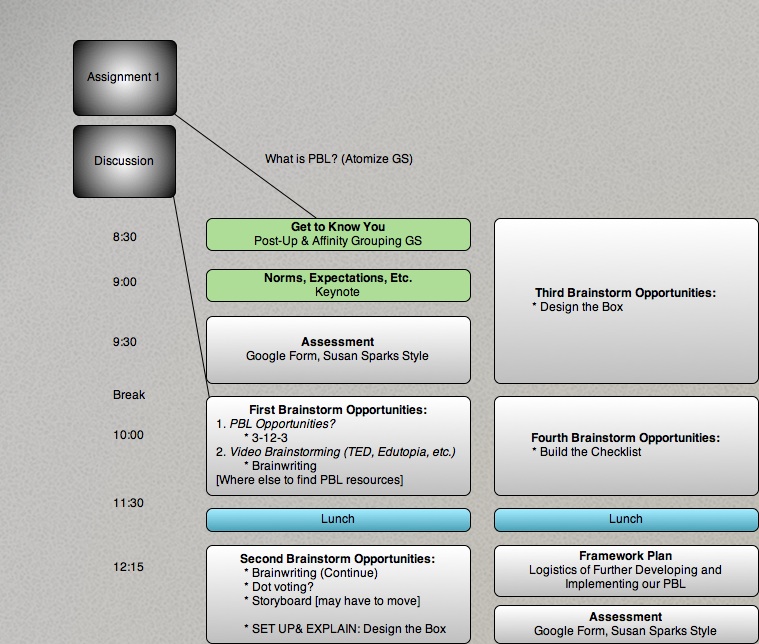
As I write this, it’s early Sunday morning. Tomorrow, on Monday, June 13, Jill Gough and I will begin Day 1 of co-facilitating “PBL: Let’s Build Something Together.” This course is a two-day (10 hour, 1PLU) summer institute through the Center for Teaching at the Westminster Schools. We have about 15 educators coming from 4-5 different Atlanta area schools. Primarily, our essential learnings – our fundamental desired outcomes – number “just” two objectives:

  1. I can brainstorm various possibilities for PBL (project-based learning).
  2. I can create framework plans for various PBL.
Here’s our Curio7 mindmap of how we are structuring the ten hours:
Whereas some people attend conferences, institutes, and workshops expecting a considerable amount of “sit-n-get” knowledge transfer, our participants will be sorely disappointed if they are wanting that typical educational conference experience. Jill and I know we will not “finish” what we are setting out to do. Monday and Tuesday will be mere beginnings.
.
You see…we really want to build something together. If we actually accomplish our essential learnings, these 15 Atlanta educators will leave committed to enacting and implementing a PBL-project in the first semester of 2011-12. We are going to learn PBL by doing PBL. Our project: build a multi-school PBL to try in the fall. So, potentially, we could have 4-5 schools putting a PBL idea into practice with students.
.
Imagine the possibilities there! We could continue to develop the project as a virtual lesson study. We could engage in instructional rounds and visit each other’s schools to observe how the project is implemented at each place.
.
Last week, at a learning opportunity at Trinity School, @gcouros challenged us all to think of ourselves as school people and lead learners. He asked us to think bigger than just our own individual classrooms. Shouldn’t we do the same for school vs schools?! Imagine what we can learn together.
.
I love being excited about something which is about to begin!