When We Choose to Learn…What We Choose to Learn

In Atlanta, we have missed an entire five-day week of school. Snow and ice! I have been so fascinated to read and hear about what some professional educators are doing with their found time. Of course, I only know about a small handfull. Of those who are making their actions known, the activities are relatively diverse. Some have spent the time entirely immersed in family – reclaiming missed opportunities from when work was too busy. Others have bathed their brains in intellectual pusuits. Here’s a small sample:

Teacher A: http://ayearwithhenrietta.com/2011/01/15/not-henrietta-but-cool/

Teacher B: http://quantumprogress.wordpress.com/2011/01/15/an-amazing-week-for-professional-development/

Teacher C: Been practicing recording my lessons so that I can post on Internet.

Teacher D: Enlisting feedback about a student-journal idea…http://jplgough.wordpress.com/2011/01/14/ever-feel-like-you%e2%80%99re-in-the-wrong-place-part-1-the-questions/

Teacher E: School’s out. I am not doing any work or learning while I am off.

Some have probably combined found-time-with-family and unexpected-moments-to-explore-an-idea. Not either-or, but both-and. Isn’t it curious what we do when we find time – maybe the most “precious commodity.” I wonder what each of these admired teachers would say to students when learning of what the 11-14 year olds would choose to do with found time. It’s interesting the “homework” we assign ourselves, isn’t it? I wonder how each of these teachers treats homework in his/her classes?

Achievement-Action: #20minwms

When I logged into iGoogle this Saturday morning, I was greeted by this image:

Achievement is certainly preceded by action. Yesterday, on Friday, I was inspired by the ACTION a sizeable handfull of teachers took when they embarked on the “20 minute experiment.” Explained more fully in the permalink above, Jill Gough encouraged a number of us to engage in an experiment that would synthesize: 1) some of David Souza’s brain research on primacy and recency, 2) formative assessment, and 3) tweeting as a means of forum discussion. Among several others, a ninth-grade physics teacher agreed to participate and became immediately involved. He provides a summary of how he implemented the experiment at Quantum Progress. Throughout the day, participating teachers would take a brief “commercial break” 20 minutes into class and ask students to summarize what they had learned so far. Together the class would craft a 140-character tweet to summarize their learning, and they would post to the teacher’s Twitter account with the hashtag #20minwms. As the tweets appeared, we could all see what was being learned in the participating classes. We even received a spirited and curious inquiry about what we were doing from a Director of Teaching and Learning at a neighboring school. As the day progressed, the number of involved teachers grew – a snow ball was born!

Can you imagine the potential of this process to serve as formative assessment for teachers and students? To connect the learning that occurs between and among classes? To break down the walls that exist between classes? To serve as a window into learning for parents? To archive an essence of what was happening during a day of school? To…

It is about learning, isn’t it?! It takes action, it requires some risk taking, and it certainly is fun when we do it together!

GOOGLE and the JHS

Recently, I have been struck by the number of people who are talking about Google’s “philosophy” of encouraging engineers to take up to 20% of their at-work time to pursue projects of their own. Here are a few of the hits produced if one Googles the topic:

According to many of the stories, some of Google’s greatest innovations have been born from this 20% time. Rather than assuming the typical hierarchy of organization would provide vision and mission to “require” a workplace of innovation, the admin and management merely provide encouragement for an attitude of “bottom-up” leadership (I hate that term and what it implies). The admin and management simply encourage the professionals to pursue personal interests and they provide time for that pursuit to happen at work. As I read the blogs and article linked above, I became intrigued by the idea of “grouplets.” Rather than individuals pursuing personal projects, engineers were banding together to work collaboratively with this 20% time.

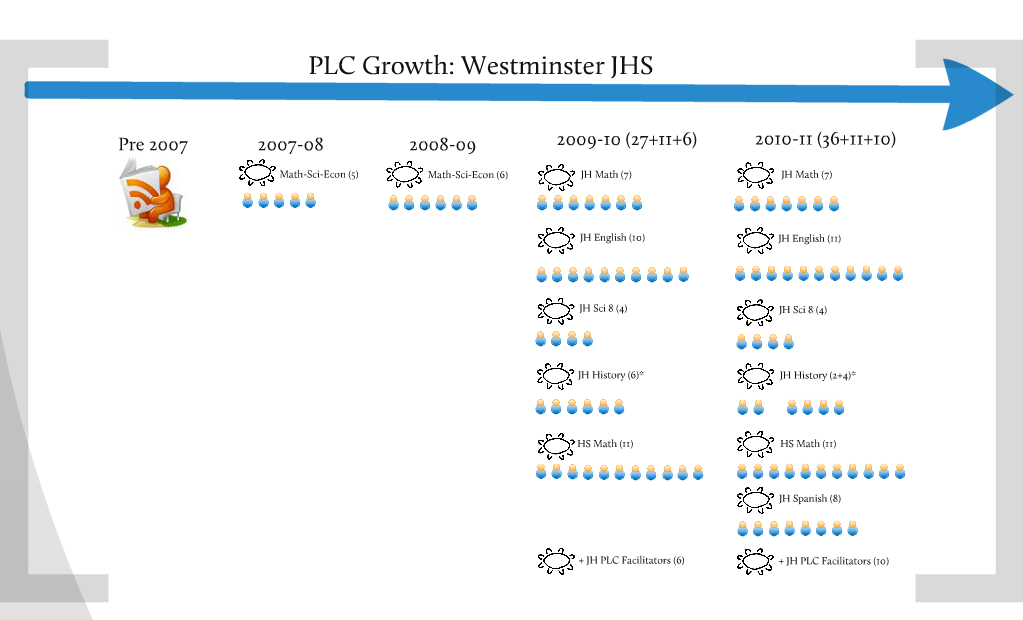
At Westminster, in the Junior High School (JHS) in particular, we have been on a multi-year journey to restructure professional development. We are using the professional learning community (PLC) model and principles to create a new infrastructure for teachers (our “learning engineers”) having the opportunity to work collaboratively together. We have taken a bit of an aggressive approach, and we believe that job-embedded time must be created for such collaboration.

Typically, teachers carry a five-class student course load. For example, a math teacher, in the past, would have five sections of student classes. In the more recent history, we have transitioned one of those periods to be a PLC period. In essence, we have created something akin to Google’s 20% time. One of five sections, transitioned to serve as a PLC period for teacher collaboration, equates to “20% time.”

Through the PLCs, teachers are innovating! Just having a guaranteed time to discuss all of the complexities of teaching and learning is such a positive development. However, much more than discussion is happening. With these four hours per week (we have a rotating schedule and every period meets four times per week), teacher teams are re-exploring writing as thinking, formative assessment ideas, second-chance testing, four-point rubric development, technology integration, content understanding in various fields, and the list goes on.

But I wonder if the 42 (of 74) teachers currently involved in formalized PLCs (we plan to work toward 100% integration for ALL teachers) see their PLC period as this Google-esque 20% time. I believe some do, for sure. But do all of them? Have I exercised my leadership in such a way that it is obvious and communicated clearly that PLC time can be for assessing student learning and creating innovations for enhancing that learning?

So many opportunities, so many possibilities! By striving to “democratize” the work day for careful study of student learning and possible educational innovations, don’t we increase the likelihood for better teaching and learning? In fact, without the 20% time in schools for the commited, motivated teachers who strive for their own continued learning and that of their students, will we really improve education, in any considerable ways, during this second decade of the 21st century?

Here’s to a New Year’s resolution for “20% time” in our schools…for the countless, dedicated teachers who simply need time to collaboratively explore, discover, innovate, and educate!

Figure 1: Formalized PLC Growth at Westminster, 2007-2011
“Only Connect…”

“Only connect…”

Before family awoke this morning, I read a few tweets and blog posts. These three are swimming in my mind still – weaving themselves together in ways that make me wish I already had developed the writing skills necessary to articulate the picture which exists in my mind.

Three tweets/blog posts:

Bob Ryshke on “Disruptive Innovations and Creating a Culture of Innovation”

Nancy Flanagan on “Digging Out”

Bill Ferriter on “One Tweet CAN Change the World”

For me, the tapestry created by weaving these three thought-provokers together can be summarized with the E.M. Forster quote, “Only connect…” For me, the most critical educational innovation to be realized in the 21st century is for administrators and teachers to work together to make possible the opportunities needed for educators to connect. Educators must be learners and must model learning, and our educational structures must be innovated to foster and promote connected learning among the adults in the buildings. We must dig out of antiquated, isolated structures that keep teachers, the lead learners, separated. We must share and we must find educators who are sharing. We need to think together. We need to connect. Our students deserve our best selves, and WE are smarter than ME.

Only connect…

A school infrastructure that allows – no, PROMOTES – connected learning among the adults is a school infrastudcture that can guide students to learning that matters greatly in the 21st century. How do we expect to facilitate 21st-century-skill development in our students if our teachers don’t live in an environment – in a mindset – that facilitates 21st century skill development?

INNOVATE for teachers and administrators to enjoy job-embedded time to learn together – to CONNECT – and I would be willing to guarantee that endless other innovations will follow. Motivation is NOT the issue for teachers…TIME is the issue. Let’s make time for lead learners to learn together…to connect.

Connect. Only connect…

Sabbatical Opportunity

Recently, on Wednesday, December 15, 2011, the president of my school Bill Clarkson announced a spring sabbatical for me. In brief, I will spend five to seven weeks focused on the exploration of school purpose and significance in the 21st century. Part of my concentration will be spent at Unboundary, and I am fortunate to be immersed in my internship during TEDxAtlanta Creativity. Additionally, my concentration will be spent visiting and observing other schools – to see how they are addressing learning in the 21st century. I am hoping to research further how we can transform schools from the industrial model detailed in Ken Robinson’s RSA Animation.

Having recently watched Science Leadership Academy‘s Diana Laufenberg deliver a compelling TEDx talk about authentic learning and exploration, I hope to gain a few more stones on the path to helping schools look more like what she advocates:

Certainly, some determined colleagues at Westminster have been working on a similar path. See John Burk’s and Jill Gough’s recent posts…they are in the blog roll at the right.

If anyone has other suggestions for educators to watch, schools to visit, books to read, ideas to explore, etc., I am open to your thoughts.

Below is the full text of the letter announcing my sabbatical.

December 14, 2010 

Dear Westminster Faculty and Parents:

Recently, the personnel committee of the board of trustees and I granted Bo Adams, principal of the Junior High School, a five-week sabbatical, which will begin on Saturday, March 5, 2011. Bo will return to his full duties at Westminster on April 11, 2011. Additionally, Bo will take a second phase of his sabbatical during a week in June and a week in July, which will bookend Bo’s typical four-week, summer vacation.

During Bo’s sabbatical, he will conduct a multipronged research study of secondary-school education in the twenty-first century. As one dimension of his study, Bo will serve a mentored internship at Unboundary, the company lead by Westminster parent Tod Martin, which assists businesses in defining one’s unique purpose and significance in the global, corporate landscape. Unboundary also coordinates and hosts TEDxAtlanta. In another dimension of Bo’s study, he will visit various secondary schools identified as benchmarks of educational excellence. While working with Unboundary staff and conducting his observations at other schools, Bo will be tweeting on Twitter (@boadams1) and posting to his blog, It’s About Learning (http://its-about-learning.blogspot.com/). As Westminster has just completed a SACS-SAIS self-study, and as we look toward our sixtieth anniversary and our next strategic plan, Bo’s sabbatical will provide further resources and insight for our school to continue positioning Westminster for the best possible education we can provide to your children in the twenty-first century.

While Bo conducts and enjoys his sabbatical, the Junior High School will be lead most ably by his immediate administrative team: Betsy Spruill, Director of Studies; Chuck Breithaupt, Dean of Boys; and Leslie Ann Little, Dean of Girls. If you have questions about Bo’s sabbatical, he is happy to respond to phone calls or emails.

Sincerely,

Bill Clarkson

Many thanks to Bill and the personnel committee for allowing me this incredible opportunity!