Tag Archives: effectiveness
Protected: What Eleanor Roosevelt may have said about learning
Blog Motivation
Reply
Since I began this blog, I have struggled with it. I started by thinking that I would try to write what others would want to read. Now, I realize that I will be much more successful if I write what I want to write…and trust that those who are interested will read the blog.
So what do I want to write? I want to write about Professional Learning Communities, teacher development, and education for the 21st Century. So if these topics interest you, we might have a connection.
During my typical school week, I so look forward to fourth period. Why? In fourth period, I participate in a professional learning community (PLC) with five amazing teach ers who are committed to learning and rethinking the ways we approach and support the classroom. For the past three weeks, we have been exploring the modeling method of instruction. We investigate, discover, record data, collaborate on interpreting the data, and formulate better understandings of the world. An example of such an investigation is illustrated below with some spring oscillation data we have been collecting. What’s more, we work together to devise how we might better create such exciting learning environments and experiences for our students.
 ers who are committed to learning and rethinking the ways we approach and support the classroom. For the past three weeks, we have been exploring the modeling method of instruction. We investigate, discover, record data, collaborate on interpreting the data, and formulate better understandings of the world. An example of such an investigation is illustrated below with some spring oscillation data we have been collecting. What’s more, we work together to devise how we might better create such exciting learning environments and experiences for our students.
As a result of our work in the last three weeks, I have spent the morning studying labor 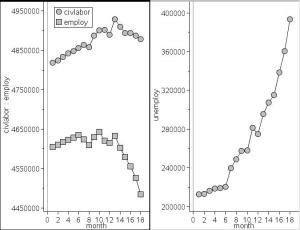 statistics in an effort to create a learning experience for Economics 8. The investigation has been captivating and invigorating, and I do not even currently teach a section of Economics 8. My PLC peers have inspired me to explore, to ask questions, and to seek for answers. Isn’t this exactly what we want for our students? What better way to build such opportunities than to participate in such opportunities ourselves.
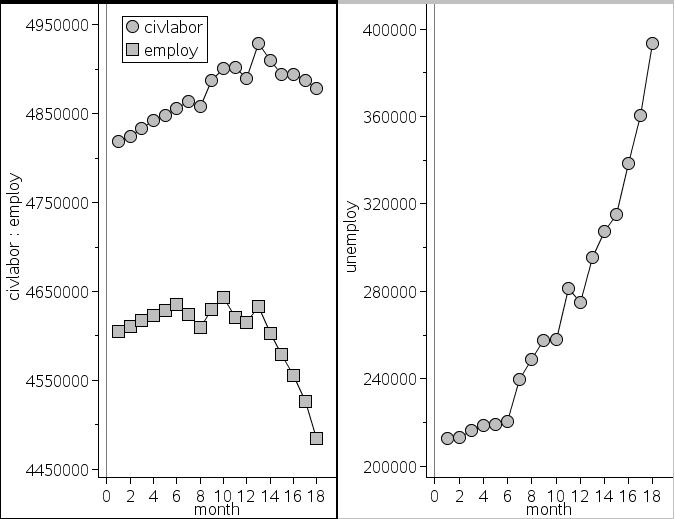 statistics in an effort to create a learning experience for Economics 8. The investigation has been captivating and invigorating, and I do not even currently teach a section of Economics 8. My PLC peers have inspired me to explore, to ask questions, and to seek for answers. Isn’t this exactly what we want for our students? What better way to build such opportunities than to participate in such opportunities ourselves.
A Quick Journal on Scope
Lately, I am thinking quite a lot about the questions of curricular scope, or content-driven curriculum. Why do so many educators feel such pressure to cover such an ambitious scope of material, say from “A to Z?” For the 21st Century, should we be looking for a different model of “coverage” that balances better deep learning with certain content knowledge acquisition? I think we should. Of course, a degree of content knowledge is arguably necessary. However, filling the head with knowledge, like filling a cup with water, is an outdated model for education. In 2009, I believe we know from the most recent brain research that our grey matter does NOT function like a vessel to be filled.
For the past two weeks, the Math-Science PLC (Professional Learning Community), of which I am a member, has been engaged in two modeling activities that involve exploring the phases of the moon and the illumination of the Earth. While the pace of learning has been slower than a delivery relying on “sage on the stage,” efficient lecture, the quality and authenticity of the learning have been rich and extraordinarily high level. By acting as a “guide on the side,” the PLC facilitator has provided a learning experience that will stick with me forever. Finally I genuinely understand the qualities of shadow and illumination for the Earth and the moon, finally I can understand the sinusoidal function that describes the data, finally I appreciate that exploration and discovery should be the driving, motivating forces in a classroom. Here’s to learning more by doing less.
 it's about learning