Recently, I have been struck by the number of people who are talking about Google’s “philosophy” of encouraging engineers to take up to 20% of their at-work time to pursue projects of their own. Here are a few of the hits produced if one Googles the topic:
According to many of the stories, some of Google’s greatest innovations have been born from this 20% time. Rather than assuming the typical hierarchy of organization would provide vision and mission to “require” a workplace of innovation, the admin and management merely provide encouragement for an attitude of “bottom-up” leadership (I hate that term and what it implies). The admin and management simply encourage the professionals to pursue personal interests and they provide time for that pursuit to happen at work. As I read the blogs and article linked above, I became intrigued by the idea of “grouplets.” Rather than individuals pursuing personal projects, engineers were banding together to work collaboratively with this 20% time.
At Westminster, in the Junior High School (JHS) in particular, we have been on a multi-year journey to restructure professional development. We are using the professional learning community (PLC) model and principles to create a new infrastructure for teachers (our “learning engineers”) having the opportunity to work collaboratively together. We have taken a bit of an aggressive approach, and we believe that job-embedded time must be created for such collaboration.
Typically, teachers carry a five-class student course load. For example, a math teacher, in the past, would have five sections of student classes. In the more recent history, we have transitioned one of those periods to be a PLC period. In essence, we have created something akin to Google’s 20% time. One of five sections, transitioned to serve as a PLC period for teacher collaboration, equates to “20% time.”
Through the PLCs, teachers are innovating! Just having a guaranteed time to discuss all of the complexities of teaching and learning is such a positive development. However, much more than discussion is happening. With these four hours per week (we have a rotating schedule and every period meets four times per week), teacher teams are re-exploring writing as thinking, formative assessment ideas, second-chance testing, four-point rubric development, technology integration, content understanding in various fields, and the list goes on.
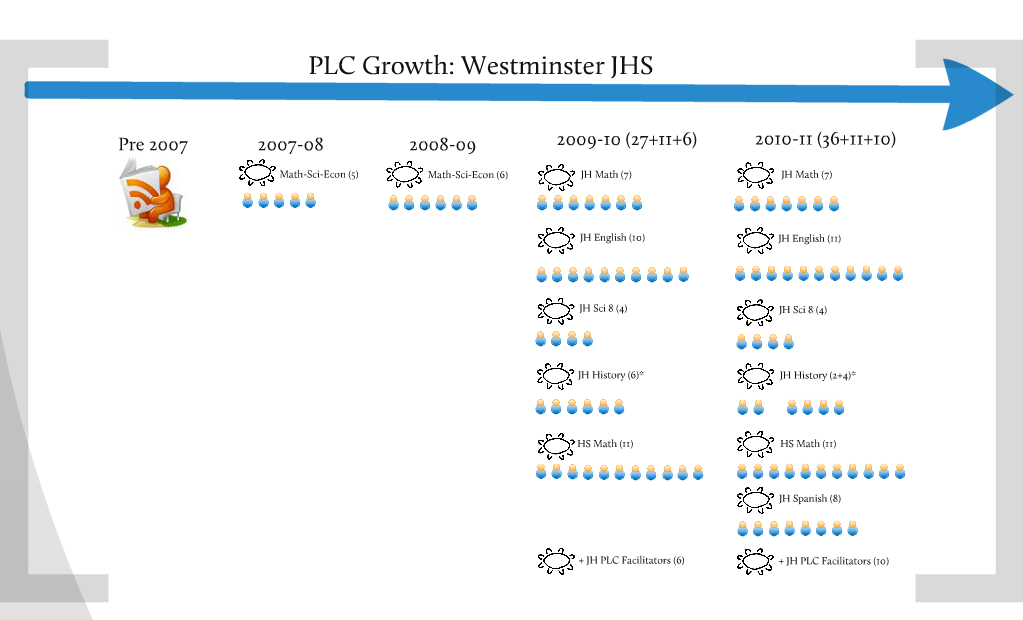
But I wonder if the 42 (of 74) teachers currently involved in formalized PLCs (we plan to work toward 100% integration for ALL teachers) see their PLC period as this Google-esque 20% time. I believe some do, for sure. But do all of them? Have I exercised my leadership in such a way that it is obvious and communicated clearly that PLC time can be for assessing student learning and creating innovations for enhancing that learning?
So many opportunities, so many possibilities! By striving to “democratize” the work day for careful study of student learning and possible educational innovations, don’t we increase the likelihood for better teaching and learning? In fact, without the 20% time in schools for the commited, motivated teachers who strive for their own continued learning and that of their students, will we really improve education, in any considerable ways, during this second decade of the 21st century?
Here’s to a New Year’s resolution for “20% time” in our schools…for the countless, dedicated teachers who simply need time to collaboratively explore, discover, innovate, and educate!
Figure 1: Formalized PLC Growth at Westminster, 2007-2011

 it's about learning