21C Learning…It’s ALL About Your Mindset! OR…What Kind of Boat Are You Building?!

Right now, I consider myself one of the most fortunate people on earth…amazing and healthy family, great health for myself and my loved ones, warm home and no worries about my next meal, exciting and purposeful job that focuses on growth of self and others, a spirituality of faith and significance in the world, a life in a country founded in freedom…and the list goes on! And for the proverbial “cherry on top,” I am serving a sabbatical to advance my work and interest on the topic of “The Future of Schools and Schools of the Future.” I imagine I am enough to make even the extreme optimists marginal. I am learning and I am growing. I am not yet the educational leader I will learn to be, but I have every advantage and the mindset I need to get there.

Since March 22, I have been in “phase II” of my sabbatical. Phase I involved a two-week internship at Unboundary, recent subject of a Huffington Post. [Search this blog for “Unboundary” to see related posts here.] Phase II is concentrated on school visits, a conference, and a few “random and invaluable” opportunities. Here is a snapshot of what phase II has involved:

  • March 22 – student-shadow visit and meeting with Laura Deisley (@Deacs84) at The Lovett School, Atlanta, GA. (a few tweets @boadams1, find date)
  • [March 22 – attended Jeff Small’s (@jeffreysmalljr) launch of novel The Breath of God.] (a few tweets @boadams1, find date)
  • [March 23 – Morris Brandon Primary, Kindergarten field trip to Yellow River Game Ranch.]
  • March 24 – sixth-grade visit to Trinity School, Atlanta, GA, and Megan Howard (@mmhoward). (a few tweets @boadams1, find date)
  • March 25 – meeting with Gever Tulley (@Gever), co-founding Brightworks, a new school, San Francisco, CA. (a few tweets @boadams1, find date)
  • March 25-28 – ASCD Annual Conference 2011 (@ASCD and #ASCD11…many tweets at this hashtag)
  • March 26 – dinner with Jill Gough (@jgough) and Grant Lichtman (soon to be on Twitter!), author of The Falconer and C.O.O. of Francis Parker School, San Diego, CA.
  • At ASCD conference, numerous informal meals and great conversations with Jill Gough, Bob Ryshke (@centerteach), and Barbara Preuss (Drew Charter School).
  • March 27 – meeting with Jill, Bob, Grant, and Bill Ferriter (@plugusin) – The Tempered Radical, Solution Tree award-winning author, and NC teacher.
  • March 27 – dinner with Jill, Bob, and Grant.
  • March 28 – Solution Tree (@solutiontree) breakfast about PLCs (professional learning communities).
  • March 29 – visit to The Bay School, San Francisco, CA. (tweets at #bayviz)
  • March 30 – meetings with Jonathan Martin (@jonathanemartin) and visit to St. Gregory School, Tucson, AZ. (tweets at #gregviz)

From all of those bullet-points – mere place-holders-in-pixels for absolutely invaluable real-life experiences – I am building a mind-map. Here is the start, and it will undergo countless changes as I reflect and synthesize…evaluate and analyze…collaborate and amplify. What is here now is only a rough beginning…a starting place.

What I am realizing already is this:

The single-most important attribute in 21st century teaching and learning is THE GROWTH MINDSET!

  1. Carol Ann Tomlinson said it directly at the ASCD conference. She talked of Dweck specifically.
  2. Heidi Hayes Jacobs alluded to it as she talked about “upgrades.” You cannot upgrade if you don’t believe in growth or fear change.
  3. Chip Heath indicated that mindset is a fundamental thread in directing the rider, motivating the elephant, and shaping the path. He talked of Dweck’s game-changing work.
  4. Peter Reynolds demonstrated the critical nature of a growth mindset as he read The Dot and Ish, and as he showed He Was Me (video below). Creativity necessitates a mindset steeped in growth orientation.
  5. Linda Darling-Hammond mentioned it by name and all but demanded it for our national education policy.
  6. John Hattie, after years of a meta-analysis of 800 meta-analyses (200,000,000 subjects) made it clear – the growth mindset is THE most influential factor in student and teacher success.
  7. My individual sessions all touched on the growth mindset in one way or another. The session on the 3rd Rail: Grading emphasized the possibility that arcane and unexamined grading practices undermine learning and promote a fixed mindset.
  8. 10,000 educators were at ASCD to learn and grow, too.
  9. Sara Lawrence-Lightfoot spoke about the third chapter of life, ages 50-75, and the need for renewed spirit aimed at growth and further development. Don’t stand still!
  10. The teachers at Lovett, Trinity, Bay, and St. Gregory who are striving to learn and grow are the teachers who are advancing the schools and earning the distinctions among the student learners.
  11. Gever Tulley is founding a school on the entire idea as represented in the philosophy and pedagogy of “learning arcs.”
  12. Grant Lichtman wrote a foundational work on the power of questioning and seeking growth as a learner and system understander of our world and thinking.
  13. Bill Ferriter promotes the connected life of Twitter and other social networking – not just to understand the iGeneration – but to share one’s resources and gain access to the resources of others for the benefit and possibility for growth and new learning.
  14. Jonathan Martin showcased Steve Johnson’s “Where Good Ideas Come From” RSA video to make the point that connectivity and coffee-housing create the opportunities for enriched thinking and enlightened growth as a collective efforts weave together for better ideas and a better world.
  15. I COULD GO ON AND ON AND ON…

And then this morning, I read a blog post of someone I met on Twitter at ASCD. I have never met the person face-to-face, but I am learning immeasurably from adding Jeff Delp (@azjd) to my Google Reader. Here is one of the quotes he chose to begin a post:

Never be afraid to do something new. Remember, amateurs built the ark; professionals built the Titanic. – Author unknown.

21st century learning…it’s ALL about your mindset. The waters of educational change are rising. What kind of boat are you building? With whom are you building it?
Tearing Down Walls

We live in an increasingly connected world. Yet barriers to connection continue to operate in schools. Kathy Boles at Harvard has described school as the egg-crate culture. With some exceptions, teaching can be an isolated and isolating profession, unless teachers and administrators work to be connected to other learners. It is far too easy to go into one’s classroom and teach…relatively alone…siloed. Classes right next door to each other, much less across a building or campus, often have no idea what is going on outside the four walls in which they are contained. And departmentalization makes for an efficient way to deliver content in neat, organized packages, but departmentalization is not the best parrot of the real, inter-connected, messy-problem world.

What can we do to step closer to modeling and experiencing real, inter-connected problem-addressing?  How do we communicate with each other when we are assigned classrooms where we can be siloed?  What could greater connectivity look like for learners of all ages?

Recently, learning partners Jill Gough and Bo Adams submitted a roughly made prototype of a three-minute video to apply for a speakers spot at TEDxSFED. It’s about “Tearing Down Walls.” It’s about experiments in learning by doing. It’s about learning.

Creativ!ty on the Ides of March

“Beware the ides of March.” In this case, though, the ides of March brought no foreboding to Julius Caesar, but a hopeful foreshadowing of “warning” about what we need more of in schools (my direct and personal  interpretation and application). And the triumvirate in this case is – openness, process, and persistence. What in tarnation am I talking about? On March 15, I enjoyed the privilege of being a TEDxAtlanta: Creativ!ty attendee! If you are not familiar with TEDx events, I encourage you to get familiar. This was my third live TEDx event, and I tune in regularly to live streams from other TEDx venues. The events at TEDxAtlanta just keep getting better and better! Here is an outline of the Tuesday’s TEDxAtlanta: Creativ!ty (with some added hyperlinks for further exploration)…

Check-In/Lunch
12:00 PM — 12:25 PM
Unboundary

Session 1
12:25 PM — 2:30 PM
TEDx: Opening Video
India.Arie & Idan Raichel: Open Door
Tod Martin: Welcome
Victoria Rowell: The Mentor
Bonnie Cramond: To the Different Ones
Michael Ouweleen: The Day I Became Funny
Sally Hogshead: How to Fascinate
Q&A with speakers

Session 2
3:00 PM — 5:00 PM
Margaret Baldwin: The Power of Dialogue
Elizabeth Turk: The Construction of Emotion
Armin Vit: Think Stupid
Viktor Venson: No Right Brain Left Behind
Q&A with speakers
Linton Hopkins: Creativity vs. Chaos

If you are a Twitter user, you can review the tweets from the event by searching the hashtag: #Creativity2011. And videos by Definition 6, capturing the speakers and their messages, will be posted to TEDxAtlanta.com ASAP. They are ALL worth the watch.

In fact, while each TEDx talk was remarkable in its own individual right, the “magic” of a TEDxAtlanta event, and I imagine the magic of other TEDx and TED events, is the interconnectedness of the talks. Magic because the talks are not coordinated in a prior fashion – beyond being of a common topic, in this case “Creativ!ty.” Throughout the day, the ideas of openness, process, and persistence echoed louder and louder for me. Many of the speakers touched on or focused on the importance of being open to ideas and diversity of perspective. What one person labels as “weird” or “strange” can just be a mis-label for creativity (see also Sir Ken Robinson’s The Element). Yet the connotations of the labels are vastly different. We need to be cautious, skeptical in fact, of placing labels on people. We are complex creatures with the potential for a rich diversity of thought and being. We should nurture that diversity of thinking and shun the human tendency to place people in boxes of “strangeness.”

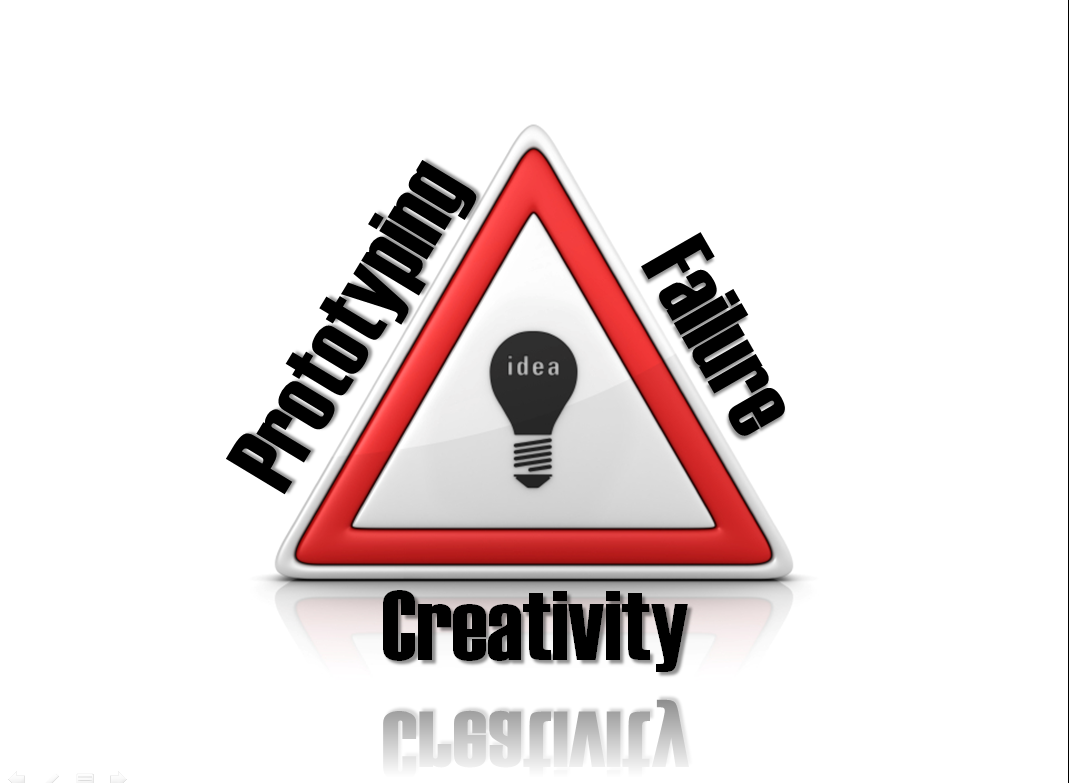
All of the speakers were woven together by the thread of process. FAILURE is expected…a good thing even. Stupid ideas should be pursued, bad jokes should be made, poor writing should fill our pages and pixels. For out of experimentation comes progress and development. Prototyping creates the opportunity for buds of ideas to become blossoms of great possibility. We have to fall down to learn to walk. We have to get bruised and scraped to learn to ride a bike. We have to talk gibberish to learn to talk. But we will learn, if we concentrate on the process of getting better…of practicing…of persisting.

Persistence is required for creativity. We are ALL creative. We were born creative. However, many of us lose sight of this fact when we let others label us as weird or strange. Others lose sight of this when we think that drawing or painting or writing is a God-given talent alone. That which we practice, we improve upon. That’s the key to creativity. Staying open to ideas and saying YES to possibility rather than NO to crazy-sounding stuff…valuing the process as the art – even more so than the finished product or results…and persisting through failure, which is simply a name for early and consistent attempts at improvement.

On Tuesday, TEDxAtlanta: Creativ!ty was a FORUM for THE GROWTH MINDSET! Want to be creative? Commit to and develop a growth mindset. That’s it in a nutshell. Like most things, creativity is about learning, much more so than about already being. It’s about learning!

A few more Mindset resources:

Riffing, Swirling, and Boarding

Had I taken my sabbatical more than four years ago, I believe that my time at Unboundary would have seemed like a journey to a foreign land. As it is now, Unboundary is very recognizable and familiar to me because of the work in which I have immersed myself regarding PLCs – professional learning communities.

In The Fifth Discipline, Peter Senge writes:

The tools and ideas presented in this book are for destroying the illusion that the world is created of separate, unrelated forces. When we give up this illusion – we can then build ‘learning organizations,’ organizations where people continually expand their capacity to create the results they truly desire, where new and expansive patterns of thinking are nurtured, where collective aspiration is set free, and where people are continually learning how to learn together.

During my first week as a sabbatical intern at Unboundary, I witnessed the power of three collaborative tools: riffing, swirling, and boarding.

  • Riffing is improvisational brainstorming. Often team members will declare that they are riffing. This seems to bring into play a set of unspoken, agreed-upon norms – these next ideas are for building more ideas, so don’t shoot them down and don’t add them to the more-concrete draft yet. Just hear me and think with me. Try to pick up a note that you can riff on, too.
  • Swirling is perspective and feedback seeking. It is asking for input and assessment. It provides evaluation from the standpoint of mixing things up so that new lenses can be applied to the thinking and creation.
  • Boarding is communal mind-mapping. Making boards literally means putting index cards up on a tack-board wall (often movable panels) in order to outline and storyboard an idea. By utilizing a board, big-picture visualization and idea connectivity is facilitated.

Watching an Unboundary team riff, swirl, and board is akin to watching a PLC. In a PLC, team members work through the four questions: 1) what should be learned, 2) how will we know if learning is happening, 3) what will we do if it has already been learned, and 4) what will we do if it is not being learned. In a PLC, this work is accomplished collaboratively through such practices as analyzing student work, establishing SMART goals and essential learnings, engaging in lesson study, and participating in instructional rounds. By working together and breaking out of the traditionally isolated way of working in schools, PLC members are able to riff, swirl, and board their ideas…all for the benefit of learning. WE are smarter than ME. Therefore, schools need to ensure time and space for teachers to work together as lead learners, rather than continuing on the path of the egg-crate culture typical of most schools.

In the 21st century, schools and other businesses – all learning organizations – must partner together to share productive and innovative techniques. We need to expand our capacities to create the results we truly desire, we need to nurture new and expansive patterns of thinking, we need to set free our collective aspirations, and we need to learn how to learn together. We need to riff, swirl, and board…together. We need to unboundary ourselves and strive for more significance…together. Imagine the thinking that school and business could do as a team. Imagine the thinkers we would facilitate in schools – thinkers who would grow into the business leaders of tomorrow. Imagine the learning that could happen!

– Senge, Peter. The Fifth Discipline: The Art and Practice of the Learning Organization. New York: Currency Doubleday. Accessed via e-copy on Amazon Kindle App for iPad.

Creativity Ponderings

Reading Jeff Small’s recent Huffington Post article, “Seeing God as the Ultimate Center of Creativity,” got me thinking a bit. Just recording some brief visual/video ponderings here…to come back to later.

JK Rowling: The fringe benefits of failure