AP, PBL, EL

As a middle school principal who does not face the direct pressures of the AP debate, I realize that I may possess a “too-simple” understanding of the discussion. However, I admire the dialogues that a few colleagues of mine are precipitating on their blogs: Quantum Progress and Experiments in Learning by Doing. Addtionally, I found the recent New York Times article on AP to be fascinating. I sent the following email to the PLC (professional learning community) facilitators at my school because I think the article illuminates two important discussions about PBL (project-based learning) and EL (essential learnings – the process of deciding “What students need to learn”).

If you have not read the NYT piece on AP, then here is link to it. I have pasted in two quotes from the article that I think are interesting in relation to the discussion about 1) PBL (project-based learning), and 2) ELs (essential learnings).
 

A committee of the National Research Council, a part of the National Academy of Sciences, called attention to these problems in 2002. It criticized A.P. science courses for cramming in too much material and failing to let students design their own lab experiments. It also said the courses had failed to keep pace with research on how people learn: instead of listening to lectures, “more real learning takes place if students spend more time going into greater depth on fewer topics, allowing them to experience problem solving, controversies and the subtleties of scholarly investigation.”

And to the delight of teachers who have gotten an early peek at the plans, the board also makes clear what will not be on the exam. Part or all of at least 20 of the 56 chapters in the A.P. biology book that Mrs. Carlson’s class uses will no longer need to be covered. (One PowerPoint slide explaining the changes notes sardonically that teachers can retire their swift marches through the “Organ of the Day.”)

Achievement-Action: #20minwms

When I logged into iGoogle this Saturday morning, I was greeted by this image:

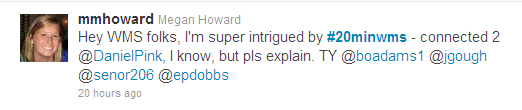
Achievement is certainly preceded by action. Yesterday, on Friday, I was inspired by the ACTION a sizeable handfull of teachers took when they embarked on the “20 minute experiment.” Explained more fully in the permalink above, Jill Gough encouraged a number of us to engage in an experiment that would synthesize: 1) some of David Souza’s brain research on primacy and recency, 2) formative assessment, and 3) tweeting as a means of forum discussion. Among several others, a ninth-grade physics teacher agreed to participate and became immediately involved. He provides a summary of how he implemented the experiment at Quantum Progress. Throughout the day, participating teachers would take a brief “commercial break” 20 minutes into class and ask students to summarize what they had learned so far. Together the class would craft a 140-character tweet to summarize their learning, and they would post to the teacher’s Twitter account with the hashtag #20minwms. As the tweets appeared, we could all see what was being learned in the participating classes. We even received a spirited and curious inquiry about what we were doing from a Director of Teaching and Learning at a neighboring school. As the day progressed, the number of involved teachers grew – a snow ball was born!

Can you imagine the potential of this process to serve as formative assessment for teachers and students? To connect the learning that occurs between and among classes? To break down the walls that exist between classes? To serve as a window into learning for parents? To archive an essence of what was happening during a day of school? To…

It is about learning, isn’t it?! It takes action, it requires some risk taking, and it certainly is fun when we do it together!

Synergy 8 Draft Thesis Statements

During this final week of the Synergy 8 pilot course, students prepared a quick piece of writing about their ONE most enduring lesson learned from the experience this semester. On Tuesday, they prepared draft thesis statements from which to prototype and revise. You can view a brief slide deck of the students’ draft thesis statements on SlideShare.

Wanted: PBL “Coffee House”

On December 14, 2010, Jonathan Martin posted a provocative piece about the Buck Institute’s Common Craft video of PBL (project-based learning): Project Based Learning for the 21st century: A Disappointing Video. Only a few readers have commented publicly on the post, and I am hoping more people get inspired to do so. I think we need a Steven-Johnson-esque “coffee house” discussion of the richness and possible limitations of PBL, including the range of project possibilities that could be brainstormed from the initial seeds spread by BIE and Jonathan Martin.

Martin points out that a mere poster project of kids sneezing in their sleeves seems inadequate as quality PBL. What if the video indicated that posters were vetted with the CDC for infectious-disease prevention considerations? What if the video suggested that the posters were further analyzed for PresentationZen-level design? What if the video detailed that the posters were distributed around the school, and the students designed experiments and research studies for tracking the incidence of illness after the posters had been posted? Could the students wrestle with the difficulties of isolating variables and determining if there was any way to measure the effectiveness of their public-service-announcement campaign? Would these additional steps create the level of complexity and richness in the video that Martin is right to advocate for?

Get in the coffee house and include your thinking. We will all benefit from exercising our leadership in this discussion by contributing to ideas that none of us could necessarily have on our own.

Better yet…take up a challenge of producing a better video…a set of videos that BIE would scramble to include on it’s fantastic website.

GOOGLE and the JHS

Recently, I have been struck by the number of people who are talking about Google’s “philosophy” of encouraging engineers to take up to 20% of their at-work time to pursue projects of their own. Here are a few of the hits produced if one Googles the topic:

According to many of the stories, some of Google’s greatest innovations have been born from this 20% time. Rather than assuming the typical hierarchy of organization would provide vision and mission to “require” a workplace of innovation, the admin and management merely provide encouragement for an attitude of “bottom-up” leadership (I hate that term and what it implies). The admin and management simply encourage the professionals to pursue personal interests and they provide time for that pursuit to happen at work. As I read the blogs and article linked above, I became intrigued by the idea of “grouplets.” Rather than individuals pursuing personal projects, engineers were banding together to work collaboratively with this 20% time.

At Westminster, in the Junior High School (JHS) in particular, we have been on a multi-year journey to restructure professional development. We are using the professional learning community (PLC) model and principles to create a new infrastructure for teachers (our “learning engineers”) having the opportunity to work collaboratively together. We have taken a bit of an aggressive approach, and we believe that job-embedded time must be created for such collaboration.

Typically, teachers carry a five-class student course load. For example, a math teacher, in the past, would have five sections of student classes. In the more recent history, we have transitioned one of those periods to be a PLC period. In essence, we have created something akin to Google’s 20% time. One of five sections, transitioned to serve as a PLC period for teacher collaboration, equates to “20% time.”

Through the PLCs, teachers are innovating! Just having a guaranteed time to discuss all of the complexities of teaching and learning is such a positive development. However, much more than discussion is happening. With these four hours per week (we have a rotating schedule and every period meets four times per week), teacher teams are re-exploring writing as thinking, formative assessment ideas, second-chance testing, four-point rubric development, technology integration, content understanding in various fields, and the list goes on.

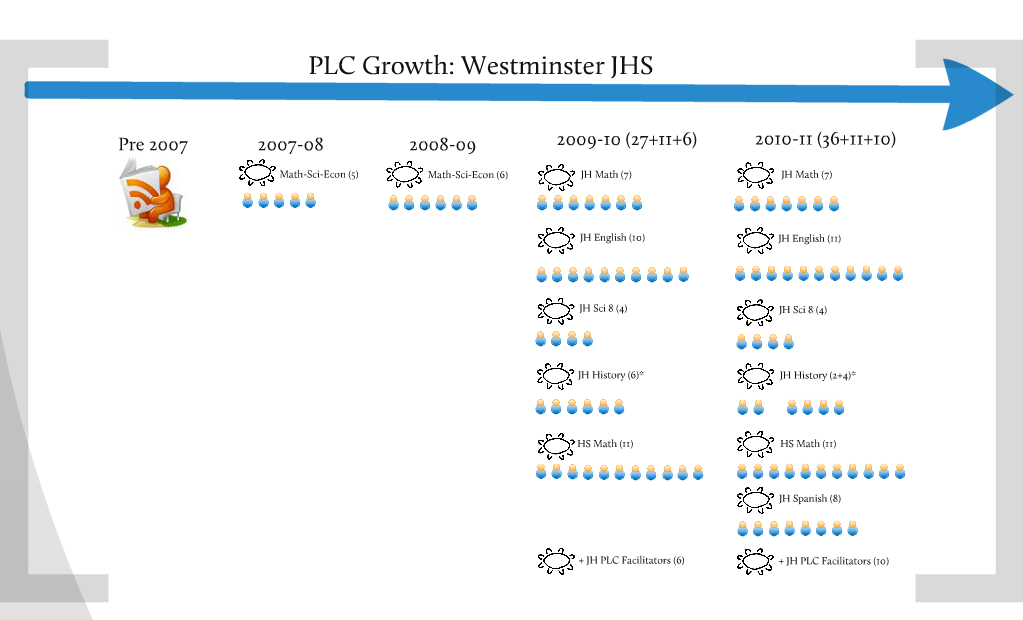
But I wonder if the 42 (of 74) teachers currently involved in formalized PLCs (we plan to work toward 100% integration for ALL teachers) see their PLC period as this Google-esque 20% time. I believe some do, for sure. But do all of them? Have I exercised my leadership in such a way that it is obvious and communicated clearly that PLC time can be for assessing student learning and creating innovations for enhancing that learning?

So many opportunities, so many possibilities! By striving to “democratize” the work day for careful study of student learning and possible educational innovations, don’t we increase the likelihood for better teaching and learning? In fact, without the 20% time in schools for the commited, motivated teachers who strive for their own continued learning and that of their students, will we really improve education, in any considerable ways, during this second decade of the 21st century?

Here’s to a New Year’s resolution for “20% time” in our schools…for the countless, dedicated teachers who simply need time to collaboratively explore, discover, innovate, and educate!

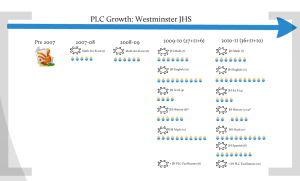
Figure 1: Formalized PLC Growth at Westminster, 2007-2011