Readicide, Springboards, and PBL

Thanks to the Westminster English Department and chair Bart Griffith, Kelly Gallagher’s Readicide was on my summer reading list. The short, compact read is full of summarized research and practical advice about how to end readicide in schools and to promote more engaged joy with reading for a lifetime. In addition to describing teaching in a “sweet spot” – neither under-teaching nor over-teaching – Gallagher provides a monumental “duh” (one of those grand aha moments!) for me in chapter three:

“In my first book, Reading Reasons (Gallagher 2003), I discuss the work of philosopher Kenneth Burke, who says the reason young people should read books is that it provides them with ‘imaginative rehearsals’ for the real world. When children read books, Burke argues, they are not just reading stories. They are being given an opportunity to understand the complex world they live in (1968). Books enable adolescents to begin wrestling with those issues that remain universal in all our lives” (66).

Later, Gallagher states that “The value comes when we use this great book as a springboard to examine issues in today’s world” (67).

With the examples that Gallagher provides, he is not merely advocating for in-class, passive imaginative rehearsal. Rather he is advocating and advancing the practice of student learners interacting ACTIVELY with their current world as citizens who are springboarding into issues through great literature and the guidance of a lead learner (teacher).

For teachers getting more comfortable or even more deeply immersed in PBL (project/problem-based learning), I believe this advice and advocacy from Gallagher provides the ideal bridge from a long-taught classic to authentic, “do-something-real-in-the-community” PBL. Gallagher gives a number of examples that would apply directly where I teach, as the books named are novels that we include in our school canon. Additionally, such books and the issues they raise could provide the threads and links that tie together curricula for integrated studies.

A great reminder about RELEVANCY…thanks Kelly Gallagher!

Gallagher, Kelly. Readicide: How Schools Are Killing Reading and What You Can Do About It. Stenhouse Publishers, Portland, Maine: 2009.
#Learnopolis and INMAX

Today, Westminster is hosting INMAX – a Benchmark Research membership group of large, independent schools in the U.S. The topic of focus is leadership and innovation, and the agenda appears quite intriguing as a whole.

At 11:30 a.m., Jill Gough (@jgough) and I (@boadams1) will be sharing a story about tearing down walls and connecting dots. We will be sharing the story of our school’s multi-year journey to become a PLC – a professional learning community. The official title of our session is “Learnopolis: Tearing Down Walls with PLC.” We plan to use the Twitter hashtag #learnopolis for tweeters, and a PDF of our slide deck is embedded below (the iMovie in slide #9 is inserted below, too, as a YouTube video).

In short, we are trying to communicate the following:

  • “School” hasn’t changed very much in the last century – maybe longer. [We need to adapt and evolve!]
  • Schools exist in a bit of an “egg-crate culture” (Kathy Boles), as we have generally organized with individual teachers and rows and columns of students. For the most part, teachers are relatively isolated as professionals.
  • In the 21st c., we can capitalize on the notion of social networks by rethinking and rebuilding the critical infrastructure of schools – the human infrastructure. [New basic building block should be learning teams.]
  • While we cannot rebuild the physical plant, we can rebuild the way we work within the physical plant. We can build a learnopolis!
  • By shifting our central paradigm from “teaching” to “learning,” and by providing regular, job-embedded, structured time for teachers to collaborate, we can build the schools that 21st c. learners desire and deserve.

We are looking forward to learning together with our colleague schools at INMAX today! And we are looking forward to building a learnopolis! After all…it’s about learning!

Temporary Move to Posterous

For a few weeks, I will be blogging more through my Posterous blog (and relatively less here). It feels a bit more mobile, and it’s quicker when using email over 3G to post (at least with what I have learned so far). If you are reading this from a browser pointed to It’s About Learning, a link to my Posterous can be found on the right column. The direct URL is http://boadams1.posterous.com/. When I post to Posterous, the post is auto-tweeted. This morning, I began this little blog experiment with a post about ski school and PBL.

#PBLCFT11, Lifelong Learning, and a Movie Trailer

Many schools have a line in their mission statements about “lifelong learning.” Without a doubt, lifelong learning is critical…absolutely invaluable. But do we really mean it? Are our schools structured to facilitate genuine lifelong learning – the way learning tends to look throughout most of life? Or are most, if not all, human beings just powerful, resilient learners who interact with their environments and adapt to the needs and demands of the situations we encounter – school, as well as the life that bookends school? Do schools model the patterns of real-life, lifelong learning? Or do schools model more of the efficiency standards of the industrial revolution?

Today, in the Center for Teaching Summer Institute, “PBL: Let’s Build Something Together,” we spent a bit of time discussing this notion of lifelong learning. (In the 5 hours of sessions today, we touched on it directly for just a few minutes…but it caught my attention.) Most agreed that lifelong learning tends to take the form of projects to engage and problems to solve.

As children and as adults, other than in the formal setting of school, does your learning tend to resemble sitting for lecture, taking notes, and testing on that recently acquired knowledge? Or does your learning tend to resemble messy, troublesome, challenging-to-decipher issues that grab your curiosity and demand your attention from multiple perspectives? Does lifelong assessment tend to look like standardized, bubble-in examination? Or does lifelong assessment tend to look more like performances and presentations made to interested audiences and decision makers? Does lifelong learning require isolated attempts – attempts where we are required to work alone? Or does lifelong learning require making connections, building on relationships, collaborating, and enlisting the help and support of others? Does lifelong learning insist on getting things right the “first time?” Or does lifelong learning accept the notion of prototyping based on the reality of “ready-fire-aim” tactics, as we learn from failures and make new, more-informed re-attempts? As one team member said today, “Is learning more about covering material, or is it more about uncovering developing understanding?”

I had a great day working with the fifteen, Atlanta-area educators who gathered to take on “PBL: Let’s Build Something Together.” (Tweets from the day are grouped and searchable by #pblcft11.) In a nut shell, we spent the vast majority of our day-one time in divergent brainstorming – generating a rich pool of potential projects for PBL. The exercises and methods we used seemed to mimic the way that most lifelong learning has occurred to me – engaging complex, challenging issues that don’t have answers that can be found on GOOGLE…muddling through complicated problems that demand collective thinking from people who are committed to collaboratively making hypotheses and testing what works and what doesn’t…accepting that success requires a great deal of trial and error and cognitive meandering.

Tomorrow, on day 2, we will concentrate on emergent and convergent thinking, as we narrow our focus onto one or two projects for which we will formulate framework plans…plans that we can use as a skeleton for putting more flesh on the bones during the upcoming school year. Ultimately, we will implement our team-designed project. We will learn so much more about PBL by actually DOING PBL. As you might expect, I am very excited about the possibilities!

PBL: Let’s Build Something Together

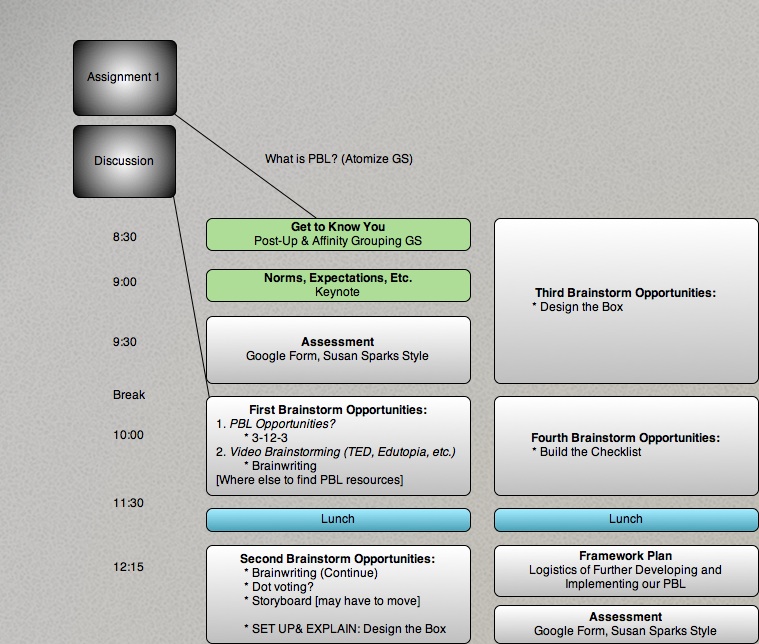
As I write this, it’s early Sunday morning. Tomorrow, on Monday, June 13, Jill Gough and I will begin Day 1 of co-facilitating “PBL: Let’s Build Something Together.” This course is a two-day (10 hour, 1PLU) summer institute through the Center for Teaching at the Westminster Schools. We have about 15 educators coming from 4-5 different Atlanta area schools. Primarily, our essential learnings – our fundamental desired outcomes – number “just” two objectives:

  1. I can brainstorm various possibilities for PBL (project-based learning).
  2. I can create framework plans for various PBL.
Here’s our Curio7 mindmap of how we are structuring the ten hours:
Whereas some people attend conferences, institutes, and workshops expecting a considerable amount of “sit-n-get” knowledge transfer, our participants will be sorely disappointed if they are wanting that typical educational conference experience. Jill and I know we will not “finish” what we are setting out to do. Monday and Tuesday will be mere beginnings.
.
You see…we really want to build something together. If we actually accomplish our essential learnings, these 15 Atlanta educators will leave committed to enacting and implementing a PBL-project in the first semester of 2011-12. We are going to learn PBL by doing PBL. Our project: build a multi-school PBL to try in the fall. So, potentially, we could have 4-5 schools putting a PBL idea into practice with students.
.
Imagine the possibilities there! We could continue to develop the project as a virtual lesson study. We could engage in instructional rounds and visit each other’s schools to observe how the project is implemented at each place.
.
Last week, at a learning opportunity at Trinity School, @gcouros challenged us all to think of ourselves as school people and lead learners. He asked us to think bigger than just our own individual classrooms. Shouldn’t we do the same for school vs schools?! Imagine what we can learn together.
.
I love being excited about something which is about to begin!