Preface
“Birds of a feather flock together.” How is it that various flocks of birds fly together in non-linear formation? How exactly do they communicate with each other to cut and cross paths in synchronized patterns? Is there a captain or a conductor or a coordinator? Do zigzagging birds rotate those roles of captain, conductor, or coordinator, like geese flying in a more linear V alternate as leads and followers? What exactly provides the connective tissue that molds together the mass of modulated majesty?
How could we “school people” learn to mimic the great flocks of birds that swarm together in tight, rhythmic formation? Biomimicry may be the way of the future, especially if we hope to innovate in the sustainable manner in which natural organisms innovate in response to their surrounding, environmental changes. In schools, we would do well to investigate and study the lines of flight that reveal a more organic pattern of collaborative learning.
Chapter 1 – Lines of Flight
Mary Ann Reilly, with her blog Between the By-Road and the Main Road, has me thinking a lot about birds. More specifically, Reilly has me contemplating lines of flight. In her post entitled “Reimagining Learning as Lines of Flight,” Reilly cites several definitions – better thought of here as contemplations or meanderings – for the term “lines of flight.”
Martin Wood and Sally Brown (2009) write: “A line of flight is essentially a movement of creativity, a practical act or a way of living that wards off or inhibits the formation of ‘centres’ and stable powers in favor of continuous variation and free action.” from here (Reilly, “Reimagining Learning as Lines of Flight,” n. pag.)
Then, Reilly switches to a second meandering and explains with a humongous string of comma-connected items that a line of flight is something like a tracer as “learners traverse and abandon, producing maps of their learning as they move.” (Reilly, “Reimagining Learning as Lines of Flight,” n. pag.) Certainly because of Reilly’s magnificent images that accompany her text, I am able to imagine more accurately the hypothetically traced path of a flying bird – serving as metaphor for the complex flight pattern of our typical, non-linear learning. I can see the hatch-work of tangled mess that really is no mess at all. In the section #6 of this post – “Reimagining Learning as Lines of Flight” – Reilly provides Maria Tamboukou’s diagram of “nomadic trajectories,” which further support the visualization of a line of flight for some winged creature such as a darting starling or meandering martin or frenetic finch – analogously representing the lines of flight we humans take as we move through a day, a week, and a month of interconnected, “messy” thinking and learning. What a gloriously beautiful tangle those lines of flight can be.
Then, in a follow-up post entitled “Exploring Lines of Flight at School (and Not),” Reilly states, “Lines of flight represent the creative impulses we compose while thinking and doing that offer a seemingly novel way to disrupt concepts cast as dualities.” (Reilly, “Exploring Lines of Flight at School (and Not),” n. pag.) Lines later, Reilly poses some traversal questions – the kind of inquiries that make you cross back in your thinking multiple times…the kind that create complex lines of flight:
- How do we attend to the creative impulses of learners that occur outside the domain of the school and challenge binary ways of knowing—ways we might well be situating as truth?
- What types of environmental and pedagogical considerations might be necessary in order to leverage/cull/come to know such thinking?
- How might we ‘carefully’ come to know and invite in (if possible) these lines of flight within the classroom and/or the ‘sanctioned’ learning?
- How often do we stop and acknowledge how little we know about our learners’ learning lives beyond our purview?
- How might lines of flight de/colonize classrooms?
- How do lines of flight engender inquiry as opposed to categorization?
- All knowing is constructed. How do lines of flight offer us a method to reduce our binary ways of knowing that may overpopulate a classroom?
Because of the visual organization of Reilly’s blog, these stirring questions seem almost to grow – to rise in flight – out of a foundational image produced by Reilly, and the image captures the real essence of our foolishness that learning is in any way bound by the four walls of a classroom – proverbial or real. If we are not mindful, our classroom thinking can trend toward thinking inside a box – literally and figuratively – as we categorize thinking into neatly bundled packages called math, science, English, and history. But are we really doing all we can to catalyze genuine inquiry in our young learners that we label as students? Are we encouraging the zigzags of natural lines of flight – the biomimicked version of a bird on the wind? Do we nourish questioning and integrate outside-of-class thinking, or do we squelch such because we have so much to cover in 180 days?
Clearly, Justin Tarte’s line of flight is intersecting Reilly’s line of flight. In his “What do you see…?” post from November 20, among other postulates of zigzagginess, Tarte questions:
If you are assigning work to be completed outside of school, do you see the other time commitments and constraints your students may have or do you see homework as more important than family and/or interests and hobbies? If you discover that a student is passionate about something that is not related to your content, do you see it as an opportunity to connect and relate your content to his/her passion or do you see his/her passion as something that is getting in the way of his/her learning? (Tarte, n. pag.)
What wonder might emerge if we school people acted more as travel agents or air traffic controllers who coordinated various trips and travels than if we kept the planes in the hangers of our cordoned-off sections of tarmacked airports?
[Ah, my own line of flight has taken me askew. And I am mixing metaphors as I am learning what I think by watching what I write. But now I am zigzagged back across a previous tracer line…]
Throughout Reilly’s posts, though, I tended to picture a single, solitary bird flying in zigzagged lines of flight, following such a tracer path as that white lightening bolt included in the foundational image emblazoned in Reilly’s “Exploring Lines of Flight at School (and Not).” But I am more interested in FLOCKS of birds – how hundreds and thousands of birds can fly together in synchronized patterning…like those starlings on Otmoor in the YouTube video that opened this post.
Holds those thoughts for a moment. I promise to return to them, but I must tell another story…such is my zigzagging line of flight.
Chapter 2 – Innovation Strategist as Orchestra Director or Offensive Coordinator
Recently, on one of his lines of flight, Jonathan Martin (@jonathanemartin) was kind enough to tweet about a blog post that I wrote a few weeks back – “May seem roundabout, but it’s an exhilarating intersection.” Jonathan forwarded my notion that we need R&D Director of Innovation positions inside schools. A follower of Jonathan’s, @mrsdurkinmuses, agreed but argued that each of us should have that role already. Then, their dialogue of tweets turned down a path of funding contemplations. Perhaps that is where their lines of flight took them. [If you are not familiar with Twitter, the following conversation exists in reverse chronological order.]
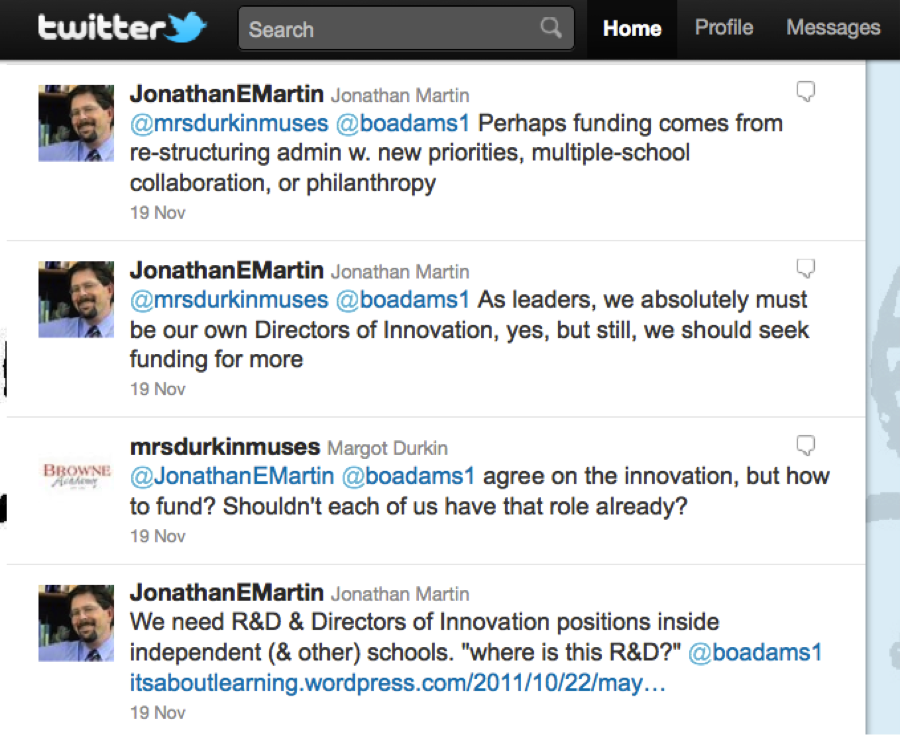
Upon much reflection, I absolutely agree that all school leaders should willingly and enthusiastically be taking on the mantle of innovator. However, from working with a division full of innovators for the past several years, I see that we can all be like those lone starlings, martins, or finches. Even with care taken towards collaborative work habits, we school people can tend to return to our classrooms and fly our own individual flight patterns – our silo-ed lines of flight. Occasionally we might intersect; in fact, we are likely to intersect. But these intersections are often chance encounters facilitated by serendipity and chance more than by planning and intent.

What if we flew as a flock? What if we became more birds of a feather? What if schools of the future steered more purposefully toward the future of schools by coordinating the lines of innovative flight? I do not mean to create irony here. I am not calling for standardization of practice, and I am not meaning to disqualify that “continuous variation and free action” that Wood and Brown defined as the creative movement of a line of flight. However, I am wondering what we school people might be able to accomplish by way of navigating more as a flock, moving in a mass of modulated majesty. Yes, we should all play our own instruments or positions, but how are we coordinating and strategizing our play?
Would an orchestra be able to create its majestic music without the swirlings of a director or conductor? Would the music sound as melodic or sweet? Would a football team be able to function as a coordinated whole, composed of unequal parts linemen, running backs, wide receivers, and quarterback, without the expert coaching from an offensive coordinator? Would the game be as purposefully exciting? Who serves in the comparable role for a school? Who weaves together the complex lines of flight of the creative masters of education – the teachers – while employing a determined focus to research and development…along a roadmap of intentional travel? Is it the school head? Is it the principal? Is it the curriculum coordinator? The department chairs? The superintendent? Can the people mantled with those titles and responsibilities devote enough majority attention to R&D and strategic, systemic innovation?
Much is being written about innovation. To name but a few:
- The Innovator’s Cookbook, by Steven Johnson
- The Innovator’s DNA, by Jeff Dyer, Hal Gregersen, and Clayton Christensen
- The Innovator’s Dilemma, by Clayton Christensen
But, in each case, notice where that apostrophe accents. That precise punctuation calls attention to the singular possessive. What if we moved that apostrophe to the outside of the letter S, and what if we forced the plural possessive? Has the book been written that tells us of how we might fly as a flock by embracing and empowering the innovators’ conductor? The innovators’ coordinator? The innovators’ connector? The innovators’ director or strategist?
In summarizing and translating Dyer, Gregersen, and Christensen with his recent post “18 Tips for Becoming Better Educational Innovation Leaders: Advice from Christensen’s Innovator’s DNA,” Jonathan Martin’s list may be the closest current thing to such a book that deals with possible macro-lines of flight for inspiring and facilitating the innovative efforts for flocks of progressive educators. Bill Ferriter also comes close to providing some serious “book chapters,” too, in his Tempered Radical posts:
- “Are YOU Intentionally Creating a TED in Your Head?”
- “Innovation Interview Questions”
- “Just How Much DOES the Composition of a Professional Learning Team Matter?”
- “More on Teaching Innovation with the Curiosity Box”
However, both of my very respected colleagues, Martin and Ferriter, may still remain as in-satiated and still-curious as I am about how to actually serve as an orchestra-like conductor or an offensive-like coordinator for directing and coaching a mass of modulated majesty of ENTIRE SCHOOLS acting as FLOCKS in such synchronized innovation. Is it enough to inspire and motivate a school-full of innovating teachers and staff? Most certainly, to inspire and motivate such is a fabulous and necessary start. But it is my experience that these innovations often remain segregated by walls that separate math class from science class, as well as by those that separate English class from history class.
Like the sound waves that blend in the airspace surrounding an orchestra playing a symphony, and like the commentated, chalk-line routes that define a football team working in offensive harmony, how do we blend and harmonize the departmentalized learning that is occurring in most disciplined classrooms of specific, segregated subject matter? Schools of the future must assuredly be tearing down walls that prevent such blending and harmonizing. And when we do, we must work as educational leaders to ensure that the resulting sounds, coming from previously impermeable containers, combine in reinforcing frequencies rather than in cancelling frequencies or noisy cacophonies. We need to work to make beautiful music.
I’d like to schedule a trip to that whole-school destination! I would like to trace that line of flight! How do all of those starlings on Otmoor know to turn, gee, and haw together?! How do they conduct their coordinated flight? How do they mold into that mass of modulated majesty? How might we “school people” develop that biomimicked synergy?
On to fly…in the zeal of zigzags…as a member of the flock, not alone.
Chapter 3 – Murmurations of Symphonic Innovation
[Coming soon…as my line of flight takes me there with my flock.]
WORKS CITED
Reilly, Mary Ann. “Exploring Lines of Flight at School (and Not)” (http://maryannreilly.blogspot.com/2011/11/exploring-lines-of-flight.html). Between the By-Road and the Main Road. Nov. 22, 2011. Google Reader via Feeddler.
Reilly, Mary Ann. “Reimagining Learning as Lines of Flight” (http://maryannreilly.blogspot.com/2011/11/reimagining-learning-as-lines-of-flight.html). Between the By-Road and the Main Road. Nov. 18, 2011. Google Reader via Feeddler.
Tarte, Justin. “What do you see…?” (http://www.connectedprincipals.com/archives/4917). Connected Principals. Nov. 20, 2011. Google Reader via Feeddler.

 it's about learning