At Mount Vernon, we are advancing our design thinking work in many ways. Most recently, we are expanding our Maker and Media Programs and building our Design and Engineering Programs. So that MVIFI and I can be strong supporters of this work, and because I am just genuinely fascinated, I am currently taking the Art of Tinkering MOOC from the Exploratorium via Coursera.
In order to capture some of my playing and learning (possibly redundant) with tinkering and making, I am establishing a new category on my blog – “tinkering journal.” And this is the first post in this category. On the Coursera site, there are great places to post and journal, but I decided to originate my posts here and paste the URLs to my course on Coursera. So, these journal entries are really for me and my reflective practice, but you are welcome to read along – if you do, I hope you find something intriguing and that you start your own tinkering.
Week 2 – Circuit Boards
WEEKLY ACTIVITY AND SHARING: Please gather materials and try making a few circuit boards of your own, using the Activity Guide [link removed] for reference. Write about your experience playing around with the circuit boards and post your photos in the Week Two Activity forum [link removed]. Don’t be afraid to show us your failures as well as your successes! If you use social media, be sure to tag your photos#tinkeringmooc so they show up on our social media wall!
Creating the circuit boards was a blast. In #fsbl mode, Phillip and I constructed the circuit boards together. Previously we had played with the battery pack, light bulb, switch, alligator clips, etc. when they were loose and “unboarded,” but they were challenging to manage and wire together when the components were loose. Once mounted on the boards, with the nail-post terminals, the play was much more fun. We could concentrate on the experiments and outcomes from our tinkering, and we could spend less time just manipulating the parts into connection.
This slideshow requires JavaScript.
Through the tinkering play, I loved listening to Phillip and me as we thought out loud about what we were constructing and experimenting to explore electricity. Even though we turn on lights all the time in our house or with a flashlight, there was something almost magical about connecting that little lightbulb to the batteries and seeing it illuminate. Despite its simplicity, we were proud of our work. The high five proved it.
Next, we worked to install a switch in the line. I took my turn first and used four wires (I think). The light turned on with the switch open, which Phillip and I were not expecting. Our eye-brow-raised, immediate eye lock proved it. Immediately, Phillip wondered aloud what could be causing that. He made a hypothesis, and we traced the circuit with our fingers (a technique recommended by the Exploratorium course teachers). Even though this outcomes was not what we were building for or expecting, we did not feel at all like failures. We had explored and discovered something, and we were even more determined to wire the system so a closed switch would turn on the light. After conjecturing about having an extra wire, we reduced the wires to three and lit the bulb with a closed switch! More high fiving commenced!
When Anne-Brown came down to the basement to check on us, she couldn’t help herself. She had to start wiring and playing, too. Such is the way it is with tinkering. It’s highly contagious and draws people in.
REFLECTION QUESTION: After trying out the Circuit Boards activity (or watching the videos if you couldn’t try it), how has your thinking been impacted? Some aspects to consider: your understanding of circuits, the process of investigation, and your role as learner and/or teacher. Please contribute your thoughts to the Week Two forum [link removed]!
Through the circuit board activity, I definitely grew to understand circuits better. While this may shock and surprise my father-in-law, who helped me finish a house basement – including the electrical – I grew in truly understanding how the elements in a series could contribute to different outcomes with the bulb and sound device. Keeping the wires visible and using different colored alligator clips made for easy tracing and thinking about what wires were doing what in the circuits. Following the advice of the Exploratorium faculty, tracing the wires when an exploration was successful or unsuccessful really helped to conceptualize the actual electron flow through the system.
The process of investigation was fun and intriguing, and I think the experience was more fun with Phillip as a partner. We got to play together and hypothesize together and discover together. I was mesmerized with how much more quickly he seemed to “get” the electron flow tracing than I did. I would often sit and ponder still, even after Phillip was dismantling the current wiring and explaining what we needed to do next to “fix” our reasoning.
Phillip and I regularly, seamlessly, and continuously switched roles of “student” and “teacher,” and we were constantly in co-learner mode. I did try to model the questioning and facilitation techniques recommended by the Exploratorium facilitators. Simple questions like, “What do you think is going to happen when we wire it like that? What makes you think that? Can you trace the circuit wires with your finger and talk through what you think is happening?” were extraordinarily expanding to our activity and perceptual understanding.
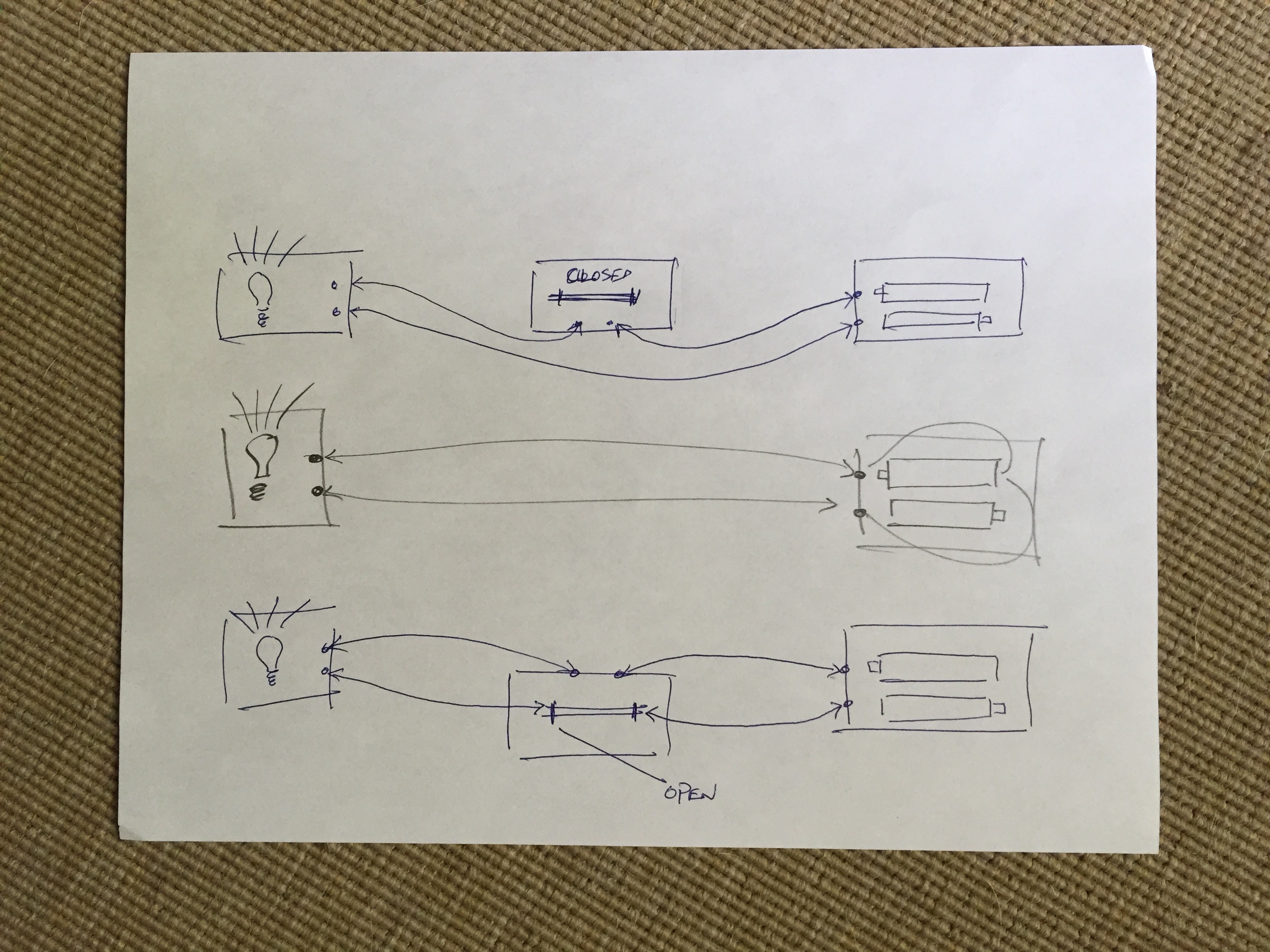
TINKERING JOURNAL PROMPT: Make a drawing of a circuit (or two) that worked when you connected it. Make a drawing (or two) of a circuit that didn’t work when connected. What did it take for you to become more comfortable exploring circuits in this way? How much time did it take? What contributed your “aha” moments, or frustrations?
Below are a few sketches of the circuit explorations described above. Because we are both already tinkerers and attend a school that supports and promotes the principle that “curiosity and passion drive learning,” Phillip and I were very comfortable exploring circuits in this way. However, we did both feel a sense of “we want to make this work.” As we played more, I would say this changed into “Let’s see what all we can make work.” It took us about ninety minutes to make the boards and play. And it seemed like about ten minutes had gone by when we were done for the day.
Circuit sketches
After making circuits that weekend, I went to school on Monday, and I played again with the circuit boards with T.J. and Meghan. T.J. is our Director of Design and Engineering Programs, and Meghan is our Director of Innovation Diploma. T.J. is who connected me with this MOOC and set me up with the circuit materials. As T.J. built more boards, Meghan played with different configurations of the circuit boards that had already been built. It was so fun to watch her experiment, especially after I had figured out some “mysteries” over the weekend with Phillip. I think I did a pretty good job of biting my tongue and letting her explore without my newfound knowledge getting in her exploratory way. I did take advantage of having someone on which to practice further my recommended facilitation skills. Most help, I think the circuit tracing and thinking aloud really helps.
As I walked to the Founders Campus, I got a text from Meghan. “I did it!,” she proclaimed. She wanted to figure out how to light multiple lights and a small motor, and she was so excited with her discovery and success that she had to let me know. I think this excitement that people feel when making a victory in tinkering is such a compelling part of this methodology and opportunity to learn by doing.
This slideshow requires JavaScript.

 it's about learning