If you are a student, educator, parent, or other-labeled learner, then do you ever wonder about this acronym “PBL?” In my daily work, I hear people ask such questions as, “Does it stand for ‘project-based learning’ or ‘problem-based learning?'” I hear others respond, “I thought it stood for ‘place-based learning.'” Still others ask, “Is PBL the same thing as CBL (Challenge-Based Learning) or DBL (Design-Based Learning)?” And a host of others curiously wonders, “Isn’t PBL just inquiry-driven instruction?” I hear some 30-year veterans declare that they’ve been doing PBL forever, and I work with master educators of various career stages that puzzle and struggle with the complexities of PBL…wondering if they’ll ever be able to “do PBL.”
I may spend the better part of a full-life career in education contemplating and practicing PBL. Personally and professionally, I find PBL fascinating and a critical component to all this talk about 21st century teaching and learning, as well as to school transformation. For me, I can think of at least a few major waypoints on my path of better understanding the depth and breadth of PBL.
- Becoming a middle-school principal and realizing that all of my real-world work, all day long, is project-based…and that I am supposed to prepare students for life in the “real world.”
- Serving in a sabbatical that was largely geared to understand more of how the “real-world” works in projects.
- Watching my two sons, currently ages 7 and 4, emerge in the world as master learners…simply because they are humans. Realizing in a “duh” moment, that has lasted for years, that their learning is primarily project-based…or passion-based…or problem-based…or place-based. And starting #FSBL (Father-Son Based Learning) as a Twitter hashtag to chronicle some of how my sons and I explore and discover in order to learn stuff that fascinates us!
- Reading, studying, and immersing myself in the book The Falconer, by Grant Lichtman (who is now an invaluable colleague).
- Participating in the TEDxAtlanta community and forging a relationship with Gever Tully, now of The Brightworks School.
- Undertaking a multiyear project to operationalize my research in 21st century learning – and to enact a Falconer-type class – by creating and co-facilitating a course known as Synergy (community-issues problem solving, transdisciplinary, non-graded but heavily assessed).
- Connecting with Jonathan Martin, currently at St. Gregory School – especially over a blog-based discussion about PBL (examples here and here).
And, in the last month, I may just have added another significant waypoint on my path to understand better the depth and breadth of PBL. In September 2010, I read an article in Educational Leadership, but I have only recently returned to the article to study it intensely – because my team of PLC (Professional Learning Community) facilitators is using the article to support the creation of a lesson study devoted to PBL.
“7 Essentials for Project-Based Learning,” John Larmer and John R. Mergendoller, Educational Leadership, September 2010, Vol. 68 No. 1, http://www.ascd.org.
For over a year, I have been thinking about the spectrum which is PBL. For PBL is not a monolithic construct, nor a dichotomous light switch. PBL is a spectrum, and I think of the spectrum as ranging from lowercase “pbl” to uppercase “PBL.” Well, what in the world causes a learning experience to move along the spectrum from lowercase pbl to uppercase PBL? I think a number of factors contribute to this spectrum location and dynamic. Two such factors are: 1) degree of focus on a community issue, and 2) connection to an authentic audience. [In future blog posts, I may discuss a number of the other contributing factors.]
Students might replicate the kinds of tasks done by professionals—but even better, they might create real products that people outside school use. (from “7 Essentials for Project-Based Learning”)
And…
Schoolwork is more meaningful when it’s not done only for the teacher or the test. When students present their work to a real audience, they care more about its quality. (from “7 Essentials for Project-Based Learning”)
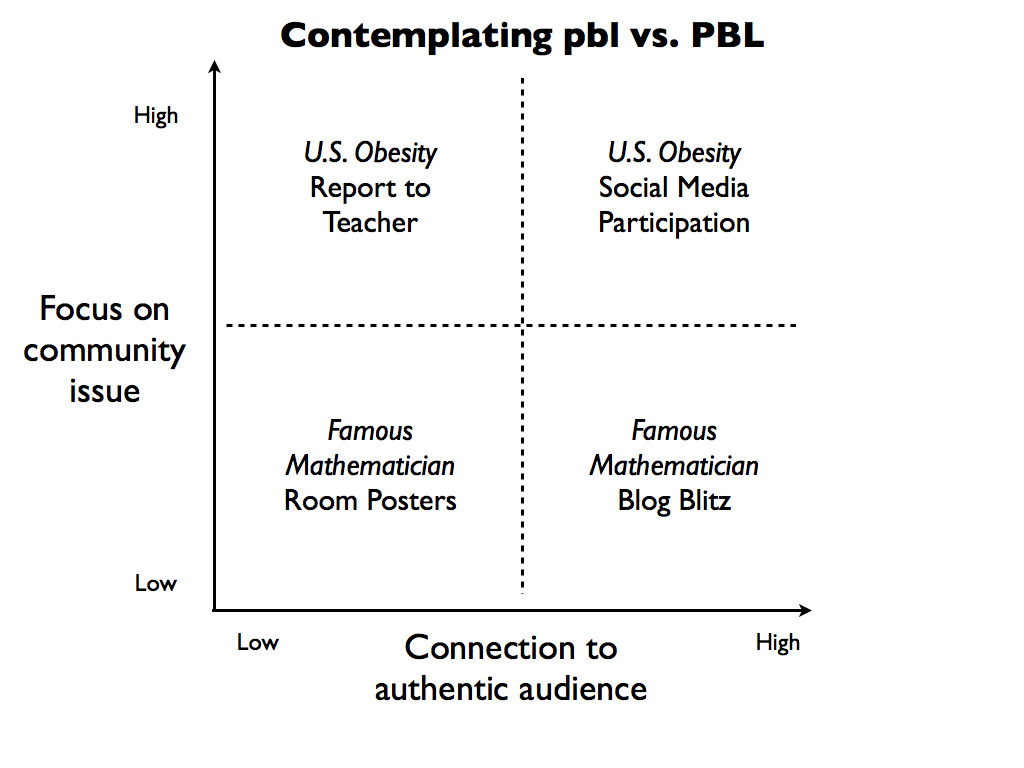 In my opinion, there are sound reasons why teachers and schools should pursue projects all along this spectrum. There are appropriate times for operating in the lower left quadrant, as well as appropriate times for operating in the upper right quadrant. But the more we work in the upper right quadrant, the more that we uppercase and capitalize the PBL. Ultimately, if education and learning are about making a positive difference in this world, then perhaps we are all striving to engage in more work at the upper right quadrant.
What do you think?
[That’s all the time I have to write this morning, and I want to publish this post 24 hours prior to our PLC-Facilitator meeting on Thursday morning, so, like most things, this is a work in progress!]
What’s Coming Up on It’s About Learning? How I use observation journaling to discover and ideate about possible PBL opportunities… Stay tuned!

 it's about learning