Updated: Quick resource pack for #NYSAISnow #NYSAISahdh

What you’ll find here, in this post, is a quick resource pack for the fun work that @GrantLichtman and I were fortunate to do with NYSAIS – the New York State Association of Independent Schools. We were at Mohonk Mountain House for the annual Assistant Heads and Division Heads conference, and the group of educational leaders focused on Time, Space, and Curriculum in educational transformation and innovative schooling.

  • Bo & Grant’s facilitator scratchpad and switchboard (Google doc with intended learning arc and links to resources and slidedecks).
  • Jim Tiffin’s (@JimTiffinJr) Storify – in three parts – archiving some of the pre-conference buzz, ideas from the keynote address on Wednesday night, sessions on Thursday and Friday, etc. In the keynote, Grant and I focused on “priming the pump” for how schools can utilize and amplify human curiosity and lessons of innovation to (r)evolutionize time, space, and curriculum use in schools. Thursday and Friday, we dove deeper into those ideas with workshop formats and facilitation.
  • Jim Tiffin’s visual notes from the keynote Wednesday night. THANKS, Jim!
  • And Grant “signed me up” for an impromptu Twitter meet-up lesson at 2:45-ish on Thursday! Love that NYSAIS spontaneously used some “unconference” thinking to enlist what learners wanted and needed…and created a spontaneous session. I so enjoyed using a lot of “yes, and…” improvisational format to mine the experience among those who attended this flash-mob session when they could’ve been hiking and playing around Mohonk in different ways. It was a fun session sharing insights from one of the most powerful professional learning tools I use!
  • Jenny Kirsch’s blog-post reflection from NYSAISahdh. Thanks, @MsJennyKirsch!

Jim Tiffin Vis Notes NYSAIS ahdh13

“If you would like to help us design school…” #MVPSchool #MVIFI

I love my school for so many reasons. Just this morning, I received an email that provided me with yet another reason. The email was sent to the entire Upper School student body, and I was copied. It was an email rich in design thinking. It was an email full of trust that honors the wisdom of the “student.” It was an email full of promise for the depths of design – at the intersection of creativity and functionality.

Design thinking is people-centered problem solving. It is fundamentally concerned with and connected to the users of the things being designed. It is full of empathy and creative, critical thinking applied to real-world issues and challenges.

The most ambitious school leaders are serious about the design of “school.” How could one not be in our current era – to continuously think, design, and act for the best learning experiences for our learners. To give anything less than such critical attention would be unthinkable. Even if one determined to leave school “as is,” it would be superb if such decision making stemmed from thoughtful research and design, rather than status quo or de facto operations.

So, here’s the email. What a glorious invitation. How grateful I am that such is commonplace where I work and learn!

All,

I hope you all had a great weekend.

If you would like to help us design school for the “Experiment” and “Produce” phases of the projects, we need your ideas and help.

I invite you to join me either for lunch Wednesday or for breakfast Friday (on me) to discuss how we might best design the school day to position you for success.

Click here to sign up. [active link in original email]

There are only 50 available slots this week, and there will [be] more opportunities in the near future.

Enjoy your day,

Tyler S. Thigpen

@tylerthigpen

Head of Upper School

Mount Vernon Presbyterian School

#NOV8 National Innovate Day! Spread the Word! #MVPSchool #MVIFI

Happy “Innovate Day!”

(November 8… Nov. 8…think about it as a car license plate…sound out the letters in “N.O.,” then blend the sounds of the “V” and the “8.” Got it?)

I mean, we have a smorgasbord of national days for this and that. Why not an “Innovate Day” – and on Nov. 8, of course?! We talk about the importance of innovation. We should celebrate it more!

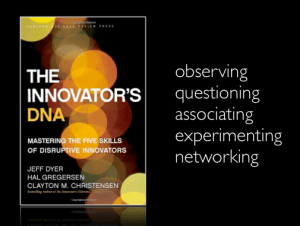
What will you do today to:

  • Observe
  • Question
  • Experiment
  • Network
  • Associate

and employ the characteristics and traits identified in Innovator’s D.N.A.?

Innovators DNA Traits

What risks will you take? What will you be gritty and persistent about? How will you celebrate the day by exercising your growth mindset to work at the intersection of creative expression and functional problem solving? How will you raise up human-centered solution seeking? What will you design?

How will you NOV8 today?

How are you thinking about the “package” we call “school?” #MVIFI

Do you ever wish you could choose the particular cable (or satellite) TV channels that you most want? Instead of having to buy the package service that comes with 361 channels or 902 channels, you could autonomously select, a la carte, the specific channels that you want to view.

Well, I’ve wanted to do that.

Listening to NPR’s Planet MoneyEpisode 488: The Secret History of Your Cable Bill” on a recent morning walk, I started to wonder how traditional school is like cable or satellite TV. Will student learners always have to “buy the entire package” of this class of math and that class of science, this class of English and that class of social studies? Or will we soon see student learners able to individualize their school subscription bundles?

It’s happened in music. We no longer have to purchase the entire album or CD. We can just buy the particular song we want and create our own playlists. It’s happened in news and broadcast journalism, and we now have the ability to create personal news stations and narrowcast our own story collections.

And it’s going to happen in schools. Well, it IS happening around schools. Think Khan Academy. Think Coursera and Udacity (Hat tip to EdSurge). Think Mozilla OpenBadges project. Think Juliette LaMontagne’s Breaker. Think Seth Godin’s Krypton Community College. Think of the future mashup of those ideas and ventures!

It’s highly likely that my 9 and 6 year-old sons will be able to autonomously aggregate courses and experiences (with badges and endorsements like on LinkedIn) and bundle their own “College Degree,” which I hope will include some residential, face-to-face relationship building in a particular physical community, too. (I imagine that it will.) But who knows?!

Learners entering MIT, Stanford, etc., will more and more be able to enter with NUMEROUS courses from those institutions already IN their digital portfolios. Will our schools require the seat-time, residential equivalents of those MOOCs? Or will they we build on the increased capacity that’s already been built when the learners reach them us?

How are you thinking about the way we package and bundle “school” in an age where people can increasingly pull and self-package the content-and-experience streams that best work for them, their passions, their interests, and their needs (with mentorship, of course!)?

GET INVOLVED as a #SolutionSeeker @colabsummit #colab13

Screen Shot 2013-09-22 at 8.14.12 AM

A day-and-a-half summit, where today’s executives and tomorrow’s leaders from our business, education and civic communities connect, communicate and collaborate on issues vital to a thriving Atlanta region.

And YOU CAN GET INVOLVED! [The following is from a @colabsummit email blast.]

For this inaugural summit, we’re launching a social innovation experiment through our LABS, to capture the ideas, dreams and hopes of what we want the future of greater Atlanta to be. And we’re asking for your help.

We need your vision, your dreams, and your ideas (lots of them) on how to solve six challenges directly related to our three main themes at (co)lab: Attracting & Retaining Talent, Cultivating Innovation and Transforming Education.

To get us started, dozens of local thought leaders, content experts and storytellers have spent weeks framing these six challenges, writing compelling briefs and creating powerful videos that will make you laugh and cry.

Here’s how you can help.

At this moment, you have immediate access to IdeaString, a digital collaborative ideation platform where together we can solve six core challenges facing the Atlanta region. We encourage you to learn about these challenges, login to IdeaString, and contribute your best ideas.

The top ideas posted onto IdeaString will be presented at (co)lab during the closing keynote, following Thomas Friedman. And all ideas will be collected into a final report that will be sent to all (co)lab partners, attendees and change agents across the greater Atlanta region.

Our goal is to catalyze great thinking and bold solutions that none of us working independently could achieve. So get in there, add your brilliant ideas and help us transform our greatest challenges into exciting opportunities. Together, we can dream and build a truly greater Atlanta region.

To access IdeaString: [as a non-attendee, AND as a powerful solution seeker!]

We invite you to share IdeaString with friends, peers, co-workers and other passionate citizens. If they are not registered for (co)lab, have them fill out this quick form to be added to IdeaString: IdeaString registration

CHALLENGES

  1. How might we design our communities to attract and retain the creative class?
  2. How might we better celebrate and amplify our arts and cultural assets?
  3. How might we foster partnerships among business, universities and governments to spark innovation and entrepreneurship?
  4. How might we make our cities and our region smarter, more efficient, more connected and more collaborative through technology?
  5. How might we raise Metro Atlanta’s current High School graduation rate to 90%
  6. How might communities rally around our students to help develop the next generation of leaders?