School Innovation Teams – Start with Outrospection #WhatIfWeekly #StudentVoice

Education faces a design challenge. From what I know about design challenges, it seems that the best designs begin with intensive stages of immersion and discovery – putting the designers in the positions of chief empathizers.

One of the best examples I know of related to this commitment of being chief empathizers comes from Dan and Chip Heath’s book Switch. The story of Dr. Jerry Sternin harnessing the local wisdom of Vietnamese mothers who were rearing healthy children amidst a malnutrition epidemic stands out to me. Actually, the story inspires me. Dr. Sternin did not swoop in with pre-conceived notions and ready-made solutions. Instead he committed to a process of immersion and discovery to find sustainable, scalable solutions that came from within the community. He leveraged empathy to create a most-likely-to-succeed solution that honored the end users.

Countless other examples come to mind, but I’ll restrain myself and offer only a few here:

  • When I enrolled in a design-thinking course from IDEO and Design Thinking for Educators, we began with a mini design challenge, and step 1 was to interview someone about their morning commute. “Learn how they feel, what they wish for, what gets in their way. Your job is to ask great questions, listen, and learn. TIP: Don’t be afraid to ask ‘Why?'”
  • When I participated in Mount Vernon Presbyterian School’s Design Institute, before we began designing our ideal outdoor classroom, we interviewed students. We collected insights from them before we even thought about preparing solutions to our own notions of classroom design.
  • When Emily Pilloton asked her student designers to imagine a better chicken coop and design it, they started with observing how chickens behave. “In three days, students would get to know their feathered ‘clients’ by observing their behavior. How do they eat? ‘They like pecking out of the straw, not eating from the trough,’ noted Kerron. How do they sleep? ‘They huddle together up in the roosting box,’ said another student. After three days, our students knew far more about chicken behavior than they ever imagined or wanted.”
  • When Imagining Learning formed to help crowd source ideas for redesigning education, they began with Listening Sessions – for students.
  • When University of Missouri-Columbia freshman Ankur Singh thought to study standardized testing, he decided to take a semester off of school in order to ask those most affected – the students.

So, for all of the schools facing essential questions of innovation, I am wondering how you are factoring in “immersion and discovery.” How are you building empathy into the design challenges?

When I was a school principal, one of the most valuable things I ever did was to shadow a student every year. For a day, I would partner with a student – most often a sixth grader – and I would trail along beside them and pretend to be a student for a day. I was off limits as a principal because I wanted to be completely immersed in the experience. In the years that I was most committed, I would even do all of the homework assignments that night of the shadow. Often, on blogs like Connected Principals, I read of other administrators engaging in such empathy gathering. Now, I am wondering if schools should not build this process into their regular routines and habits.

Maybe schools need innovation teams. Among other jobs, these innovation teams could commit to shadowing students, interviewing students, observing school days and after-school activities, talking with parents about what family life is like at home after school, etc. I bet devoting just three days a year to such immersion and discovery would yield invaluable insights and empathies. [Why the arbitrary number of three days? Well, if it’s good enough for the chickens in Bertie County, NC, I figured it was a good starting place!]

Our school innovations might improve mightily if we designed with the students’ voices at the core – if we committed to “outrospection.”
Business, Social Entrepreneurship, and Education – Exploring Intersections and Interchanges #School3pt0

One of the things we do at Unboundary is explore the intersections and interchanges of business, social entrepreneurship, and education. In the past few days, a number of things have crossed my path that relate to this nexus of learning innovation and significant transformation. I thought I’d share just a few of these things…

A dear friend and colleague emailed me last week (we actually stay in touch every week), and with her permission I am posting a little bit from our latest e-correspondence.

Also, I usually check out your blog from time to time. Doing so always inspires some thoughts, connections, the quiet voice I hear inside me… the one who says “teach them they are not who they think they are.” That is what I heard myself say in response to “how do we teach young people to thrive in a world of possibility?”
I really love the time in which I have lived my life. I would not want to go back but I have loved the life I have lived and look forward to the future. I do struggle with the corporate influence on education. Going way back before my time I still like what Thomas Dewey said in 1910… “The aim of a 20th century education is not the creation of a labor force but the enrichment of the individual and society by developing a child’s social power and insight.” The good news I think is that 21st century skills and education really do help to develop social power and insight.

When we spoke by phone, we agreed that education is a “both-and” issue. Education should BOTH enrich the individual and society AND create a high-quality labor force. I’m not really interested in making schools more business like – at least not like many people interpret that “corporate influence on education.” However, I am very interested in examining ALL of the ways and means that business, social entrepreneurship, and education can work together as something like sections of the same orchestra – for the benefit of learners and for the benefit of the challenges and opportunities we face in our world. I may be oversimplifying the complex, but it seems to me that we should all see ourselves as playing for the same team.

With that in mind, and with a few projects happening here at Unboundary, the following two articles are well worth reading. Both articles point to collaboration among business and education. I find the comments at the conclusion of the first article particularly interesting, and I think they provide a compelling segue into the second article.

I’m forming my own hypotheses about the future intersections and interchanges for business, social entrepreneurship, and education. By sharing these bits here in this post, I hope I can contribute just a bit to the hypotheses you might be forming.

America’s Shoddy Education System Is a Business Problem,
by Jeff Stibel  |   9:00 AM December 6, 2012

Jeff Stibel’s company is implementing a three-part plan to help address some of the issues in education. The entire HBR article and the comments are intriguing, and I found these two paragraphs particularly poignant. [HT to Frank Rauss for bringing this article to my attention.]

Our most precious natural resource is not diamonds or oil or agriculture; it is human capital. The seeds we plant grow only with education. While our program will help offset any immediate gaps with existing employees, the primary focus is on the next batch of bright and talented employees — the children who will one day bridge the talent gap for businesses across the nation.

There are many ways to tackle this problem, and it’s time that businesses focus on the ones within our control. We cannot rely solely on the government, parents or educators. This is our problem too. I am honored to say that my company is doing our small part. If other businesses follow suit or take their own novel approaches, we can solve the education and talent gap.


School Reform for Realists,
by by Andrea Gabor |   August 28, 2012

Andrea Gabor shares examples of Cisco, NYCDOE, iZone, Global Technology Preparatory, and Houston Petroleum Academies. She also offers some profound takeaways about “best practices” in business-education partnerships. [Another HT to Frank Rauss for making sure I didn’t miss this link in my feed reader.]

On the ground, the most effective business–education partnerships are those that foster innovative education opportunities in which both students and parents can participate, and those that create bridges between schools and the outside world, including potential employers. The following stories demonstrate some of the principles that help these partnerships work. What distinguishes them from many outright failures is the quality of collaboration. In these examples, business leaders did more than donate funds and technology; rather, schools and businesses sought to learn from one another.

Finally (at least for this post), I recommend looking at the relatively new business structure called L3Cs (L3Cs explained on Wikipedia). As I walk Lucy in the morning and as I work, I am enjoying thinking about the potential of L3Cs for the future of schools and schools of the future.

In a “3.0 school” established as an L3C, lines between the labels of “students,” “researchers,” “social innovators,” and “employees” get blurred. Perhaps in the future, L3C “schools” will actually pay salaries to young learners (instead of collecting tuitions from them) who are studying such things as cancer cures, robotic surgeries, and transportation and communications innovations in un-siloed coursework that seems a lot more like on-the-job training complete with degree credits. An L3C working to solve the planet’s energy or water issues could synergize the NGO aspect of that work with the for-profit opportunities and integrated-studies possibilities.

Last month, Unboundary participated in an exciting meet-up about L3Cs and higher education. Here’s the press release distributed by Americans for Community Development.

PRESS RELEASE

On November 14, 2012, in Indianapolis, Indiana, Americans for Community Development (ACD) hosted a conference on the groundbreaking concept of implementing the L3C business structure as a form of organization for colleges and universities, using the L3C model to create opportunity ecosystems within the higher education system.  This conference was facilitated by the Lumina Foundation and held at their headquarters in Indianapolis. This meeting was the first of its kind in history bringing together a group of professionals from within higher education, business, law and philanthropy. Over the course of the day the main topic of discussion was how to connect higher education, job creation, entrepreneurship and economic development with the L3C business model as an organizational structure for colleges and universities. This concept “reflects a totally new way of thinking about higher education and how to organize it”.  L3C institutions will be individually unique but will resemble each other in underlying structure. This is a fresh outlook on the organization of colleges and universities that create holistic environments in which institutions are giving back to the students and communities and the students and communities are giving back to the institutions therefore creating opportunity ecosystems that thrive. The very first L3C university, Rockport University L3C, was formed just prior to the conference and conference attendees were asked to contribute intellectually to its development. A large number of the attendees asked to be part of a taskforce ACD is forming to advance the concept of L3C colleges and universities. ACD thanks Bo Adams and Govantez Lowndes from Unboundary for being part of the small group we invited to participate in this ground-breaking event.

Book Review: Bringing Innovation to School @SuzieBoss @SolutionTree

There has been an explosion of interest in and writing about innovation. By no means have I read all of the latest works on innovation, but I have read quite a bit – books and articles by Tony Wagner, Clayton Christensen, Steven Johnson, Tom Kelley, and Peter Drucker. Most recently, I have completed my first round of studying the book Bringing Innovation to School: Empowering Students to Thrive in a Changing World, written by Suzie Boss and published by Solution Tree. For those who subscribe to “seeing is believing” and respect storytelling as a vivid means for seeing more clearly how we might innovate schools and prepare our next generation of innovators (Boss, 1), this is a #MustRead.

From the very first line of the introduction, Boss shows us innovation in schooling by telling us real stories. The first tale begins in Bertie County, North Carolina, with Emily Pilloton’s elective-course project called Studio H – “a hand’s on immersion in the design and build process with an emphasis on local problem solving” (1).  Having seen Pilloton’s TED talk, “Emily Pilloton: Teaching design for change,” I was immediately warmed and invited in by Boss’s initial fuel and kindling for the book. I knew that Boss was committed to presenting high-quality examples, and I wanted to listen to and engage in more of Boss’s storytelling.

Whereas many books primarily present summarized theory and garnish the conceptual with brief examples pushed to sidebars, Boss treats the real-life stories as the main dishes, and she peppers the well-told tales with summarizing remarks and connections to big-picture innovation strategies. In some ways, Boss flipped the typical book, much like all kinds of educators talk of flipping the classroom. I loved this approach and methodology. Many of her stories involved educators and schools that I follow closely through blogs, Twitter, and the news. Some of her stories involved educational leaders that I have come to regard as friends. A number of her stories were brand new to me. All of her stories – and there are many of them – taught me things I did not yet know, filled in gaps about things I had wondered, and inspired in me an even deeper desire to investigate more robustly and learn more. Boss’s book strikes me as one of those rare finds that I know I will pick up time and time again to find a particular story as I connect its dots to another case I am working on, to review my notes and highlighting as I am making my own meaning about innovation in schools, and to return to a dog-eared page as I am ready to explore in more detail the robust set of resources that Boss accumulated in one place.

In the curation of her book, Boss organized the learning arc in a wonderful manner. “Part I: Setting the Stage,” creates a clear understanding of innovation and makes a compelling case for the critical nature of marrying education and innovation. Throughout “Part II: Building a New Idea Factory,” Boss weaves together her case studies – fabulous stories that balance ideal amounts of individual length and collective insightfulness. She wows the reader with what’s already being done, as well as with what’s possible, in regards to creating space for students to be immersed in and empowered by motivating, exciting work that honors their capacity to make a difference now and grow into the knowers and doers that our world demands. And Suzie Boss means to disrupt our own complacency. As an advanced organizer, she wrote in the section intro, “As we take a closer look at these schools and classrooms in the following case studies, put on your own critical lenses and consider: Which ideas are you ready to borrow now? What seems possible longer term? What feels out of reach in your current situation (and why)? Each case study ends with practical suggestions for how to get started” (51). This is meant to be a book of action. It’s a destination and travel book with images and narratives that make one want to venture out and arrive posthaste. What’s more, “Interspersed with these examples are five Strategy Spotlights to further expand your innovation toolkit” (51). Not only does Boss inspire us to go and do, but she also provides parts of the map to get to those places – enough pieces to help us feel we’ve already started and well on our way. In “Part III: Moving from Thinking to Doing,” Boss reiterates even more directly the importance of sharing ideas and leveraging networks for innovation progress. She also details eight action steps for impacting systems-level innovation. This third of the three sections is the shortest and took me the longest to read – I had trouble deciding what not to highlight, as it was all underlining-worthy.

At the end, Boss provides three appendixes, too: A) additional resources for design thinking, digital gaming, innovation and invention, project-based learning, and social innovation; B) an innovation rubric; and C) a discussion guide that could facilitate endless, powerful reflections and planning for motivated groups of administrators, faculty, parents, and/or students.

In Gary Hamel’s great new book, What Matters Now, he writes, “We owe our existence to innovation. We owe our prosperity to innovation… We owe our happiness to innovation… We owe our future to innovation… Innovation isn’t a fad—it’s the real deal, the only deal. Our future no less than our past depends on innovation.” And in Suzie Boss’s Bringing Innovation to School, she relays a rich repertoire of stories of how we might pay our indebtedness to innovation by investing in it more purposefully and pervasively in our educational system – for our dear children.

P.S. You can also read Suzie Boss’s work on blog sites for Edutopia, Stanford Social Innovation Review, and Huffington Post. I highly recommend her postings. She tweets to @SuzieBoss.

Bo Adams (@boadams1) serves as Director of Educational Innovation at Unboundary, a transformation-design and strategic studio in Atlanta, GA.

___

Boss, Suzie. Bringing Innovation to School: Empowering Students to Thrive in a Changing World. Bloomington: Solution Tree, 2012. Print.

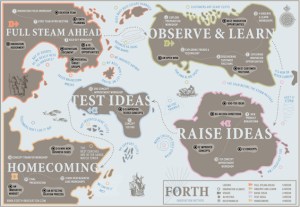
Gijs van Wulfen’s map for innovation

This map from Gijs van Wulfen, one of LinkedIn’s thought leaders in innovation, is worth exploring. In van Wulfen’s Nov. 12 article, “The best innovators are need seekers,” he summarizes Booz & Company’s three fundamental innovation strategies, and van Wulfen adds his own Fourth innovation method. Definitely worth exploring.

PROCESS POST: Dreaming about learning apps that use data collection and dashboard displays

I love dreaming about the future of education. From dreams come possibilities and innovations. To stretch my own thinking, I seek inspiration from a number of sources. Frog design and TED are two of my favorites.

In the past 24 hours, I’ve thought more about data collection and dashboard display, all in the service of continuing to develop systems that visualize and enhance individual student learning. Recent inspirations for this dreaming have come from:

  • Advancing the Future of Healthcare: frog’s Connected Care Solution. I particularly love the images and visuals of the individual health dashboard. Where frog is showing dashboard items for blood pressure, BMI, physical activity, etc., I see a translation to education that could be dashboard items for oral communication, collaborative problem solving, and project management success.
  • Matt Killingsworth: Want to be happier? Stay in the moment (TED talk). In the talk, Killingsworth describes his app that collects information from a huge data set of people. In translation to education, I could see such an app being used on student smart phones, so that learners could real-time report on what they’re doing in class or at home to learn, if they are enjoying and/or benefiting from what they are doing, if they feel deeply engaged or confused or bored. That individual data could be aggregated to see a clearer picture of an individual learner’s preferences, proficiencies, etc. That data could also be aggregated on a larger set to see what types of activities are working best for various learner profiles, age groups, etc. And all of this data could feed into the dashboards imagined above.

Does any such app, data collection, and dash boarding already exist? If so, I would love for you to leave a comment and a link about what’s already out there. The closest thing I have seen personally is the data tool being developed with Khan Academy that provides individual and class data sets of learning targets, time spent on modules, etc.

Just like frog design’s CCS could reveal what’s working and what to address with a person’s health, and just like Matt Killingsworth’s app could reveal what is leading to greater happiness for folks, a comparable learning app could make tangible so much about what is working and what to address with individual learners and groups of learners.

If we can dream it, we can build it.