

Today, Lower School students at Mount Vernon Presbyterian School participated in the Cardboard Challenge, inspired by Caine’s Arcade.
People from 41 countries took part – more than 78,900 participants. Only two organizations in the state of Georgia (U.S.A.) flexed their scissors, spread their tape, and exercised their design muscles for the Cardboard Challenge. Thanks to collaboration among the faculty at Mount Vernon, and thanks to the creative confidence of our students, the Mustangs were in that number!
Mary Cantwell (@scitechyedu) set up a time-elapse camera to record the coordinated, staged efforts of five grade levels working in 45-minute shifts. So, we should be able to see the action from start to finish before too long.
Here’s the message Mary sent to invite the architects and engineers:
The DEETS:
Challenge: Students will be challenged to imagine and create the metropolises of the world! (decided we needed more than just ATL)
Time: 45 min blocks of building/play time; Sign Up Here [link removed] if you want to participate
Do B4 Arriving: Partner/Trio groups – have them research famous/interesting buildings/structures from around the world, plan out what they want to build, sketch it (with boxes in mind), and arrive on the CityBox party with a Plan of Action
AND/OR The HR selects a city together – plans out what they will build to represent different aspects of the city.
AND/OR The HR decides to create and build a fictional city/town and plans out all they want and need in this city (could be connected to a novel study, a story being studied, a SS moment in history)
Show Up. Respect what has already been created. Stake out your space. Get your boxes, imagine, create, play.
Mary Cantwell
People, Needs, Empathy
What an amazing sight to see the buildings take shape and form! At carpool this afternoon, I asked my typical question to a bunch of the students: What was the most incredible thing you did and learned today?
Usually I get a myriad of responses. Today, though, they ALL talked about their buildings – the Coliseum, Hancock Building, Notre Dame, Hippodrome, and the Taj Mahal, just to name a few. Zach even explained to me how he built the Burj Khalifa – the tallest skyscraper in the world!
The basics are not subjects. They’re purposes.
Sir Ken Robinson, #colab13, 9/22/2013
And design — user-centered design — enables impact on our purposes. What’s more, in school, design (“design thinking”) can serve as a trunkline that integrates various arteries, connects the capillaries of disciplines and amplifies our capacities to get somewhere with action.
Especially when we view the public, not as hindrances or headaches, but as part of our design team. [Hat tip to @bigwags, Mike Wagner, for pointing me to George Aye’s TEDxDesMoines Talk.]
Teachers are designers. Either intentionally or unintentionally, maybe. But teachers are designers.
Some feel that the word, the title, “designer” is being co-opted by too many industries and sectors and professions. But how could one really deny the essence of teacher as designer.
Teachers design with curriculum, learning environment, instructional methodology, and assessment. Together, these elements create pedagogical design.
Because of the heightened attention that design and design thinking are getting, we know more about how great designers design with the needs of the user clearly at the center of the design. Discovery, ethnography, examination, observation, interview – all of these and more are the tools of great design and design thinking.
For the truly intentional, great teachers, formative assessment is an invaluable tool – a system really – to discern the deepest needs of the user… the “student.” Through purposeful use of formative assessment, great teachers – great pedagogical designers – collect critical information by way of discovery (assessment), ethnography (assessment), examination (assessment), observation (assessment), interview (assessment), etc.
But, for these assessments, these tools of discovery and empathy, to be design-employed, the insights gained must be used to inform and transform the pedagogical design for the improvement of the user experience. Better known as “deep learning.”
If an assessment is merely something at the end of instruction to provide a grade for a paper grade book or digital SIS (student information system), then enormous potential is being wasted, underutilized, undervalued. Assessment, used as design tool, can form better design for curriculum, instruction, learning environment, assessment, etc. To reach this potential, though, we need to be intentional as designers.
If you are pursuing design thinking at your school, perhaps you are using the d.School model:
Or perhaps you are using the model from Design Thinking for Educators:
At Mount Vernon, we’ve developed our own model of design thinking:
Or perhaps you are working to nurture and build innovators and tracking with such work as Innovators DNA, purposefully infusing the known traits of innovation:
Among all of these models, and among the practices of the most highly respected designers and design thinkers, empathy lives at a core – through intentional and purposeful discovery, observation, and ethnography – in order to enhance and improve design for the needs of the user.
Assessment – formative assessment – is essential for one to be a design-intentional teacher.
How are you using assessment as a systemic tool for exceptional design? For the user experience? For the learners?
#ItsAboutLearning
$9.99
That’s what a small can of chalkboard paint cost at a hardware store nearby. With several cans of chalkboard paint and a few cans of whiteboard paint, a lower school teacher transformed the learning environment for the student learners coming to her soon.
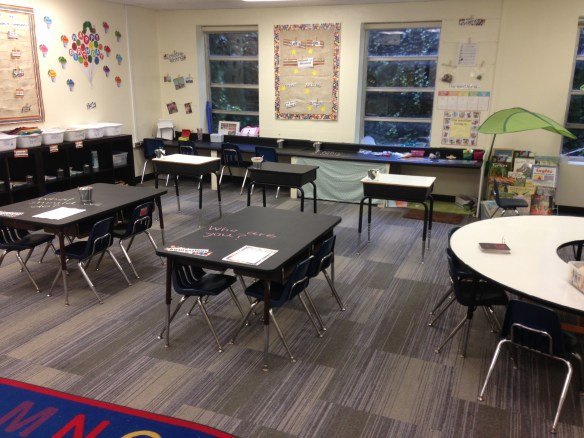
Instead of students “getting in trouble” for writing on the desks, Miss F altered the typical “classroom” environment so that desk writing was not only permissible, but encouraged and fun.
For 1st graders. Learning to write and express themselves through writing.
When the student learners gathered in the room for the first time, during a recent orientation day, there was much writing and drawing on desks! They owned their learning environment with those acts of defiance turned and transformed into acts of creativity.
And should the student learners tire of sitting, there are standing-level desks and exercise balls to bounce on while one learns. A far cry from “Sit still!”
What an act of transformation. To reverse the typical paradigm. Instead of expecting students to bear the lion’s share of conforming to the rules of the room, the rules of the room were re-conformed to promote the desired dispositions and learning explorations of the student learners!
And with such a flip in conformity expectations, transformations are made possible. And deep relationships forged.
 = = = = = = = = = =
Recent, incredible resources on space re-design:
 it's about learning