Yesterday, in a Center for Teaching brainstorming meeting, one of us suggested some curriculum-design work that would go beyond traditional subject-area or departmental curricula. Then, this morning I read David Wees’s blog post about Zoe Weil’s TEDxDirigo talk. In the 17 minutes and 24 seconds, Zoe explains the brainstorm idea perfectly…
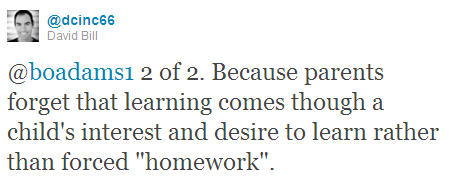
By the calendar, epiphany has ended. On this 12th day of January, though, we Atlantans just experienced our third snow day…SCHOOL IS CLOSED! Already, as a principal of a middle school, I am receiving texts, tweets, and emails asking, “When will we return?,” “Will we make up these missed days?,” “Could the make-up days interfere with our family vacations?,” “Can your teachers send some homework for my kids to do?” I actually received more than one message posing this last question. When I tweeted about this parental request, I received this immediate reply:
Of course, not all parents have forgotten that learning starts with curiosity and interest. Could it really be possible that even a few have forgotten? While I have never met @dcinc66, he is a member of my PLN, and I believe he has a valid point.
Another member of my PLN is my oldest son, PJ. During our third snow day this week, PJ insisted that we build a robot. After watching the 1980s classic (at least to me) Short Circuit, PJ began saving kleenex boxes, old food boxes, toilet paper rolls, and any other discarded piece of trash that looked like a robot part to him. Today, PJ made it clear that it was prime time to put his corrogated collection to good use. PJ’s brother JT entered the fray, and we three Adams boys felt transported to the robo-lab.
Learning is the hallmark of humanity. When I feel most engaged, I am learning. When PJ and JT are most engaged, they are learning. For me, epiphany continued today. PJ reminded me that learning most often looks like a project. The best learning happens when we choose to explore and discover.
After our robot skeleton was complete, PJ and JT became interested in heartbeats. After all, in Short Circuit, Number 5 was alive! With a stethescope, we measured our heart rate at rest and after a few laps around the house. A fourth snow day was just announced. Tomorrow, I will not be surprised if the boys ask to shock the kleenex boxes to see if we can jolt Number 6 to life. I think they just assigned themselves their own homework.
Bo Adams serves as principal teacher for the Junior High at The Westminster Schools, in Atlanta, GA. First and foremost, he considers himself a dad. Close behind on the list, he thinks of himself as a “learner-preneur.”
Jonathan Martin’s post “Project Based Learning for the 21st Century: A Disappointing Video” has been “haunting” me a bit – in a positively good way. I responded with a comment on his blog, and I “thought out loud” by posting this early reaction – “Wanted: PBL ‘Coffee House.'” Even earlier, during Christmas vacation, I posted a vlog in order to contemplate some elements of PBL (“Vlogging is Thinking – PBL“) inspired by the same BIE video that spurred Martin’s “disappointing video” post.
More recently, Martin has posted “8 High Quality Project Based Learning (PBL) Videos.” Also, my learning and teaching partner, Jill Gough, has gotten into the blog-comment discussion, too. I am hoping for even more ripples in the pond…more learners and teachers entering the coffee house for PBL (see Steve Johnson’s TED talk if you are unfamiliar with the coffee house reference).
Now, I would like to offer another response to Martin’s blog post and provide an additional thread for the coffee house discussion about PBL. I am making an hypothesis that Kiran Bir Sethi’s TED talk comes closer to what Martin was hoping for in the BIE video about project-based learning.
Through the video story of Riverside School and “infecting India,” I believe that Sethi hits at the heart of what Martin says he finds to be missing from the BIE video – a meaningful and tangible connection of the student project to a real-world issue…and through media/experiences that make an impact on the issue (as opposed to just making posters for the viewing of members of the class). Relevancy – first-hand-involvement style relevancy – provides the “rigor” (I prefer “vigor“) that Martin wishes for the BIE video.
In the near future, I hope to publish a series of posts about PBL, what stands in the way of PBL implementation, and how schools can overcome those obstacles and integrate more PBL into their curricula. Engaging in this virtual discussion with Martin and others is invaluable to me as I think through the complexities of PBL. Additionally, I find the “What is 21st Century Education?” post to be particularly enlightening about the discipline of quality PBL. And, of course, Linda Darling-Hammond pubishes outstanding work about PBL. For me, the most revealing has been Powerful Learning: What We Know About Teaching for Understanding.
As a middle school principal who does not face the direct pressures of the AP debate, I realize that I may possess a “too-simple” understanding of the discussion. However, I admire the dialogues that a few colleagues of mine are precipitating on their blogs: Quantum Progress and Experiments in Learning by Doing. Addtionally, I found the recent New York Times article on AP to be fascinating. I sent the following email to the PLC (professional learning community) facilitators at my school because I think the article illuminates two important discussions about PBL (project-based learning) and EL (essential learnings – the process of deciding “What students need to learn”).
If you have not read the NYT piece on AP, then here is link to it. I have pasted in two quotes from the article that I think are interesting in relation to the discussion about 1) PBL (project-based learning), and 2) ELs (essential learnings).
A committee of the National Research Council, a part of the National Academy of Sciences, called attention to these problems in 2002. It criticized A.P. science courses for cramming in too much material and failing to let students design their own lab experiments. It also said the courses had failed to keep pace with research on how people learn: instead of listening to lectures, “more real learning takes place if students spend more time going into greater depth on fewer topics, allowing them to experience problem solving, controversies and the subtleties of scholarly investigation.”
And to the delight of teachers who have gotten an early peek at the plans, the board also makes clear what will not be on the exam. Part or all of at least 20 of the 56 chapters in the A.P. biology book that Mrs. Carlson’s class uses will no longer need to be covered. (One PowerPoint slide explaining the changes notes sardonically that teachers can retire their swift marches through the “Organ of the Day.”)
On December 14, 2010, Jonathan Martin posted a provocative piece about the Buck Institute’s Common Craft video of PBL (project-based learning): Project Based Learning for the 21st century: A Disappointing Video. Only a few readers have commented publicly on the post, and I am hoping more people get inspired to do so. I think we need a Steven-Johnson-esque “coffee house” discussion of the richness and possible limitations of PBL, including the range of project possibilities that could be brainstormed from the initial seeds spread by BIE and Jonathan Martin.
Martin points out that a mere poster project of kids sneezing in their sleeves seems inadequate as quality PBL. What if the video indicated that posters were vetted with the CDC for infectious-disease prevention considerations? What if the video suggested that the posters were further analyzed for PresentationZen-level design? What if the video detailed that the posters were distributed around the school, and the students designed experiments and research studies for tracking the incidence of illness after the posters had been posted? Could the students wrestle with the difficulties of isolating variables and determining if there was any way to measure the effectiveness of their public-service-announcement campaign? Would these additional steps create the level of complexity and richness in the video that Martin is right to advocate for?
Get in the coffee house and include your thinking. We will all benefit from exercising our leadership in this discussion by contributing to ideas that none of us could necessarily have on our own.
Better yet…take up a challenge of producing a better video…a set of videos that BIE would scramble to include on it’s fantastic website.
 it's about learning