#PBLCFT11, Lifelong Learning, and a Movie Trailer

Many schools have a line in their mission statements about “lifelong learning.” Without a doubt, lifelong learning is critical…absolutely invaluable. But do we really mean it? Are our schools structured to facilitate genuine lifelong learning – the way learning tends to look throughout most of life? Or are most, if not all, human beings just powerful, resilient learners who interact with their environments and adapt to the needs and demands of the situations we encounter – school, as well as the life that bookends school? Do schools model the patterns of real-life, lifelong learning? Or do schools model more of the efficiency standards of the industrial revolution?

Today, in the Center for Teaching Summer Institute, “PBL: Let’s Build Something Together,” we spent a bit of time discussing this notion of lifelong learning. (In the 5 hours of sessions today, we touched on it directly for just a few minutes…but it caught my attention.) Most agreed that lifelong learning tends to take the form of projects to engage and problems to solve.

As children and as adults, other than in the formal setting of school, does your learning tend to resemble sitting for lecture, taking notes, and testing on that recently acquired knowledge? Or does your learning tend to resemble messy, troublesome, challenging-to-decipher issues that grab your curiosity and demand your attention from multiple perspectives? Does lifelong assessment tend to look like standardized, bubble-in examination? Or does lifelong assessment tend to look more like performances and presentations made to interested audiences and decision makers? Does lifelong learning require isolated attempts – attempts where we are required to work alone? Or does lifelong learning require making connections, building on relationships, collaborating, and enlisting the help and support of others? Does lifelong learning insist on getting things right the “first time?” Or does lifelong learning accept the notion of prototyping based on the reality of “ready-fire-aim” tactics, as we learn from failures and make new, more-informed re-attempts? As one team member said today, “Is learning more about covering material, or is it more about uncovering developing understanding?”

I had a great day working with the fifteen, Atlanta-area educators who gathered to take on “PBL: Let’s Build Something Together.” (Tweets from the day are grouped and searchable by #pblcft11.) In a nut shell, we spent the vast majority of our day-one time in divergent brainstorming – generating a rich pool of potential projects for PBL. The exercises and methods we used seemed to mimic the way that most lifelong learning has occurred to me – engaging complex, challenging issues that don’t have answers that can be found on GOOGLE…muddling through complicated problems that demand collective thinking from people who are committed to collaboratively making hypotheses and testing what works and what doesn’t…accepting that success requires a great deal of trial and error and cognitive meandering.

Tomorrow, on day 2, we will concentrate on emergent and convergent thinking, as we narrow our focus onto one or two projects for which we will formulate framework plans…plans that we can use as a skeleton for putting more flesh on the bones during the upcoming school year. Ultimately, we will implement our team-designed project. We will learn so much more about PBL by actually DOING PBL. As you might expect, I am very excited about the possibilities!
PBL: Let’s Build Something Together

As I write this, it’s early Sunday morning. Tomorrow, on Monday, June 13, Jill Gough and I will begin Day 1 of co-facilitating “PBL: Let’s Build Something Together.” This course is a two-day (10 hour, 1PLU) summer institute through the Center for Teaching at the Westminster Schools. We have about 15 educators coming from 4-5 different Atlanta area schools. Primarily, our essential learnings – our fundamental desired outcomes – number “just” two objectives:

  1. I can brainstorm various possibilities for PBL (project-based learning).
  2. I can create framework plans for various PBL.
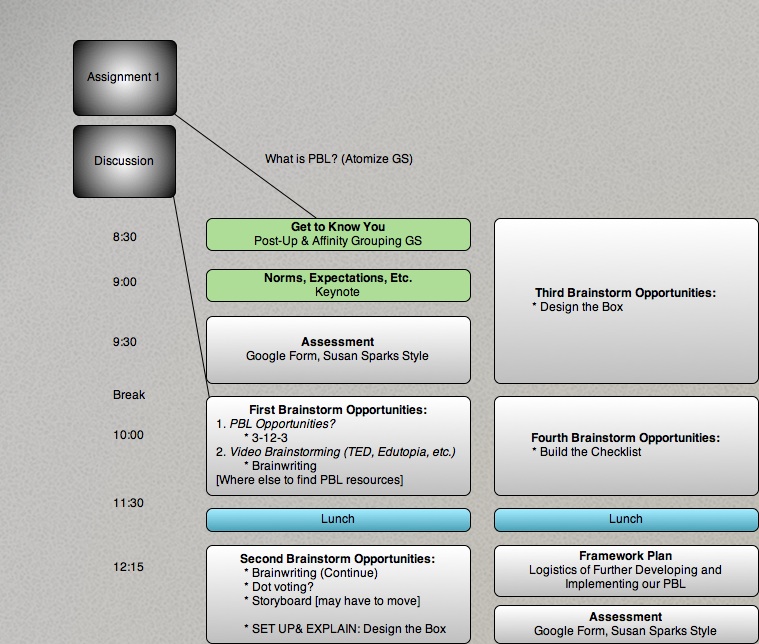
Here’s our Curio7 mindmap of how we are structuring the ten hours:
Whereas some people attend conferences, institutes, and workshops expecting a considerable amount of “sit-n-get” knowledge transfer, our participants will be sorely disappointed if they are wanting that typical educational conference experience. Jill and I know we will not “finish” what we are setting out to do. Monday and Tuesday will be mere beginnings.
.
You see…we really want to build something together. If we actually accomplish our essential learnings, these 15 Atlanta educators will leave committed to enacting and implementing a PBL-project in the first semester of 2011-12. We are going to learn PBL by doing PBL. Our project: build a multi-school PBL to try in the fall. So, potentially, we could have 4-5 schools putting a PBL idea into practice with students.
.
Imagine the possibilities there! We could continue to develop the project as a virtual lesson study. We could engage in instructional rounds and visit each other’s schools to observe how the project is implemented at each place.
.
Last week, at a learning opportunity at Trinity School, @gcouros challenged us all to think of ourselves as school people and lead learners. He asked us to think bigger than just our own individual classrooms. Shouldn’t we do the same for school vs schools?! Imagine what we can learn together.
.
I love being excited about something which is about to begin!

Can you spare 27 minutes for learning and world peace?

Do you have 27 minutes to devote to both educational reform and world peace? Do you? Just 27 minutes of your life. Twenty minutes is for watching the TED talk below –  John Hunter on the World Peace Game. Two minutes is for reading my words here, which I try to make brief and get out of the way. Five minutes is to share the talk with another person or other people via whatever means you want. I would be willing to guarantee you that you will find value in the 27 minutes you spend doing so. Make it in the video to…

7:20 and you will see a teacher show an artifact of a simple game board that he designed so that he could avoid lecture, avoid dry textbook methods, and engage students in something we all love to do – play games.

8:00 and you will be wanting to build the enhanced prototype yourself…I do!

16:30 and you will see profound learning from a child that cannot be easily tested, but demonstrates self-evident assessment.

18:45 and you will contemplate the power of “spontaneous compassion” and a realistic hope for when these students earn the leadership positions of the world.

John Hunter shows the power of story, the power of dealing in questions rather than answers, the power of project- and problem-based learning, the power of 21st century skills leading the efforts of a classroom, and the power of a teacher who innovates and keeps learning. These are ideas worth spreading.

Many thanks to the colleague who shared this talk with me and our Junior High History PLC.

This post is cross-listed at Connected Principals

A Team of Learners Innovates Writing Workshop

On rare occasions, I sometimes think it would just be easier to go start another school instead of working on teams of educators trying to innovate curriculum and instruction that has a long history and tradition. However, each and every day (seriously) something or someone brings me back from that relatively irrational cliff face. One of the great hallmarks of my current school – my place of work for the past 16 years – is our regular practice and willingness to analyze and consider ourselves. And I don’t mean admiring ourselves, although all people and institutions can fall into that trap periodically. No, I mean “considering ourselves” in the sense of examining our practices and asking if we can do better for the learners in our care. No matter how frustrating some issues of static inertia or dynamic change may seem, I believe we are genuinely into continuous improvement.

A few weeks ago, the chair of the English department came to see me. He said he had been thinking about what PBL (project-based learning, problem-based learning, passion-based learning, etc.) would look like in a 21st century English classroom. Now this man is a great thinker, so when he said he had been “thinking about,” I knew he had put some serious time, research, reflection, and conversation into the effort. In short, his idea for 21st century PBL in English involves the complexities and integrated nature of publishing. An idea with genius and endless potential!

What to do with the idea? Well, we work in PLCs (professional learning communities) in the Junior High. While not everyone is formally involved – YET! – it is our developing way of working…our ethos of working and learning together. So…the idea was taken to the JH English PLC and, specifically, the Writing Workshop team. Several members of this team had been thinking about potential innovations to the Writing Workshop course and its intersection with Synergy and Economics, which are two more courses in a triad of classes for our eighth graders. Now a confluence of thinking and thinkers used Steven Johnson’s “coffee house” to swirl and rift on some possible manifestations of publishing in the Writing Workshop course. What a blessing that we have four hours a week built into our work days in order to collaborate in this way. May we never take for granted that we have a developing infrastructure to get us anywhere we want to go!

Largely because we could collaborate in PLC meetings, a proposal was quickly drafted and presented to a few administrators. Largely because we have a dynamic vision statement for our work as a school, a foundation existed that practically inspired this type of curricular and instructional innovation and improvement. This week, we were able to send a letter to parents of rising eighth graders explaining that Writing Workshop would be innovating for 2011-12 in order to utilize topical or thematic electives. Here is the letter that was sent:

Today, rising eight-grade students will hear about the innovations in group homeroom, and they will be able to respond to a survey which requests their desired topic of elective focus. Now, they have a choice much greater than that which existed before in this course. Now, they will be able to develop an authentic audience through publishing work. Oh the places we could go!

Possibilities and realities enacted through the passions and determinations of a team of educators. How fortunate I am to work with these teachers! How fortunate I am to work with these learners! How fortunate I am to learn with these learners! It’s about learning!

Possibility from the Mother (Nature) of Invention – Schedules

DISCLAIMER: This post is merely a “thinking post.” I am NOT announcing a change to the daily schedule at the Westminster Junior High. [That ought to make a few people read on!]

God did not create the school schedule. Administrators did. So…nothing is carved in stone. – Unknown

During this second semester, we have had some significant schedule changes due to weather. In January we missed an entire week of school, and the Junior High has compensated for the lost instructional time by altering what is typically our exam week in the final days of May. Also, because of the severe winds and rains of April, we have had to cancel or delay school on a couple of days. Throughout these disruptions to the expected and well-planned moments of school, our Junior High teachers have demonstrated remarkable flexibility and adaptability. They have modeled those 21st C skills by adapting and readjusting to the necessary changes in schedule thrown at us by Mother Nature. [Thanks, Junior High!] Students and parents have shown great understanding and flexibility, too. [Thanks, students and parents!]

So, by my reckoning, we have altered at least 7-8 days of school. There has been no real wailing or gnashing of teeth. People have adjusted. Perhaps we have been so flexible because you just cannot mess with Mother Nature. Perhaps we realize that there are a number of ways to schedule school. Throughout a typical year, we do have special days for L.E.A.P. (Leadership Experience Advisement Program). So, people must value that various modes and methods of learning require schedules that fit the myriad models of instruction. When we can plan and anticipate in advance, we can also be flexible with our normal 55-minute-class based schedule.

Well, all of this has me thinking a lot. If we can demonstrate flexibility and adaptability during the forces of Mother Nature, and if we can demonstrate flexibility and adaptability during planned, expected schedule changes for different modes of learning…then couldn’t we run a week-long (or a two-week long) experiment with a different schedule in 2011-12? Just to learn by doing?

Why would I even propose such an idea? Our school recently rolled out a vision statement for learning in the 21st century at Westminster. In the vision, among other things, we call for more integrated studies and project-based learning. These modes require longer blocks of time for activity, exploration, experimentation, discovery, and authentic learning. So, couldn’t we experiment with a schedule not too terribly different with our current schedule? Couldn’t we run an experiment and see what we think about one period a week per course being longer in time and function? Wouldn’t we learn immeasurably from having to walk and work in such a schedule?

We’ve shown we can adapt and exercise flexibility. We have the skills. Imagine what we could learn by using those skills to explore a new setting. Anyone game? I have a file of about 50 different school schedules. Below is but one example as a possible week-long experiment. I think some interesting preparations and possible outcomes could be explored and discovered. What do you think?