-
A Taxonomy of Innovation – Harvard Business Review
[HT @meghancureton] Seen this? Could be useful for #ATLk12dt and it’s cool! http://t.co/ydopTlFTrg @scitechyEDU @boadams1
-
A Short Memory is Best For Innovation – Explore Create Repeat – by 4ormat
“In order to innovate, you need to let go by having a “short memory”: create, then release. Dwelling on the past prevents you from moving forward. While you should carry with you the lessons you’ve learned, you shouldn’t let them define your current project.”
-
Great resource bank from HASTAC on badge systems and microcredentialing.
-
One Simple Practice That Will Revolutionize Your Career | Accidental Creative
“Cultivating a deep well of stimuli from which to cull insights and apply them to your work is one of the most effective methods I’ve encountered for setting yourself up to thrive in the create on demand world.”
Provides some pointers for developing a “daily study,” or what I call my personal learning plan (the morning part)… https://itsaboutlearning.wordpress.com/plp/
[HT @tara_supersub – a former student who quickly became one of my teachers.]
-
Find the Coaching in Criticism – Harvard Business Review
An excellent piece on the 3 triggers that feedback can touch, and an outstanding summary of 6 steps to becoming a better receiver of feedback,
[HT @chiphouston1976 and @nicolenmartin]
-
Feedback is crucial. That’s obvious: It improves performance, develops talent, aligns expectations, solves problems, guides promotion and pay, and boosts the bottom line.
-
But it’s equally obvious that in many organizations, feedback doesn’t work.
-
Most companies try to address these problems by training leaders to give feedback more effectively and more often. That’s fine as far as it goes; everyone benefits when managers are better communicators. But improving the skills of the feedback giver won’t accomplish much if the receiver isn’t able to absorb what is said. It is the receiver who controls whether feedback is let in or kept out, who has to make sense of what he or she is hearing, and who decides whether or not to change. People need to stop treating feedback only as something that must be pushed and instead improve their ability to pull.
-
-
The Eight Characteristics Of Effective School Leaders – Forbes
-
Laura Eddolls – Explore Create Repeat – by 4ormat
So many lessons here…
-
Do you think you need to be multidisciplinary in order to be successful as a creative professional?
-
I think being a relaxed person and having a relaxed style is comforting and attractive to other people. I don’t like formality, and I don’t think many people do, so I avoid it to a certain extent.
-
the curation/incubation of many creative ideas is crucial in order to innovate; others have also suggested that over-saturation of ideas is detrimental to original thought.
-
You continuously have to be aware of your surroundings and who is doing what.
-
why I always blog about my mistakes and what I learn, because I want people to learn from me as I’ve had the chance to learn from others.
-
-
The Benefits of Experience | LinkedIn
HMW build more experience into school-based learning?
-
The Online Education Revolution Drifts Off Course : NPR
An interesting and important provocation about the first iterations of MOOCs and how online education is learning from the critical core/corp of relationship-based learning.
-
Transforming Education: The One Thing I’d Change in 2014 | Edutopia
“Learning to listen doesn’t mean that we stop all other work. It doesn’t mean that the principal ceases to lead from a collaboratively built, living vision; it doesn’t mean that teachers stop offering challenging texts or allow their classrooms to become unruly. It would mean that we’d pay much more attention to how we communicate with each other, to how we listen to each other.
Authentic dialogue could lead to stronger communities, to deeper understandings across difference, and to finding creative solutions to the problems that exist in our schools and country. That’s my hope for 2014: that we learn how to slow down, listen, and effectively communicate with each other.”
-
“Feynman, eloquent and enthralling as ever, illustrates the connectedness of everything to everything else”
-
If our small minds, for some convenience, divide this glass of wine, this universe, into parts — physics, biology, geology, astronomy, psychology, and so on — remember that nature does not know it!
-
-
SpeEdChange: Seven Pathways to a New Teacher Professionalism
-
What does learning look like? What do learning spaces look like? What questions do humans ask in learning spaces?
-
Author Archives: boadams1
“So let us put it all back together, not forgetting ultimately what it is for.”
If our small minds, for some convenience, divide this glass of wine, this universe, into parts — physics, biology, geology, astronomy, psychology, and so on — remember that nature does not know it! So let us put it all back together, not forgetting ultimately what it is for.
Richard Feynman, as shared on Maria Popova’s Brain Pickings
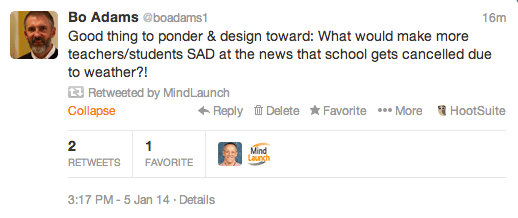
Snow and ice days cause wailing and gnashing of teeth in School 3.0
As I breezed the Twitter stream awhile today, I noticed a number of people from various reaches of the United States hailing that their school had already been announced CLOSED on Jan. 6 due to inclement weather – snow and ice!
Just one example:
Well well my former Michigan co-workers already have school closed for tomorrow. They r deep n snow! Their bragging has begun lol [emphasis mine]
Like you maybe, I’ve heard about strange rituals like children wearing pajamas inside out and flushing ice cubes down the toilet to encourage the elements to delay or cancel school.
So, of course, I cannot help but wonder:
What would make school so great as a learning-and-engagement community that teachers and students would actually be sad, devastated even, when school was canceled for inclement weather?

We should design for that emotion! For that desired user experience!
And if school canceled simply provides more time for people to do other things that get neglected “due to” their professional/school lives – hence the excitement about the cancelation, then we could learn from those insights, too! But I imagine that’s not all that’s at stake. How ’bout you?!
[Selfish blogger’s note: I so wish hundreds…thousands of people would fill the comments with examples of what school would/could be like that would make them sad if it got canceled due to weather. And then I wish we would make those schools happen more!]
+ + + + +
RELATED POST FROM THE PAST:
CHANGEd: What if schools factored in experiment days like snow days? 60-60-60 #6
#MustRead Shares (weekly)
-
The problem with thinking ‘content is king’ in education
“Mistaken belief that changing the content of what stus study will magically alter what occurs in classrooms” Cuban: http://t.co/BaadM0f18P
-
Harvard EdCast: Making the Rounds | Harvard Graduate School of Education
“In School-Based Instructional Rounds: Improving Teaching and Learning Across Classrooms, published by Harvard Education Press, Lecturer Lee Teitel explores this innovative approach of improving teaching and learning. Through case studies at five distinct models of K-12 schools, Teitel examines how the instructional rounds methods were implemented and what the schools have learned from the process.
In this edition of the EdCast, Teitel speaks about the book and shares his evolving research on school-based instructional rounds. ”
[HT @cliffordshelley via “LS Chilipeppers” Diigo group]
Steve Seidel has run educational #rounds at PZ for years. Do any of you do it in your schools/museums/etc.? http://t.co/56wIL2KEl6 -
Teachers: How Slowing Down Can Lead to Great Change | Edutopia
“It’s time to slow down. In our crazy whirling, we are only creating more chaos and mess to clean up.
If we slowed down, we could reflect on what we’ve been doing and what’s been working; we could ask questions, explore root causes, and we could listen to each other. And if we engaged in some of these practices, there’s a greater likelihood that we’d uncover authentic solutions, make some significant changes, feel better about our work, and deliver some sustainable results.”
-
Creating Great Students | Edutopia
HT @cliffordshelley via “LS Chilipeppers” Diigo group
-
dy/dan » Blog Archive » Teacher Data Dashboards Are Hard, Pt. 2
Dan Meyer provides a number of important thoughts and resources in the investigation of Teacher Data Dashboards and progress reporting. This is part 2.
[HT @occam98]
-
dy/dan » Blog Archive » Teacher Data Dashboards Are Hard, Pt. 1
Dan Meyer provides a number of important thoughts and resources in the investigation of Teacher Data Dashboards and progress reporting. This is part 1.
[HT @occam98]
-
Marco Cibola – Explore Create Repeat – by 4ormat
“I think it’s very important to never stop learning. There’s a tendency, especially when I’m busy and working for clients, to just become a machine that churns out work that builds a portfolio of clones. There’s a certain comfort and security with repeating what you know and giving the client what they expect. But it can also get boring and unsatisfying. It can feel stagnant. I think that curiosity and going into the unknown is what makes work interesting. I love problem solving, but not when I’ve already solved the problem.”
-
Unstuck’s Best Advice of 2013 – 16 Tip Cards
Unstuck Point of View
“There’s no shame in getting stuck. The more we get stuck, the more often we can make life better. Let’s embrace the stuck moment — and then do something about it.”
Put into Practice
“This year, we had the pleasure of sharing all kinds of tips and ideas in the name of Unstuck. Your response has been gratifying, because every time a tip works, someone’s life gets a bit better. And most likely, that makes someone else’s life better. The ripple effect of getting unstuck is an exponential force for good. So in the spirit of building that force, we present the best of Unstuck’s advice in 2013 as printable and pin-able tip cards to keep handy and to share.” -
Solving Problems for Real World, Using Design – NYTimes.com
“While the projects had wildly different end products, they both had a similar starting point: focusing on how to ease people’s lives. And that is a central lesson at the school, which is pushing students to rethink the boundaries for many industries.
At the heart of the school’s courses is developing what David Kelley, one of the school’s founders, calls an empathy muscle. Inside the school’s cavernous space — which seems like a nod to the Silicon Valley garages of lore — the students are taught to forgo computer screens and spreadsheets and focus on people.”
-
“interested in experiential learning for multi-disciplinary teams”
QUILT POST: 2014 themes – One body, How are you smart, Rewild [ed], Creating great learners, Slowing to change
Predicted primary themes in my blog posts in 2014:
- interdependence
- avoiding labels; supporting all learners to find their Element; fighting the fundamental attribution error; identifying how we are smart over how smart we are
- rewilding school to more closely align with education and learning
- curiosity-driven, persistently gritty, learner-centered engagement
- slowing down to accelerate and amplify change; pedagography – making better maps of where we are and where we intend to be
Patches of a common quilt, for sure…
From a speech given in September 2005, at Thunderbird School of Global Management:
We are more than six billion people and we are suffering from complex global problems, many of them man-made. The world is one-unit, one body, but our minds still think in terms of we and they. In reality, however, there is no such thing as us and them. We are one body. So the destruction of one part is the destruction of the whole. We must make an effort to recognize that the “others” are also part of humanity, that my future depends on your future. We may find some comfort in the notion of independence, the idea that we control our destiny and can take care of ourselves, but that idea only exists in our mind. In reality, we are all interdependent.
– the Dali Lama, as quoted in Being Global: How to Think, Act, and Lead in a Transformed World, by Angel Cabrera and Gregory Unruh
– reminded me, too, of Roman 12:4
.
Derek Paravicini and Adam Ockelford: In the key of genius (TED talk)
.
George Monbiot: For more wonder, rewild the world (TED talk)
.
From “Creating Great Students,” Ben Johnson, Edutopia, Dec. 23, 2013
We know (and have known for a long time) that the best all-around way to get students to learn is student-directed learning (also known as student-centered), but after all this time, we are still trying to get the teachers to quit doing so much direct instruction and engage more students with inquiry, project-based learning, and experiential learning.
.
From “Teachers: How Slowing Down Can Lead to Great Change,” Elena Aguilar, Edutopia, Dec. 11, 2013
If we slowed down, we could reflect on what we’ve been doing and what’s been working; we could ask questions, explore root causes, and we could listen to each other. And if we engaged in some of these practices, there’s a greater likelihood that we’d uncover authentic solutions, make some significant changes, feel better about our work, and deliver some sustainable results.