Unknown's avatar

About boadams1

Learner. Husband. Dad. Mountaineer. Head of School at Mackintosh Academy - Boulder, in Boulder, Colorado. Have worked in transformation design, educational innovation, and school leadership for 30+ years.

Wanted: PBL “Coffee House”

On December 14, 2010, Jonathan Martin posted a provocative piece about the Buck Institute’s Common Craft video of PBL (project-based learning): Project Based Learning for the 21st century: A Disappointing Video. Only a few readers have commented publicly on the post, and I am hoping more people get inspired to do so. I think we need a Steven-Johnson-esque “coffee house” discussion of the richness and possible limitations of PBL, including the range of project possibilities that could be brainstormed from the initial seeds spread by BIE and Jonathan Martin.

Martin points out that a mere poster project of kids sneezing in their sleeves seems inadequate as quality PBL. What if the video indicated that posters were vetted with the CDC for infectious-disease prevention considerations? What if the video suggested that the posters were further analyzed for PresentationZen-level design? What if the video detailed that the posters were distributed around the school, and the students designed experiments and research studies for tracking the incidence of illness after the posters had been posted? Could the students wrestle with the difficulties of isolating variables and determining if there was any way to measure the effectiveness of their public-service-announcement campaign? Would these additional steps create the level of complexity and richness in the video that Martin is right to advocate for?

Get in the coffee house and include your thinking. We will all benefit from exercising our leadership in this discussion by contributing to ideas that none of us could necessarily have on our own.

Better yet…take up a challenge of producing a better video…a set of videos that BIE would scramble to include on it’s fantastic website.

GOOGLE and the JHS

Recently, I have been struck by the number of people who are talking about Google’s “philosophy” of encouraging engineers to take up to 20% of their at-work time to pursue projects of their own. Here are a few of the hits produced if one Googles the topic:

According to many of the stories, some of Google’s greatest innovations have been born from this 20% time. Rather than assuming the typical hierarchy of organization would provide vision and mission to “require” a workplace of innovation, the admin and management merely provide encouragement for an attitude of “bottom-up” leadership (I hate that term and what it implies). The admin and management simply encourage the professionals to pursue personal interests and they provide time for that pursuit to happen at work. As I read the blogs and article linked above, I became intrigued by the idea of “grouplets.” Rather than individuals pursuing personal projects, engineers were banding together to work collaboratively with this 20% time.

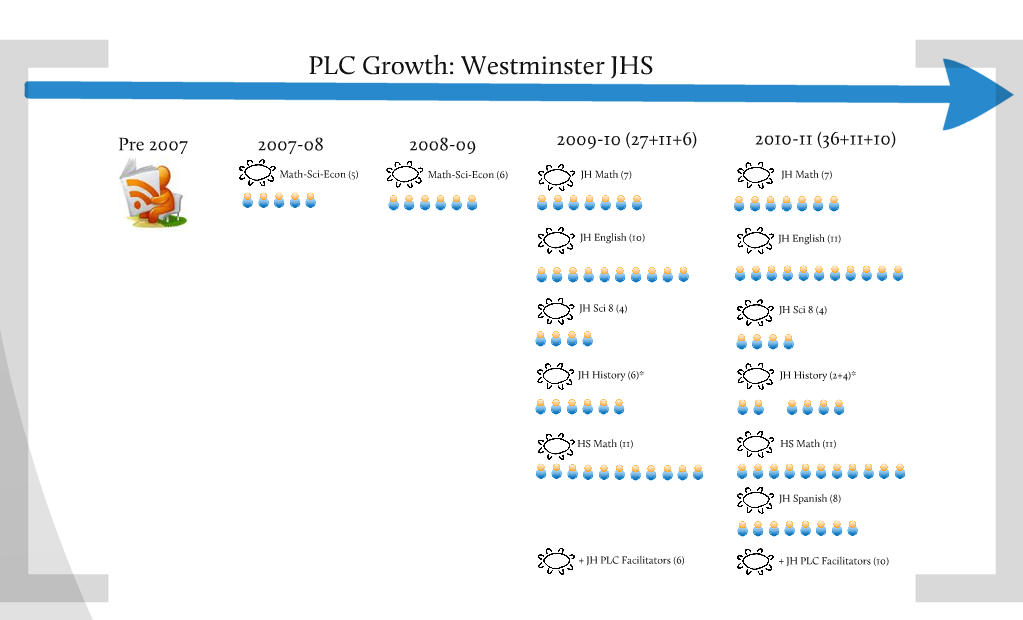
At Westminster, in the Junior High School (JHS) in particular, we have been on a multi-year journey to restructure professional development. We are using the professional learning community (PLC) model and principles to create a new infrastructure for teachers (our “learning engineers”) having the opportunity to work collaboratively together. We have taken a bit of an aggressive approach, and we believe that job-embedded time must be created for such collaboration.

Typically, teachers carry a five-class student course load. For example, a math teacher, in the past, would have five sections of student classes. In the more recent history, we have transitioned one of those periods to be a PLC period. In essence, we have created something akin to Google’s 20% time. One of five sections, transitioned to serve as a PLC period for teacher collaboration, equates to “20% time.”

Through the PLCs, teachers are innovating! Just having a guaranteed time to discuss all of the complexities of teaching and learning is such a positive development. However, much more than discussion is happening. With these four hours per week (we have a rotating schedule and every period meets four times per week), teacher teams are re-exploring writing as thinking, formative assessment ideas, second-chance testing, four-point rubric development, technology integration, content understanding in various fields, and the list goes on.

But I wonder if the 42 (of 74) teachers currently involved in formalized PLCs (we plan to work toward 100% integration for ALL teachers) see their PLC period as this Google-esque 20% time. I believe some do, for sure. But do all of them? Have I exercised my leadership in such a way that it is obvious and communicated clearly that PLC time can be for assessing student learning and creating innovations for enhancing that learning?

So many opportunities, so many possibilities! By striving to “democratize” the work day for careful study of student learning and possible educational innovations, don’t we increase the likelihood for better teaching and learning? In fact, without the 20% time in schools for the commited, motivated teachers who strive for their own continued learning and that of their students, will we really improve education, in any considerable ways, during this second decade of the 21st century?

Here’s to a New Year’s resolution for “20% time” in our schools…for the countless, dedicated teachers who simply need time to collaboratively explore, discover, innovate, and educate!

Figure 1: Formalized PLC Growth at Westminster, 2007-2011

Move…Learn

“Move and the way will open.” Enjoy this brief Garr Reynolds’ post and think of ‘moving’ as ‘learning.’

Play! Tinker!

An important reminder from Lee Burns about the importance of PLAY in learning. As for me, I may have learned more about problem solving by finishing the basement of a house than I have learned about problem solving in any other way. And it all felt like play…well, most days!

Take some time and check out Gever Tulley’s Tinkering School, and watch his TED talks, too.

Grades – A Measure or a Rank

Is a course grade a measure of a student’s learning? Is a course grade merely a way to rank students for whatever gateway comes next? Can a course grade be both and do a good job at each task?

Recently, a good colleague sent me a link to a New York Times Education article on grading at University of North Carolina, Chapel Hill. The article begins like this…

It could be a Zen koan: if everybody in the class gets an A, what does an A mean?

The answer: Not what it should, says Andrew Perrin, a sociologist at the University of North Carolina, Chapel Hill. “An A should mean outstanding work; it should not be the default grade,” Mr. Perrin said. “If everyone gets an A for adequate completion of tasks, it cripples our ability to recognize exemplary scholarship.”

The article author Tamar Lewin goes on to explain that UNC is considering adding more context to its grading – a median average to accompany the mean average, as one example. In my opinion, the more context that can be added to a grade, the better! A grade devoid of meaningful context is not worth much. Why? My answer: because grades mean so many different things to different people.

Just read the article to get a snapshot of the confusion surrounding grades. I am not sure that such a thesis was intended by the author, but that is what the article concisely points out for me. For the schools that declare something like “no more than 35% of students can receive A’s,” they are clearly siding that grades are merely rankings. Relative achievement numbers so that the students can be lined up against a wall from “best to worst” – at least as well as such can be done with the likely imperfect instruments used to evaluate student learning (in theory).

But shouldn’t grades be real measures of learning? In the ideal, shouldn’t a grade give a learner an indication of how he/she performed relative to a clearly articulated standard…a mutually visible quality criteria (mutual in that the teacher and the student can see the same target equally well)? In this case, a grade is an absolute achievement number, not a relative achievement number. Such a grade would indicate to a student how he/she measured against a clear learning goal – NOT how he/she measured simply relative to other people.

What if Mr. Perrin taught a seminar course of 20 students, and all twenty students happened to be the “best” 20 students on campus? (Just go with me for a minute.) If Mr. Perrin had established and made known to his students (better yet…established with his students) the clear learning targets, AND if the 20 students had all achieved at the highest levels according to those clearly established targets, THEN shouldn’t all 20 get “As?”

Granted, if all 20 got As, it would make it very difficult for a receiving institution to know which one of the 20 students was “the best of the best.” But don’t grades fall short of their true meaning and intent when we use them as simple, imperfect rankings? If used for their true meaning and intent, shouldn’t the grades be for the primary purpose of the RECEIVER of the grade?! Should not the grade be an indicator to the receiver – the earner – of the grade that “Oh, I understand this material and this set of skills – the grade indicates that to me’? Or should the grade just be…”Oh, I am ranked 8th of 20 in this course. I was not in the top 35%. I must not know the material that well”? What if all of the top 8 MASTERED the content targets…the course objectives…the quality criteria? Is it just “too bad” for that 8th student?

Maybe the course instructors don’t really know what the clear targets are. Or maybe they don’t know how to articulate clear targets to the students. Or maybe they just didn’t articulate any targets to the students. Or maybe the targets are complex enough that simple numerical averages are not enough to communicate one’s understanding of the material and skills. Does my weight, alone as a number, indicate my level of health? Does my BMI, as a stand-alone number? Or would more context be helpful?

More context of the learning objectives is needed. Kudos to UNC for realizing that more context is needed. I hope Mr. Perrin considers that grades might be best used for communicating to the learner rather than to the next gateway through which the learner must pass. No wonder students “grade grub.” If the grade is just a relative benchmark for lining me up so that I can be “assessed” for the next program, then I would grade grub too! I am a learner – why would I not learn such a behavior if the grade just indicates a ranking. To grub a point is the most simple way to increase my rank – a decent plan A to move up the ranks. How can we blame students for such a behavior if we create the system that promotes such behavior?

BUT…if grades were a measure of my learning compared to clear targets, then “grade grubbing” might come more in the form of such questions as, “What did I not know as well on this content?” “How could I learn it better next time?” I love it when I hear these types of questions!