As I venture into my new office each day at Unboundary, I am greeted by these words displayed on a wall:
In times of profound change, the learners inherit the earth, while the learned find themselves beautifully equipped to deal with a world that no longer exists.
– Eric Hoffer
And this admonition comes from a client workshop we hosted not long ago:
Look with no pre-conceived ideas – let go of wanting to be “the one who knows” which closes the possibility of discovering what you don’t know.
We face dramatic and profound changes in education and schooling, and we need to be working toward what we don’t yet know. In a recent blog post spurred by Diane Ravich’s question, “How would you welcome student teachers to the profession?,” Chris Thinnes responded:
I would say — to these students who have heard the ‘call’ and chosen to embrace the life of the ‘response’ — “Congratulations. You have entered the profession during a time that will be remembered as the most turbulent and transformative in the history of the institution. Once the tireless efforts of impassioned colleagues, educators and activists, have urged the national discourse on education to its apogee, you will help with your daily efforts to reframe a system’s return to its highest ideals: to prepare learners, rather than test takers; to foster citizenship, rather than competition; and to encourage dreamers, rather than drones.
– Chris Thinnes, How Would You Welcome Student Teachers to the Profession? by CURTISCFEE on AUGUST 14, 2012
And, in my morning ritual of watching at least one TED talk a day, I viewed “A sense of humor about Afghanistan? Artist Aman Mojadidi shows how.”
https://ted.com/talks/view/id/1539
In the talk, as he briefly yet deeply explored the dynamics of identity, Mojadidi ended this way:
But I do them because I have to, because the geography of self mandates it. That is my burden. What’s yours?
Doesn’t the “geography of self” mandate that we school people – we educators (from the Latin educare, which means to draw out that which is already there) – re-examine our identity and re-commit to our purpose? Many, if not most, people agree that the world is changing at a rapid pace. And as Aran Levasseur stated in his provocative “Does Our Current Education System Support Innovation?,”
The best schools throughout history prepared their students for the social and economic realities of their time.
How are we doing at preparing our students for a future that we can only imagine? Many are discussing the changes that schools must at least be contemplating, if not implementing, should we want to remain relevant leaders for our learners in this changing world – preparing our “students for the social and economic realities of their time” – not our time.
Are we learning as fast as the world is changing?
We educators owe it to the world to be the catalysts and models of learning, not simply deliverers of information that can now be accessed by ways and means that did not exist when our school system was developed in the industrial age.
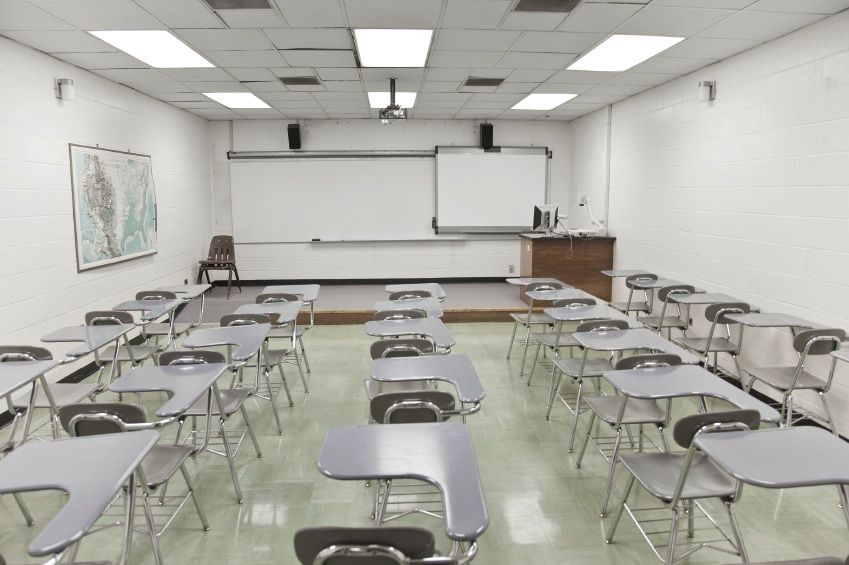
My burden is to help reform this picture – school as information delivery system:

“A Modern Classroom” by David Lentz, purchased at iStock Photo
Several factors contribute to my strong feelings about the stereotypical picture of “school classroom.”
- About 95% of what we know about the brain, we have learned in the last twenty years. Yet many schools have not adjusted significantly. We know that we are out of balance when we compare rows-and-columns-of-desks-learning to the ways in which the brain works best.
- Our industrial-age school design was created when information was challenging to obtain. Schools were the clearinghouses for transference of information and knowledge. Classrooms were designed for information 1.0. Essentially, the teachers were radio towers to the students radio receivers. But we are now in a 2.0 and 3.0 world. Information can be accessed easily and ubiquitously. What to DO with information and knowledge, however, is at an all-time premium. What we CREATE and ENHANCE with our knowledge is more critical now. Rows and columns of desks, in which to receive information passively, are not the best means of CREATING, DOING, and ENHANCING.
- We should be coaching students through more real-world contexts in order to “Make Learning Whole” (David Perkins). Rows and columns of desks are not the best way to learn to “play the whole game,” to “play out of town,” or to “learn from the team.” (Or for that matter, rows and columns of desks are not the best way to engage the other four out of seven principles that Perkins espouses.)
- The world faces a great many challenges, and students today want to contribute to addressing and solving those challenges, problems, and issues. Despite the short-selling that some commit when it comes to young people, the youth of today care far more deeply about the world and its conditions than my generation cared when we were in school. We should be spending less time in rows and columns of desks so that our students can engage with the world and contribute to its improvements…with our guidance as professional educators. School could be more about giving and less about receiving. School could be more real. School could be more authentic. School could enhance civic engagement by utilizing civic engagement.
- We are experiencing The Creativity Crisis. We will not solve this crisis by spending our time in schools seated in rows and columns of desks in the proportion of time in which we do so. We can – and should – teach for creativity…across the disciplines.
- Will our current proportion of time spent in desks help us reach the aspirations of…Howard Gardner, in 5 Minds for the Future; Daniel Pink, in A Whole New Mind; Bernie Trilling and Charles Fadel, in 21st Century Skills (and the list goes on)? They ALL implore us to concentrate more attention on…
- the Disciplined Mind, the Synthesizing Mind, the Creating Mind, the Respectful Mind, the Ethical Mind [Gardner];
- Design, Story, Symphony, Empathy, Play, and Meaning [Pink];
- Creativity and Innovation, Critical Thinking and Problem Solving, Communication and Collaboration (in addition to the 3 Rs of Reading, Writing, and Arithmetic). [Trilling and Fadel]
- We should “design for outcomes” (see the TED talk below – “Timothy Prestero: Design for people, not awards“). Are the outcomes we want for our students and learners best achieved by the rows-and-columns-of-desks preponderance?
Are we learning as fast as the world is changing?
How might we re-design school so that we can learn as fast as the world is changing? How might we re-design school so that we can address the seven issues above (and there are more issues than just these seven to address)?
Many assume that the core purpose of a school is to teach the students. What if we have that “not quite right?” Perhaps the core purpose of a school is to be a learning community – a place where we deeply understand learning. If it were so, then I believe that we would continue to educate students well…even better.
So, how might we re-purpose a school to be a learning community?
A First Step to Making a School a Learning Community
Teachers might reconsider their identity – an identity formed from over a hundred years of the rows-and-columns-of-desks stereotype. We teachers should re-invent ourselves to be better blends of researchers and practitioners.
Jennifer de Forest said it better than I can in her “Bridging the Reasearch-Practice Divide: A Call for School-Centered Research,” which appeared in the Spring 2010 edition of Independent School magazine.
Education researchers constantly bemoan teachers as resistant to implementing their findings. At the same time, teachers complain that education research is either too esoteric to be of any use in a real classroom or an exercise in proving the obvious. This persistent research-practice chasm is maintained by both the prosaic details of how and where we work, and by a more profound epistemological schism that cleaves researchers and practitioners into two separate worlds that tend to dismiss the legitimacy of each other’s wisdom. In the former, knowing must at least appear to be systematically built on data; in the latter, authority comes from the practical trial-and-error experience of doing.
This knowing-versus-doing divide is exacerbated by the fact that researchers and practitioners belong to their own organizations, attend separate conferences, read different publications, and, often, speak a different jargon. As a result, despite the efforts of an occasional intrepid translator who traverses these worlds, many good ideas on how to improve schooling stall at the research-practice border where they languish, unshared or forgotten. In addition, the border is littered with missed opportunities for research-practice partnerships that promise to turn good schools into vehicles for the greater good by making lessons from their practice public. Indeed, every school has its own ripe research questions waiting to be plucked for investigation.
This morning, while listening to Dan Pink interview Tom Peters, Pink asked Peters to explain “You are your calendar.” Peters essentially said that there was no sexy explanation. Bottom line – time is what we have, and we become what we spend our time doing. What if we built more research and experimentation time into the school workday? Educators could be both researchers and practitioners. Micro experiments and macro investigations could be occurring all the time.
Of course, we would have to prepare for such a rearrangement of time and work…
- Faculties must be provided time and space to develop research questions and processes, and administrators should work tirelessly to provide this time embedded into the school day. Learning is social, and people must be provided the opportunities and possibilities for working in teams. If I did anything right in my nine years as principal, it was merely to tear down the walls that were separating the faculty so that they could meet and work together during the school day.
- Faculties must be allowed to fail, as failure is a part of the genuine experimental process. There are few, if any, lab manuals for the type of educational research that I am advocating for in this post. We have to observe-research-make hypotheses-craft experiments-prototype-interatively improve-communicate, communicate, communicate.
- Schools must communicate transparently with parents about this approach to schooling – that action research will be built into the workday. It does not mean that our students are guinea pigs. In fact, our students are NOT our products. Our programs, pedagogies, and methods are our products, as well as our processes, and we need to be innovating, improving, and enhancing these approaches – through research and practice. Can anyone prove that our existing methods are the best that we got? If we are to remain unchanged, then the burden of proof should be on the current practitioners. If we are to learn, and grow, and improve, then we must experiment…with clear and inclusive communication with families.
- The school organizational model should be re-designed to be more network oriented than hierarchically oriented. I have been writing quite a bit about this lately. I have been researching and considering the possibilities for flattening schools and orchestrating conflict and using practices such as “Mutual Fun” at Rite Solutions. In his decades of research, Jim Collins has encouraged us all to move from “good to great” by doing such things as hedge-hogging, fly-wheeling, and concentrating on who. What if our hedgehog concept in schools was to be the research-practice centers for better education? What if we got the flywheels moving by connecting our best resources – our faculties? What if we concentrated on the who – getting our
teachers educators networked?
- Schools should bake in the design-thinking process. Here are just “4 Lessons the Classroom Can Learn from the Design Studio.” If we want to learn as fast as the world is changing, we must prototype faster and use iterative failure to improve and enhance our designs. When most school timelines are annually based, we will not see the rate of change that we need. Our cycle must be more adaptable, more flexible, more agile. Design-thinking can help create interior time frames that are faster and quicker so that a year can see much more innovation and advancement in the school setting.
Are we learning as fast as the world is changing?
We could be. We should be. We can. Will we?
What’s In It for The Kids?
Imagine the “trickle down” that could happen with students if our faculty culture were re-oriented in these ways? Our students could utilize similar models and structures in order to explore, research, and improve the world in which they live. Most importantly, the school community could be immersed in processes that provide the frameworks and structures for the world that is coming – we would all be learning to observe, empathize, collaborate, hypothesize, experiment, prototype, revise, re-purpose, re-mix, design, meta-cognate,…so that we could map-make our future. It’s about equipping learners with the tools – the content and the skills – to be creational thinkers and citizen doers.
We should start with ourselves.
It’s about learning.
 it's about learning