This past week in Synergy 8 – the interdisciplinary, problem-solving course in Westminster’s Junior High – students emailed their parents with two document attachments. The first was a collaboratively created newsletter that hosted six stories from student teams and an article from Ms. Gough and me. The story teams consisted of four students each, and the teams addressed a major question that parents had expressed at Class Rotation night. By responding to these parent questions, such as, “What is Synergy 8?,” students detailed what we’ve been doing in this learning environment for the past month.
Even more importantly, though, students attached a personalized progress report with anecdotes about the learning and growth that each had experienced during the first month of Synergy 8. In the past, marking periods at school involved at least two adults “talking” about a student’s learning. A teacher wrote a comment to a parent, and the student sat relatively passive, waiting to read the comment until it was published. This week, however, the students returned to the drivers’ seats, in the position of first-hand describers of their own learning and growth.
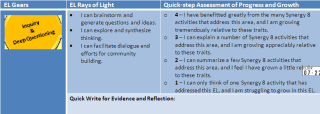
In addition to thinking back with the use of the newsletter articles, student reflection began with a rubric that Ms. Gough and I designed (a portion is pasted above). The rubric organized the twelve essential learnings of Synergy 8 into four categories and students indicated their perceived learning and growth using a four-point scale with simple criteria. Then, students selected their greatest area of learning and growth – their “bright spot” (a la the Heath brothers’ Switch) – and engaged a writing exercise to explain their development in that area. During the drafting and revising stages, students posted their rubric ratings and writing samples to a GOOGLE form so that Ms. Gough and I would have the student data. After completing a revised draft, students sent a progress report that included at least two drafts of their reflection and writing. Parents and teachers (copied on the e-mail) could read about the student’s learning and growth, and we could see the actual progress of the writing by way of the multiple drafts included.
Here’s an example of one student’s reflection:
“Synergy 8 is not the most typical class in school. It is very different from other classes. The teachers are more our equals than our teachers. We are all learners in this course. However, because Synergy 8 is a new course, we still have to work out the kinks. I have become an excellent problem solver because of this. I have been taking notes in my observation journal to help me identify ideas or problems. Through these notes, I have asked questions about our school and our community. I have also posted on Grou.ps to help others solve their problems.
“One specific journal entry I have written is about cell phone usage during school. This was one of my early journal entries. I asked some questions concerning cell phones during school. When we started using Grou.ps as a communication tool, I found that others had similar ideas on cell phones. From here, many of us have commented on whether they think cell phones would work during school. Beau M. says of cell phones, “It all depends on how you use the device. If you use it responsibly, it’s beneficial. If people can’t use it like they should, well, it’s not beneficial. The 6th grade laptops could be used as “what’s for lunch” devices, but they use them correctly. I think we have enough responsibility to do the same.” I agree with Beau. With cell phones, we can take notes and search questions or ideas we have during class. The next step for this is to take action and create an experiment. This way, we could see if this is a realistic goal.
“From a small journal entry, we have created something much more. We have produced rich conversation on this topic, and this is what Synergy 8 is about. For me, learning how to identify a problem and take action to fix it is what we need to do. This is why we are here. From Synergy 8, I have learned to take note of the world around me—to live in the now. There will always be another challenge waiting for me if I look around.”
Don’t we want students in middle school to take more ownership of their own learning and growth? Don’t students have the capacity to describe their own development? Shouldn’t students be able to explain what and how they have learned? Instead of having students read an adult conversation about their school experience, I am thrilled that the Synergy 8 students directed that conversation this week.

 it's about learning