#NOV8 National Innovate Day! Spread the Word! #MVPSchool #MVIFI

Happy “Innovate Day!”

(November 8… Nov. 8…think about it as a car license plate…sound out the letters in “N.O.,” then blend the sounds of the “V” and the “8.” Got it?)

I mean, we have a smorgasbord of national days for this and that. Why not an “Innovate Day” – and on Nov. 8, of course?! We talk about the importance of innovation. We should celebrate it more!

What will you do today to:

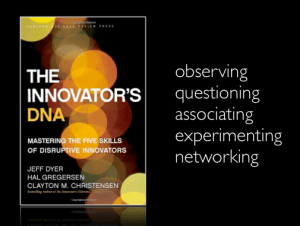
  • Observe
  • Question
  • Experiment
  • Network
  • Associate

and employ the characteristics and traits identified in Innovator’s D.N.A.?

Innovators DNA Traits

What risks will you take? What will you be gritty and persistent about? How will you celebrate the day by exercising your growth mindset to work at the intersection of creative expression and functional problem solving? How will you raise up human-centered solution seeking? What will you design?

How will you NOV8 today?

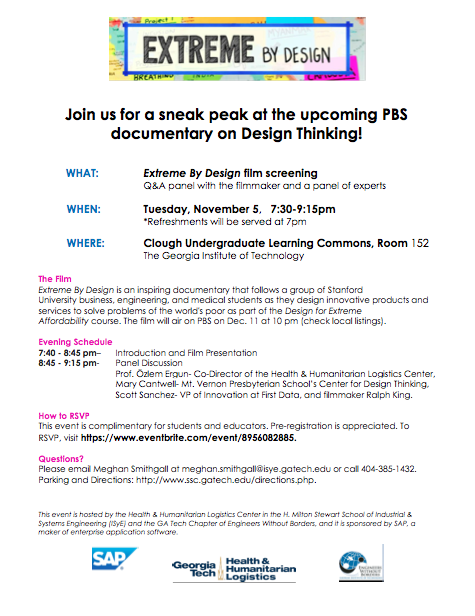
Extreme by Design film screening #DTK12Chat

Screen Shot 2013-11-05 at 4.18.33 AM

EBD Screening_Atlanta

Screen Shot 2013-11-05 at 4.19.07 AM

ExtremeByDesign Poster

#MustRead Shares (weekly)

  • A truly inspirational piece that reminds us professional educators to be grateful for our work. At the same time, I can’t help but think that one does not have to “Quit Your Job and Become a Teacher” if we would work more earnestly for Education 3.0, which could provide more opportunities for student learners to connect with “teachers” in their workplaces… a different way of thinking about “school.”

    [HT @RhettsMustangs]

    tags: teaching #MustRead

  • “The third annual Global Employability Survey, designed and commissioned by the French education consulting firm Emerging and carried out by the German market research firm Trendence, asked recruiters and senior international executives to profile an ideal university graduate — and the ideal university producing such graduates.”

    [HT Greg Jones @CoopScience]

    tags: global_competitiveness #MustRead

  • An oldie but goodie! Hat tip to Eileen Fennelly for sending me this piece and reminding me of it. Krakovsky gives a strong summary of Dweck’s mindset work and connects to a number of related researchers and applications.

    tags: mindset Dweck #MustRead

Posted from Diigo. The rest of my favorite links are here.

How are you thinking about the “package” we call “school?” #MVIFI

Do you ever wish you could choose the particular cable (or satellite) TV channels that you most want? Instead of having to buy the package service that comes with 361 channels or 902 channels, you could autonomously select, a la carte, the specific channels that you want to view.

Well, I’ve wanted to do that.

Listening to NPR’s Planet MoneyEpisode 488: The Secret History of Your Cable Bill” on a recent morning walk, I started to wonder how traditional school is like cable or satellite TV. Will student learners always have to “buy the entire package” of this class of math and that class of science, this class of English and that class of social studies? Or will we soon see student learners able to individualize their school subscription bundles?

It’s happened in music. We no longer have to purchase the entire album or CD. We can just buy the particular song we want and create our own playlists. It’s happened in news and broadcast journalism, and we now have the ability to create personal news stations and narrowcast our own story collections.

And it’s going to happen in schools. Well, it IS happening around schools. Think Khan Academy. Think Coursera and Udacity (Hat tip to EdSurge). Think Mozilla OpenBadges project. Think Juliette LaMontagne’s Breaker. Think Seth Godin’s Krypton Community College. Think of the future mashup of those ideas and ventures!

It’s highly likely that my 9 and 6 year-old sons will be able to autonomously aggregate courses and experiences (with badges and endorsements like on LinkedIn) and bundle their own “College Degree,” which I hope will include some residential, face-to-face relationship building in a particular physical community, too. (I imagine that it will.) But who knows?!

Learners entering MIT, Stanford, etc., will more and more be able to enter with NUMEROUS courses from those institutions already IN their digital portfolios. Will our schools require the seat-time, residential equivalents of those MOOCs? Or will they we build on the increased capacity that’s already been built when the learners reach them us?

How are you thinking about the way we package and bundle “school” in an age where people can increasingly pull and self-package the content-and-experience streams that best work for them, their passions, their interests, and their needs (with mentorship, of course!)?
#MustRead Shares (weekly)

  • “Gardner’s theory initially listed seven intelligences which  work together: linguistic, logical-mathematical,  musical,  bodily-kinesthetic, spatial, interpersonal and intrapersonal; he later added an eighth, naturalist intelligence and says there may be a few more.  The theory became highly popular with K-12 educators around the world seeking ways to reach students who did not respond to traditional approaches, but over time, “multiple intelligences” somehow became synonymous with the concept of “learning styles.” In this important post, Gardner explains why the former is not the latter.”

    tags: multipleintelligences Gardner learningstyles multiple_intelligences learning_styles #MustRead

  • “… anew breed of educators, inspired by everything from the Internet to evolutionary psychology, neuroscience, and AI, are inventing radical new ways for children to learn, grow, and thrive. To them, knowledge isn’t a commodity that’s delivered from teacher to student but something that emerges from the students’ own curiosity-fueled exploration. Teachers provide prompts, not answers, and then they step aside so students can teach themselves and one another. They are creating ways for children to discover their passion—and uncovering a generation of geniuses in the process.”

    HT @JamieReverb

    tags: sugata_mitra StudentCentered Control pedagogy School Change #MustRead innovation Curriculum engagement passion

    • “The bottom line is, if you’re not the one controlling your learning, you’re not going to learn as well.”
    • But when scientists build machines that are programmed to try a variety of motions and learn from mistakes, the robots become far more adaptable and skilled. The same principle applies to children, she says.
    • Peter Gray, a research professor at Boston College who studies children’s natural ways of learning, argues that human cognitive machinery is fundamentally incompatible with conventional schooling.
    • Gray points out that young children, motivated by curiosity and playfulness, teach themselves a tremendous amount about the world. And yet when they reach school age, we supplant that innate drive to learn with an imposed curriculum. “We’re teaching the child that his questions don’t matter, that what matters are the questions of the curriculum. That’s just not the way natural selection designed us to learn. It designed us to solve problems and figure things out that are part of our real lives.”
    • taught the kids about democracy by letting them elect leaders who would decide how to run the class and address discipline.
    • letting children “wander aimlessly around ideas.”
    • higher graduation rate than the city’s average for the same populations. They do it by emphasizing student-led learning and collaboration
    • Now that our society and economy have evolved beyond that era, our schools must also be reinvented.
    • “Intelligence comes from necessity,”

Posted from Diigo. The rest of my favorite links are here.