-
Innovation Excellence | Can Innovation Be a Structured Repeatable Process?
-
Innovation Excellence | To Understand Is To Perceive Patterns
-
Timothy Prestero: Design for people, not awards | Video on TED.com
-
What Difficult Questions about Learning Must We Ask Ourselves? | CurtisUES.info
-
How Can We Invite the Voice of Young Students into the Design of Their Learning? | CurtisUES.info
-
Important Power Players Assemble To Discuss How Social Media Can Be Used For Good | Fast Company
-
I just had an idea. Each one of our companies has some link buried somewhere with best practices for nonprofits. What if we all made a new website that had everyone’s stuff in one place? If there were one site that says, Here’s how you work with Adobe and YouTube and Twitter and how you combine them–that would be amazing.
-
Facebook, Twitter, LinkedIn, YouTube, Zynga – discussing possibility of one common website among them to help people with best practices for non-profits. Wow.
-
-
Successful programs need to have three components: content, community, and a call to action.
-
-
10 Rules for Students and Teachers (and Life) by John Cage and Sister Corita Kent | Brain Pickings
-
Usable Knowledge: Education at bat: Seven principles for educators
-
4 Lessons The Classroom Can Learn From The Design Studio | Co.Design: business + innovation + design
Architect and K-12 thought leader from Perkins + Will explains what education can learn from the architecture studio: 1) a culture of critical collaboration, 2) interdisciplinary problem solving, everyday, 3) tinkering with solutions and reclaiming failure, and 4) the shared power of the pencil and pixel. Includes stung videos from John Seely Brown, and IDEO’s Design Thinking for Educators.
-
Bridging the Reasearch-Practice Divide
Making a call for school-centered research, Jennifer de Forest advocates for independent schools to leverage their traits and culture in order to combine practice with experimental research. The positive outcomes that result: 1) improving their own practice, 2) contributing to the professionalization of teaching, and 3) promoting the greater educational good.
-
Exciting, Essential Next Steps: Thoughts on the NMC K-12 Horizon Project Short List « 21k12
-
The Future of Learning Institutions in a Digital Age – The MIT Press
-
The Creativity Crisis – Newsweek and The Daily Beast
.@jennzia here’s a report on decrease in creativity among US children over recent decades http://t.co/jdeekkI1
-
The correlation to lifetime creative accomplishment was more than three times stronger for childhood creativity than childhood IQ.
-
Yet there is one crucial difference between IQ and CQ scores. With intelligence, there is a phenomenon called the Flynn effect—each generation, scores go up about 10 points. Enriched environments are making kids smarter. With creativity, a reverse trend has just been identified and is being reported for the first time here: American creativity scores are falling.
-
A recent IBM poll of 1,500 CEOs identified creativity as the No. 1 “leadership competency” of the future.
-
solutions emerge from a healthy marketplace of ideas, sustained by a populace constantly contributing original ideas and receptive to the ideas of others.
-
lack of creativity development in our schools.
-
In effect, it’s left to the luck of the draw who becomes creative: there’s no concerted effort to nurture the creativity of all children.
-
When faculty of a major Chinese university asked Plucker to identify trends in American education, he described our focus on standardized curriculum, rote memorization, and nationalized testing. “After my answer was translated, they just started laughing out loud,”
-
Overwhelmed by curriculum standards, American teachers warn there’s no room in the day for a creativity class. Kids are fortunate if they get an art class once or twice a week. But to scientists, this is a non sequitur, borne out of what University of Georgia’s Mark Runco calls “art bias.” The age-old belief that the arts have a special claim to creativity is unfounded. When scholars gave creativity tasks to both engineering majors and music majors, their scores laid down on an identical spectrum, with the same high averages and standard deviations. Inside their brains, the same thing was happening—ideas were being generated and evaluated on the fly.
-
Herein lies the key…creativity is NOT a class to be taught. Creativity is a foundation to be nurtured in ALL classes, and if those classes are integrated rather than subject-divided…all the better!
-
-
The argument that we can’t teach creativity because kids already have too much to learn is a false trade-off.
-
Creativity isn’t about freedom from concrete facts. Rather, fact-finding and deep research are vital stages in the creative process. Scholars argue that current curriculum standards can still be met, if taught in a different way.
-
requires first understanding the new story emerging from neuroscience.
-
right and left hemispheres of the brain activate together
-
A WHOLE new mind! Not “left brain” and “right brain.”
-
-
Creativity requires constant shifting, blender pulses of both divergent thinking and convergent thinking, to combine new information with old and forgotten ideas.
-
Highly creative people are very good at marshaling their brains into bilateral mode, and the more creative they are, the more they dual-activate.
-
Is this learnable? Well, think of it like basketball. Being tall does help to be a pro basketball player, but the rest of us can still get quite good at the sport through practice. In the same way, there are certain innate features of the brain that make some people naturally prone to divergent thinking. But convergent thinking and focused attention are necessary, too, and those require different neural gifts. Crucially, rapidly shifting between these modes is a top-down function under your mental control. University of New Mexico neuroscientist Rex Jung has concluded that those who diligently practice creative activities learn to recruit their brains’ creative networks quicker and better. A lifetime of consistent habits gradually changes the neurological pattern.
-
Creativity is learnable. Great analogy to basketball playing – being tall helps, but all can get better with determined practice.
-
-
improvising
-
“Creativity can be taught,”
-
What’s common about successful programs is they alternate maximum divergent thinking with bouts of intense convergent thinking, through several stages.
-
Along the way, kids demonstrated the very definition of creativity: alternating between divergent and convergent thinking, they arrived at original and useful ideas.
-
These paragraphs describe high-quality PBL and design thinking!
-
-
And they’d unwittingly mastered Ohio’s required fifth-grade curriculum
-
With as much as three fourths of each day spent in project-based learning, principal Buckner and her team actually work through required curricula, carefully figuring out how kids can learn it through the steps of Treffinger’s Creative Problem-Solving method and other creativity pedagogies. “The creative problem-solving program has the highest success in increasing children’s creativity,” observed William & Mary’s Kim.
-
Preschool children, on average, ask their parents about 100 questions a day.
-
Why, why, why—sometimes parents just wish it’d stop. Tragically, it does stop. By middle school they’ve pretty much stopped asking. It’s no coincidence that this same time is when student motivation and engagement plummet. They didn’t stop asking questions because they lost interest: it’s the other way around. They lost interest because they stopped asking questions.
-
found highly creative adults tended to grow up in families embodying opposites
-
Parents encouraged uniqueness, yet provided stability. They were highly responsive to kids’ needs, yet challenged kids to develop skills. This resulted in a sort of adaptability: in times of anxiousness, clear rules could reduce chaos—yet when kids were bored, they could seek change, too. In the space between anxiety and boredom was where creativity flourished.
-
also true that highly creative adults frequently grew up with hardship.
-
Hardship by itself doesn’t lead to creativity, but it does force kids to become more flexible—and flexibility helps with creativity.
-
In early childhood, distinct types of free play are associated with high creativity.
-
role-play
-
voicing someone else’s point of view helps develop their ability to analyze situations from different perspectives.
-
play is a safe harbor to work through forbidden thoughts and emotions.
-
In middle childhood, kids sometimes create paracosms—fantasies of entire alternative worlds
-
found a remarkably high rate of paracosm creation in their childhoods.
-
From fourth grade on, creativity no longer occurs in a vacuum; researching and studying become an integral part of coming up with useful solutions.
-
As school stuffs more complex information into their heads, kids get overloaded, and creativity suffers. When creative children have a supportive teacher—someone tolerant of unconventional answers, occasional disruptions, or detours of curiosity—they tend to excel.
-
quitting because they’re discouraged and bored, not because they’re dark, depressed, anxious, or neurotic.
-
creative people, for the most part, exhibit active moods and positive affect.
-
contentment is a kind of complacency creative people rarely have. But they’re engaged, motivated, and open to the world.
-
those who do better in both problem-finding and problem-solving have better relationships
-
those high in creative self-efficacy had more confidence about their future and ability to succeed.
-
Why-What-How: Being Research-Practice Designers…I Dream a School
As I venture into my new office each day at Unboundary, I am greeted by these words displayed on a wall:
In times of profound change, the learners inherit the earth, while the learned find themselves beautifully equipped to deal with a world that no longer exists.
– Eric Hoffer
And this admonition comes from a client workshop we hosted not long ago:
Look with no pre-conceived ideas – let go of wanting to be “the one who knows” which closes the possibility of discovering what you don’t know.
We face dramatic and profound changes in education and schooling, and we need to be working toward what we don’t yet know. In a recent blog post spurred by Diane Ravich’s question, “How would you welcome student teachers to the profession?,” Chris Thinnes responded:
I would say — to these students who have heard the ‘call’ and chosen to embrace the life of the ‘response’ — “Congratulations. You have entered the profession during a time that will be remembered as the most turbulent and transformative in the history of the institution. Once the tireless efforts of impassioned colleagues, educators and activists, have urged the national discourse on education to its apogee, you will help with your daily efforts to reframe a system’s return to its highest ideals: to prepare learners, rather than test takers; to foster citizenship, rather than competition; and to encourage dreamers, rather than drones.
– Chris Thinnes, How Would You Welcome Student Teachers to the Profession? by CURTISCFEE on AUGUST 14, 2012
And, in my morning ritual of watching at least one TED talk a day, I viewed “A sense of humor about Afghanistan? Artist Aman Mojadidi shows how.”
https://ted.com/talks/view/id/1539
In the talk, as he briefly yet deeply explored the dynamics of identity, Mojadidi ended this way:
But I do them because I have to, because the geography of self mandates it. That is my burden. What’s yours?
Doesn’t the “geography of self” mandate that we school people – we educators (from the Latin educare, which means to draw out that which is already there) – re-examine our identity and re-commit to our purpose? Many, if not most, people agree that the world is changing at a rapid pace. And as Aran Levasseur stated in his provocative “Does Our Current Education System Support Innovation?,”
The best schools throughout history prepared their students for the social and economic realities of their time.
How are we doing at preparing our students for a future that we can only imagine? Many are discussing the changes that schools must at least be contemplating, if not implementing, should we want to remain relevant leaders for our learners in this changing world – preparing our “students for the social and economic realities of their time” – not our time.
Are we learning as fast as the world is changing?
We educators owe it to the world to be the catalysts and models of learning, not simply deliverers of information that can now be accessed by ways and means that did not exist when our school system was developed in the industrial age.
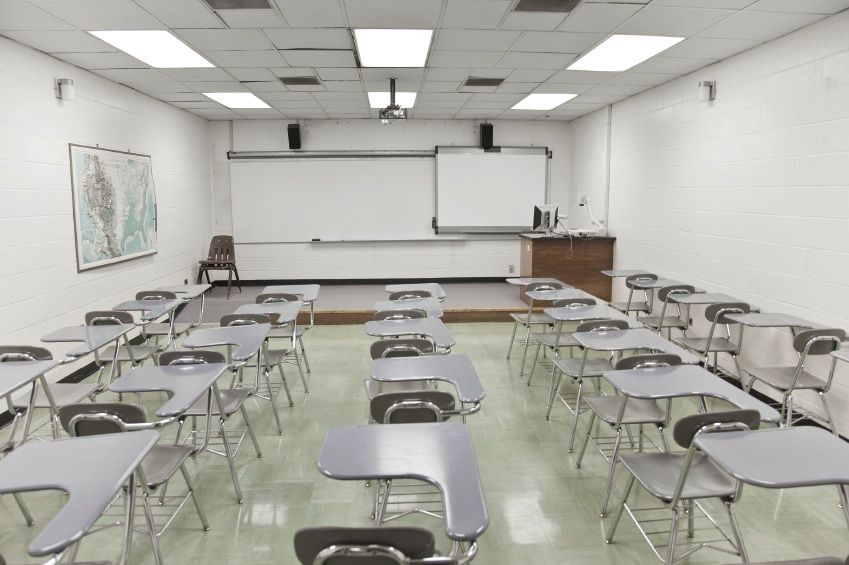
My burden is to help reform this picture – school as information delivery system:
Several factors contribute to my strong feelings about the stereotypical picture of “school classroom.”
- About 95% of what we know about the brain, we have learned in the last twenty years. Yet many schools have not adjusted significantly. We know that we are out of balance when we compare rows-and-columns-of-desks-learning to the ways in which the brain works best.
- Our industrial-age school design was created when information was challenging to obtain. Schools were the clearinghouses for transference of information and knowledge. Classrooms were designed for information 1.0. Essentially, the teachers were radio towers to the students radio receivers. But we are now in a 2.0 and 3.0 world. Information can be accessed easily and ubiquitously. What to DO with information and knowledge, however, is at an all-time premium. What we CREATE and ENHANCE with our knowledge is more critical now. Rows and columns of desks, in which to receive information passively, are not the best means of CREATING, DOING, and ENHANCING.
- We should be coaching students through more real-world contexts in order to “Make Learning Whole” (David Perkins). Rows and columns of desks are not the best way to learn to “play the whole game,” to “play out of town,” or to “learn from the team.” (Or for that matter, rows and columns of desks are not the best way to engage the other four out of seven principles that Perkins espouses.)
- The world faces a great many challenges, and students today want to contribute to addressing and solving those challenges, problems, and issues. Despite the short-selling that some commit when it comes to young people, the youth of today care far more deeply about the world and its conditions than my generation cared when we were in school. We should be spending less time in rows and columns of desks so that our students can engage with the world and contribute to its improvements…with our guidance as professional educators. School could be more about giving and less about receiving. School could be more real. School could be more authentic. School could enhance civic engagement by utilizing civic engagement.
- We are experiencing The Creativity Crisis. We will not solve this crisis by spending our time in schools seated in rows and columns of desks in the proportion of time in which we do so. We can – and should – teach for creativity…across the disciplines.
- Will our current proportion of time spent in desks help us reach the aspirations of…Howard Gardner, in 5 Minds for the Future; Daniel Pink, in A Whole New Mind; Bernie Trilling and Charles Fadel, in 21st Century Skills (and the list goes on)? They ALL implore us to concentrate more attention on…
- the Disciplined Mind, the Synthesizing Mind, the Creating Mind, the Respectful Mind, the Ethical Mind [Gardner];
- Design, Story, Symphony, Empathy, Play, and Meaning [Pink];
- Creativity and Innovation, Critical Thinking and Problem Solving, Communication and Collaboration (in addition to the 3 Rs of Reading, Writing, and Arithmetic). [Trilling and Fadel]
- We should “design for outcomes” (see the TED talk below – “Timothy Prestero: Design for people, not awards“). Are the outcomes we want for our students and learners best achieved by the rows-and-columns-of-desks preponderance?
Are we learning as fast as the world is changing?
How might we re-design school so that we can learn as fast as the world is changing? How might we re-design school so that we can address the seven issues above (and there are more issues than just these seven to address)?
Many assume that the core purpose of a school is to teach the students. What if we have that “not quite right?” Perhaps the core purpose of a school is to be a learning community – a place where we deeply understand learning. If it were so, then I believe that we would continue to educate students well…even better.
So, how might we re-purpose a school to be a learning community?
A First Step to Making a School a Learning Community
Teachers might reconsider their identity – an identity formed from over a hundred years of the rows-and-columns-of-desks stereotype. We teachers should re-invent ourselves to be better blends of researchers and practitioners.
Jennifer de Forest said it better than I can in her “Bridging the Reasearch-Practice Divide: A Call for School-Centered Research,” which appeared in the Spring 2010 edition of Independent School magazine.
Education researchers constantly bemoan teachers as resistant to implementing their findings. At the same time, teachers complain that education research is either too esoteric to be of any use in a real classroom or an exercise in proving the obvious. This persistent research-practice chasm is maintained by both the prosaic details of how and where we work, and by a more profound epistemological schism that cleaves researchers and practitioners into two separate worlds that tend to dismiss the legitimacy of each other’s wisdom. In the former, knowing must at least appear to be systematically built on data; in the latter, authority comes from the practical trial-and-error experience of doing.
This knowing-versus-doing divide is exacerbated by the fact that researchers and practitioners belong to their own organizations, attend separate conferences, read different publications, and, often, speak a different jargon. As a result, despite the efforts of an occasional intrepid translator who traverses these worlds, many good ideas on how to improve schooling stall at the research-practice border where they languish, unshared or forgotten. In addition, the border is littered with missed opportunities for research-practice partnerships that promise to turn good schools into vehicles for the greater good by making lessons from their practice public. Indeed, every school has its own ripe research questions waiting to be plucked for investigation.
This morning, while listening to Dan Pink interview Tom Peters, Pink asked Peters to explain “You are your calendar.” Peters essentially said that there was no sexy explanation. Bottom line – time is what we have, and we become what we spend our time doing. What if we built more research and experimentation time into the school workday? Educators could be both researchers and practitioners. Micro experiments and macro investigations could be occurring all the time.
Of course, we would have to prepare for such a rearrangement of time and work…
- Faculties must be provided time and space to develop research questions and processes, and administrators should work tirelessly to provide this time embedded into the school day. Learning is social, and people must be provided the opportunities and possibilities for working in teams. If I did anything right in my nine years as principal, it was merely to tear down the walls that were separating the faculty so that they could meet and work together during the school day.
- Faculties must be allowed to fail, as failure is a part of the genuine experimental process. There are few, if any, lab manuals for the type of educational research that I am advocating for in this post. We have to observe-research-make hypotheses-craft experiments-prototype-interatively improve-communicate, communicate, communicate.
- Schools must communicate transparently with parents about this approach to schooling – that action research will be built into the workday. It does not mean that our students are guinea pigs. In fact, our students are NOT our products. Our programs, pedagogies, and methods are our products, as well as our processes, and we need to be innovating, improving, and enhancing these approaches – through research and practice. Can anyone prove that our existing methods are the best that we got? If we are to remain unchanged, then the burden of proof should be on the current practitioners. If we are to learn, and grow, and improve, then we must experiment…with clear and inclusive communication with families.
- The school organizational model should be re-designed to be more network oriented than hierarchically oriented. I have been writing quite a bit about this lately. I have been researching and considering the possibilities for flattening schools and orchestrating conflict and using practices such as “Mutual Fun” at Rite Solutions. In his decades of research, Jim Collins has encouraged us all to move from “good to great” by doing such things as hedge-hogging, fly-wheeling, and concentrating on who. What if our hedgehog concept in schools was to be the research-practice centers for better education? What if we got the flywheels moving by connecting our best resources – our faculties? What if we concentrated on the who – getting our
teacherseducators networked? - Schools should bake in the design-thinking process. Here are just “4 Lessons the Classroom Can Learn from the Design Studio.” If we want to learn as fast as the world is changing, we must prototype faster and use iterative failure to improve and enhance our designs. When most school timelines are annually based, we will not see the rate of change that we need. Our cycle must be more adaptable, more flexible, more agile. Design-thinking can help create interior time frames that are faster and quicker so that a year can see much more innovation and advancement in the school setting.
Are we learning as fast as the world is changing?
We could be. We should be. We can. Will we?
What’s In It for The Kids?
Imagine the “trickle down” that could happen with students if our faculty culture were re-oriented in these ways? Our students could utilize similar models and structures in order to explore, research, and improve the world in which they live. Most importantly, the school community could be immersed in processes that provide the frameworks and structures for the world that is coming – we would all be learning to observe, empathize, collaborate, hypothesize, experiment, prototype, revise, re-purpose, re-mix, design, meta-cognate,…so that we could map-make our future. It’s about equipping learners with the tools – the content and the skills – to be creational thinkers and citizen doers.
We should start with ourselves.
It’s about learning.
A piece of “what”: Take 15 minutes to read an article and watch a TED talk – if you care anything about creativity, discoverers, and school.
Questions may be the single most important thing about learning, about school, about nurturing curiosity. If we want creativity to flourish, then we must nurture curiosity in schools.
Is school nurturing questions? How might we experiment with “school” so that we develop the core of curiosity and questioning – of the students, teachers, parents, administrators alike?
Over the weekend, thanks to Zite, I read a fabulous article entitled The Creativity Crisis. It may be one of the most important articles I have ever read. I hesitate to write much on this blog post because I would rather readers spend the time reading the article. In the piece, Bronson and Merryman weave together educational psychology, neuroscience, project-based learning, human development…and hope. Hope bred from motivation which considers how we educate young people. What are we nurturing in young people by the way we are educating them? Do our hopes and needs match our means and habits?
Preschool children, on average, ask their parents about 100 questions a day.Why, why, why—sometimes parents just wish it’d stop. Tragically, it does stop. By middle school they’ve pretty much stopped asking. It’s no coincidence that this same time is when student motivation and engagement plummet. They didn’t stop asking questions because they lost interest: it’s the other way around. They lost interest because they stopped asking questions.
– Po Bronson and Ashley Merryman in “The Creativity Crisis,” Newsweek, July 10, 2012, as found on The Daily Beast. http://www.thedailybeast.com/newsweek/2010/07/10/the-creativity-crisis.html
How might we keep them asking questions! How might we reflect back to them that we are all creatives…all discoverers! We began as such. School should nurture and develop such – for us all.
Are we facilitating the development of new discoverers? How are we balancing time spent in desks and textbooks with time spent exploring, hypothesizing, designing, and experimenting? Are we out of balance in the ways that many schools are operating? Adam Savage, of Mythbusters, sheds some light on the wonders of science and exploration and discovery in his TED talk: “How simple ideas lead to scientific discoveries” (and embedded below). How might we re-imagine and re-purpose time in school so that we create the space and atmospheres of exploration and discovery? How might we make school more about getting in the field…couldn’t we flip the field trip? Through whatever means, we must help students understand that they are the discoverers…that they can change the world.
What happens when you look at what the discoverers were thinking about when they made their discoveries it that you understand – they are not so different from us. We are all bags of meat and water. We all start with the same tools.
I love the idea that different branches of science are called fields of study. Most people think of science as a closed black box. In fact, it is an open field. And we are all explorers. The people that made these discoveries just thought a little bit harder about what they were looking at. And they were a little bit more curious. And their curiosity changed the way people thought about the world, and thus it changed the world. They changed the world.
And so can you.
– Adam Savage…6 min, 30 sec mark of 7 min, 30 sec talk
How are you helping to nurture questions, curiosity, exploration, and discovery? If you are not doing so, you are more aligned with the problems than with the solutions.
#MustRead Shares (weekly)
-
The Seven Deadly Sins of Innovation Leaders | Management Innovation eXchange
-
Is Self-Evolving Learning Our Holy Grail? « The Learning Pond
-
Innovation Excellence | Sustainable Innovation – a conversation with Alan South of Solar Century
-
The DaVinci Institute – The Future of Education by Thomas Frey | Diigo
-
KnowledgeWorks – Map of Future Forces Affecting Education – Education Map
-
LDT alum Brady Fukumoto reflects on 2012 LDT Expo | EdSurge News
-
the design process is fantastic, perhaps ideal, for finding optimal solutions to known problems given time and resource constraints, but what can design thinking do for education when we have not even conclusively figured out what the problems are? How can we possibly empathize with students and teachers when each individual varies so much in aptitude, motivation, and socio-economic status? How can we iterate when our testing cycle is 18+ years long?
-
What can design thinking do for something as complex as education?
-
the design process is never complete and requires always revisiting old ideas to see where they can be improved
-
-
First, Let’s Fire All the Managers – Harvard Business Review
-
What DOES Teacher Leadership Look Like in an #atplc School? – The Tempered Radical
-
Anatomy of a Khan-troversy – Teaching Now – Education Week Teacher
-
The Power of Networks: Shifting our Metaphors for Learning and Knowledge « 21k12
-
Best Practices for Leading via Innovation – Rick Lash – Harvard Business Review
-
Stephen Ritz: A teacher growing green in the South Bronx | Video on TED.com
-
-
The simple fact is that a college or university education is not job training. In recent decades, it’s become conflated with job training, at least in North America, and this is too bad. A liberal arts education is all about expanding your mind, all about being able to think. It’s not about gaining skills that you are then going to use in a job.
-
Why can’t it be both?! Why can’t education be BOTH to encourage enhanced thinking AND to help prepare us for what work is really like? Why do we have to make it a false dichotomy?
-
-
Liberal arts education is to make people into good citizens, not into good workers.
-
“Liberal arts education is to make people into good citizens, not into good workers.” Why can’t it be BOTH?!
-
-
Liberal arts education is to make people into good citizens, not into good workers.
-
We’re training people to be members of civilization, not employees.
-
“We’re training people to be members of civilization, not employees.” Aren’t we doing both?
-
-
-
Raising Successful Children – NYTimes.com
-
But it is in the small daily risks — the taller slide, the bike ride around the block, the invitation extended to a new classmate — that growth takes place. In this gray area of just beyond the comfortable is where resilience is born.
-
If you can’t stand to see your child unhappy, you are in the wrong business. The small challenges that start in infancy (the first whimper that doesn’t bring you running) present the opportunity for “successful failures,” that is, failures your child can live with and grow from. To rush in too quickly, to shield them, to deprive them of those challenges is to deprive them of the tools they will need to handle the inevitable, difficult, challenging and sometimes devastating demands of life.
-
There is no parent more vulnerable to the excesses of overparenting than an unhappy parent.
-
One of the most important things we do for our children is to present them with a version of adult life that is appealing and worth striving for.
-
-
Raising Successful Children – NYTimes.com
-
The happiest, most successful children have parents who do not do for them what they are capable of doing, or almost capable of doing; and their parents do not do things for them that satisfy their own needs rather than the needs of the child.
-
PROCESS POST: Starting to put the pieces together…
How might a school (and education, at large) become more agile, more adaptable on a larger scale and shorter time frame?
What if we explored recipes that combined ingredients of Collins’ Good to Great (the flywheel effect, “who” before “what,” and the hedgehog concept), Design Thinking and the Japanese concept of “kaizen” (continuous improvement through…Discovery, Interpretation, Ideation, Experimentation, Evolution), and Manuel Lima’s power of networks, which is closely related to Friedman’s flattened world?
- Collins, Jim. “Good to Great.” Fast Company, October 2001. http://www.jimcollins.com/article_topics/articles/good-to-great.html
- Fukumoto, Brady. “PERSPECTIVE: What can design thinking and LDT do for education?” https://www.edsurge.com/n/ldt-alum-brady-fukumoto-reflects-on-2012-ldt-expo
- Lima, Manuel. “RSA Animate: The Power of Networks.” http://www.youtube.com/watch?v=nJmGrNdJ5Gw
Could we re-imagine and re-purpose so that school becomes more of a quickly evolving ecosystem that better integrates learners with real-time, real-life, contextual learning and a developing citizen skill-content set that readies learners for the present and future more than for a past that is rapidly fading?
To move from the industrial age to the information age to the creativity age, must we synergize processes that can better develop creational momentum?
[“A piece of ‘why,'” A piece of ‘what,'” and A piece of ‘how'” are strands of a series on why school needs to change, what about school needs to change, and how schools might navigate the change.]