Make learners conform to the room, or make the room conform to the learning? #EdSpace

$9.99

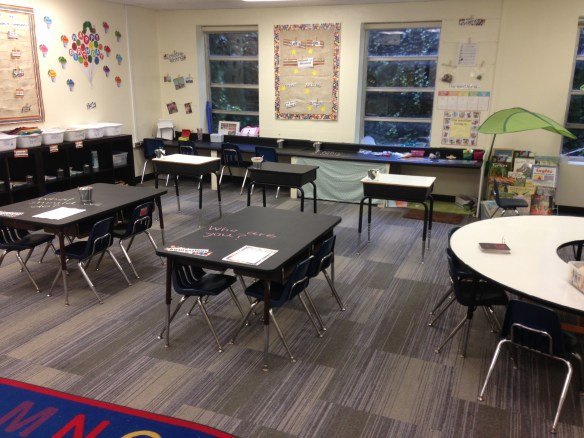
That’s what a small can of chalkboard paint cost at a hardware store nearby. With several cans of chalkboard paint and a few cans of whiteboard paint, a lower school teacher transformed the learning environment for the student learners coming to her soon.
2013-08-12 09.01.34

Instead of students “getting in trouble” for writing on the desks, Miss F altered the typical “classroom” environment so that desk writing was not only permissible, but encouraged and fun.

For 1st graders. Learning to write and express themselves through writing.

When the student learners gathered in the room for the first time, during a recent orientation day, there was much writing and drawing on desks! They owned their learning environment with those acts of defiance turned and transformed into acts of creativity.

And should the student learners tire of sitting, there are standing-level desks and exercise balls to bounce on while one learns. A far cry from “Sit still!”

What an act of transformation. To reverse the typical paradigm. Instead of expecting students to bear the lion’s share of conforming to the rules of the room, the rules of the room were re-conformed to promote the desired dispositions and learning explorations of the student learners!

And with such a flip in conformity expectations, transformations are made possible. And deep relationships forged.

2013-08-12 11.09.55 = = = = = = = = = = 

Recent, incredible resources on space re-design:

“8 Tips and Tricks to Redesign Your Classroom,” Edutopia, August 6, 2013, by David Bill (@DavidSBill) and The Third Teacher+ (@TheThirdTeacher)

It works in architecture and urban planning. It can work in ed transformation, too. #PedagogicalMasterPlanning

From Nancy Duarte’s Resonate, which, by the way, is one of the best books I own, especially in it’s multi-touch book format.

Dan Roam, author of Back of the Napkin, says that, ‘The person who has the ability to verbally describe a problem has a great talent – but also a great limitation. All the real problems of today are multidimensional, multifaceted, and deeply layered. There is no way to fully understand them – thus no way to effectively begin solving them – without at some point literally drawing them out.’

Thought experiment: 

Imagine contemplating a significant remodel or renovation of your home (or school). Now, imagine only dealing in words and verbal descriptions with the various sub-contractors: builders, electricians, HVAC, lighting, flooring, plumbing, casing and carpentry, technology, etc. Also, imagine only naming the remodeling specifics in general-goals terminology. Now, imagine not providing much time, space, or opportunity for these people to ask questions, engage in R&D, meet together and discuss, sketch ideas and check understanding, develop shared knowledge around the transformation, etc. No blueprints, images, infographics, design elements, or visuals. Only words. Inadequate discussion.

How do you think the remodel or renovation would turn out?

Follow-up questions…the deeper thought experiment:

How are schools – those with the greatest intentions and people; those that truly recognize and accept their need for change – how are they going about the transformations of their teaching and learning cores/corps?

Could you show me the designs, blueprints, images, and visuals for those fundamentally important modifications? (I could not have done so as a school principal, and I regret that – I consider it a major failing that I am now working to resolve and re-prototype.)

Can you show dedicated time, space, and regular opportunity for the various members of your school team – faculty, admin, parents, students, etc. – to meet to talk, compare notes, ask questions, attend “practice or rehearsals,” develop shared understanding, etc.? (We did work really hard at this during my last principalship. The Junior High faculty deserves so much credit here for the collaborative, professional-learning-community work that was accomplished.)

Wrap-up question:

How might we commit to and devote the same vigor for community engagement and transformation design in our teaching and learning core/corp that we use in our physical building and campus development?

It works in architecture and urban planning. It can work in ed transformation, too.

#PedagogicalMasterPlanning

238 Provocations for School 3.0 – John Maeda’s TEDGlobal 2012 Talk #School3pt0

There are at least 238 provocations for School 3.0 in “John Maeda: How art, technology, and design inform creative leaders.”

I see ideations for such things as form + content, networking diagrams for learning communities, play leading to powerful discovery, and 235 more!

What do you see?

Julian Treasure #TED: Why architects need to use their ears

How much do we think about the sound design of classrooms and learning spaces? “Julian Treasure: Why architects need to use their ears” shows us – and, even better, helps us listen to the fact that we don’t consider sound design enough!

A lesson from chairs – for whom are many classrooms designed?

The chairs in classrooms can illustrate an interesting point…one worth considering. I can’t believe I’ve never really noticed this before. I’ve observed hundreds of classes. The actual chairs never made a note in my observations.

Compare and contrast the chairs at student desks with those at teacher desks. Which chairs are more flexible, more comfortable, more geared to ergonomic learning? What does the comparison show? For whom are many classrooms designed?

Earlier today, I was reading Jonathan Martin’s post – “Inspiring and Informative: Lessons Learned Visiting Albemarle Schools with Superintendent Pam Moran.” I was challenged and inspired by the rich details of the school visit.

I was also struck by the student and teacher seating. A small detail? Maybe. Maybe not.